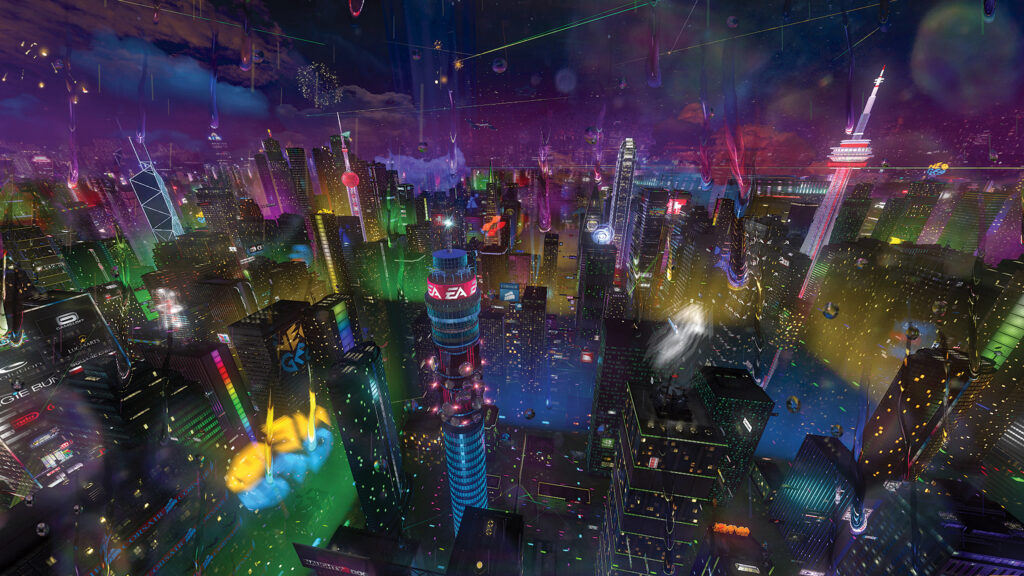
AT THE BEGINNING of the twenty-first century, a group of artists started appropriating, reworking, and hacking the now-rich history of video games. The best example of this creative endeavor is Cory Arcangel’s iconic Super Mario Clouds—a video of the eponymous game’s background clouds, isolated and scrolling across the screen ad infinitum.
With new technologies advancing on a near daily basis, one can hardly imagine what incredible digital experiences artists will come up with next. Whatever they are, they will undoubtedly continue to stimulate worldwide art lovers, who are now more than prepared to embrace these media.
The history of modern art is the history of “cutting edge” art. For many decades, creating modern art meant experimenting with traditional media like painting and sculpture. More recently, it has involved a range of newer technologies.
Like many things ahead of their time, video and computer art have only slightly touched the public consciousness over the years. While the twentieth century celebrated a parade of abstract expressionism, pop art, minimalism, and other handmade styles, tech-based art always lurked in the background—even collaborating with these movements—before becoming its own recognized arena by the end of the century.
Tech-based art came out of the birth of interactive art, a concept that emerged in 1920s Europe through trailblazing artists such as Marcel Duchamp. In this early period, most interactive-art experiments involved the viewer looking at an artwork from a specific position in order to experience a unique visual illusion.
In the late 1950s, inspired by these forms of kinetic art, as well as the dance-like process of the action painter Jackson Pollock, the American conceptual artist Allan Kaprow began to perform his “happenings” across various locations in New York City. These scripted performances mimicked everyday events that both performers and the audience members participated in and experienced, hybridizing theater and fine art.
Meanwhile, in Europe, Swiss sculptor Jean Tinguely explored interactive art by creating complex machinery that, when activated by the viewer, moved, lit up—or even self-destructed.
By the sixties, a new generation that included Texan proto-pop artist Robert Rauschenberg and the experimental, global art group known as Fluxus became interested in creating works through the new technologies of the day.
In fact, Bell Laboratories, the technology think tank that created radio astronomy, the laser, and the operating system UNIX, among other groundbreaking innovations, was one of the first and most influential entities on the computer-art scene. Engineers Ken Knowlton, Lillian Schwartz, and Billy Klüver, who collaborated with Rauschenberg to form Experiments in Art and Technology (EAT), were all early practitioners of technology-based art who worked at Bell.
These early experiments were crucial influences on many fine artists who would come to use technology in their performance practices—from Vito Acconci and Valie Export’s video-recorded performances of the 1970s to Matthew Barney’s high-production films of the 1990s. They also helped birth a full-fledged computer-art world, which is now home to a plethora of artists, gallerists, and collectors all dedicated to tech-based art.
A Glossary of New-Media Art Terms
Sidebars by Allison Meier
Artificial Intelligence (AI) Mimicking human actions or decision-making, AI in art raises questions about agency and creation.
Augmented Reality (AR) Overlaying a virtual experience on the real world, AR offers new possibilities for merging the digital with the physical.
Generative Art is made through autonomous systems, whether computer automation or a set of rules, such as Sol LeWitt’s wall drawings created based on the late artist’s instructions.
Interactive Art In the 1950s and ’60s, “happenings” brought the audience into the art, such as Claes Oldenburg’s environments populated with oversized hamburgers and cake.
Metaverse is a buzzy term for an internet future where users experience a fully formed virtual world.
Net Art (net.art) emerged in the early 1990s with artists harnessing newly available digital space to create work outside of gallery walls, such as in web browsers, computer programs, and email.
NFTs have experienced exponential growth even as their sustainability remains to be seen. Standing for non-fungible token, meaning it is unique, an NFT is part of a blockchain (data) proving ownership—it cannot be copied even if the image itself can.
Post-Internet Art This is not art about a time after the internet but rather about how our world is impacted by online media.
Virtual Reality (VR) Usually involving a headset that immerses users in a digital environment, VR has boomed in art after years of use for gaming and movies.