Book Borrowing
Mississippi turned its reading scores around with the science of reading. Can Oklahoma stay consistent enough to do the same?

WHEN ADDISON SAMS was in the third grade in Chandler, Oklahoma, she had trouble with rhyming, spelling, and memorization. She struggled to read; there were tears. In the classroom, she was assigned shorter books than other students. “That didn’t feel too good, as a little kid,” Sams says.
Sams and her mother, Alisha, sought outside testing. They found that Addison had dyslexia, a learning disability that makes it more difficult to process language while reading and writing. They started working with tutors who use techniques known as the science of reading. These methods worked. Sams, who was reading far below her grade level, caught up to her peers. At fourteen, she doesn’t love reading now but can do it. “She can read longer passages quicker. She doesn’t fatigue as easily,” Alisha Sams says. “The frustration is a lot less.”

Crystal Whelan, a former special education teacher, is a reading specialist in Tulsa employing the same methods that worked on Sams. Whelan says when children who have doubted themselves learn to read, it’s like magic. She remembers a particular student who would avoid assignments while telling lengthy stories. “Now he’s reading chapter books to me. He says, ‘Reading’s easy. Just give me a book and I’ll read it to you.’ It’s amazing. It’s an amazing change to watch,” Whelan says.
Sams’ and Whelan’s experiences mark a shift in thinking about public education efforts, because the science of reading techniques that worked for them are shown to work for almost everyone. Public educators have largely relied on a strategy called “cueing,” which teaches students to use different sources of information (like context clues and visuals) in order to guess the word. But cueing alone is an incomplete approach. Studies have shown that special attention to the words themselves is a major key to successful readers. This is a core pillar of the science of reading, which is taught according to five main categories: phonics (the study of letters and their sounds), word sounds, fluency, vocabulary, and comprehension. Implementing this practice involves sounding words out so that they map onto your brain, allowing you to recognize them on the page in an instant. Once a word is mapped to your brain, there isn’t much, short of brain damage, that can remove it.
The science of reading is touted as the miracle in the so-called “Mississippi Miracle,” a term that refers to the dramatic improvement of reading instruction in the state over approximately the past decade. Mississippi’s fourth-grade reading scores rose ten points between 2013 and 2019. By 2023, the Magnolia State, one of the poorest states in the country, had the ninth-highest scores in the nation. Insiders call it the “Mississippi Marathon,” emphasizing that it took many years of uniform and consistent effort within the public school system and among its supporters to achieve results. And those results aren’t uniformly accepted. Mississippi eighth-graders still read far below the national average, a fact critics point to as proof there hasn’t been meaningful lasting change.

Still, other states are looking to replicate Mississippi’s success. Texas began mandating research-based literacy training in 2019. In 2021, Arkansas was the first of eight states to ban a teaching model based on guessing words from clues, while New Mexico launched science of reading initiatives. In 2024, Kansas passed comprehensive reading reforms with goals to incorporate the science of reading into teacher education.
Locally, the stakes are high: only 27 percent of Oklahoma third-graders met the mark as proficient or advanced in reading in the 2024–2025 school year. The question now is, can Oklahoma create a unified, disciplined plan to implement reforms that are proven to work, even with children who have learning disabilities?

“I think if we’re wanting to replicate what Mississippi did, we need to replicate all of it, and not just portions of it,” says Melissa Ahlgrim, the literacy, policy, and programs director at the Oklahoma State Department of Education. Ahlgrim described a piecemeal application of various efforts and, in some cases, the elimination of a policy that Mississippi has touted as essential. The “third grade gate” is a pillar in Mississippi; it means any child who isn’t reading at level can be retained, or held back. Oklahoma had a similar policy but pared it down, as thousands of children were at risk of being held back, and eliminated the initiative in 2024 with the Strong Readers Act.
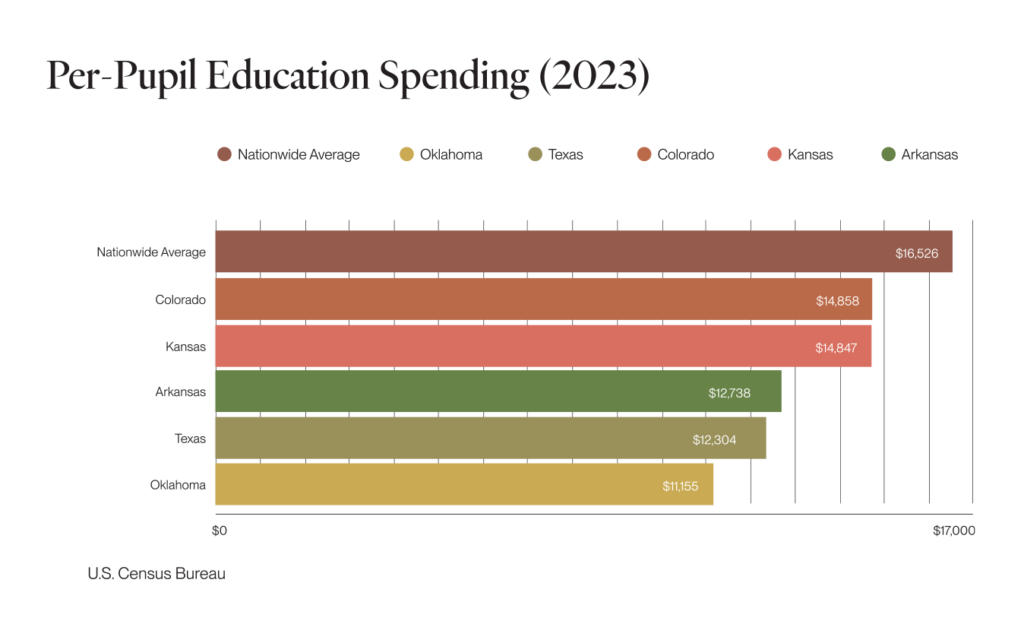
While critics of the retainment policy say it’s ineffective and cruel, especially without adequate preparation, others say Oklahoma needed to stay the course. It’s inconsistency that’s keeping Oklahoma full of struggling readers, according to doctor of education Mary Dahlgren, an educator of more than forty years. Dahlgren pointed out that in 2013–2014, Oklahoma employed fifty-eight literacy coaches, who worked with school staff around the state on learning the science of reading. Test scores subsequently rose five points in 2015. Funding for the coaches was cut from Oklahoma’s budget by Janet Barresi, then state superintendent of public instruction.
Funding for the coaches, who figure large in Mississippi’s model, was cut from Oklahoma’s budget by Janet Barresi, then state superintendent of public instruction. National Assessment of Educational Progress test numbers, which measure academic achievement in reading, have continued to slump since 2015.
“Oklahoma can do it,” Dahlgren says. “We made some great gains in just a short period of time. If we had stuck with that model, we would be able to continue to do that.” Now there are new efforts in Oklahoma’s statehouse to shore up literacy, Mississippi-style. Senator Adam Pugh (R-Edmond) filed Senate Bill 1778 to require summer school for struggling early learners. Two other lawmakers are touting the Oklahoma READS Act, House Bill 2944, which proposes that reading coaches be assigned by the state depending on need within districts. Both bills would reinstall the third-grade gate.
But where the money will come from is unclear. The latest legislative session in Oklahoma began February 2, 2026, and runs through May. Alisha and Addison Sams say they hope whatever needs to be done will be done to help the science of reading take consistent shape across the state, pointing to how it changed their lives. “I think it’s about confidence and knowing you have the tools,” Alisha Sams says. The future of Oklahoma readers remains to be seen. For now, all eyes will be on the state’s legislature as it convenes through May.
This story was produced in partnership with the nonprofit newsroom Public Radio Tulsa.
Philanthropy Steps In