On Kindness
We haven’t slept well since the news of Nex Benedict’s death on February 8, 2024. We imagine the sound of traffic, orienting us to the fact that this is not a dream. In the end, it all comes down to this question: Why?
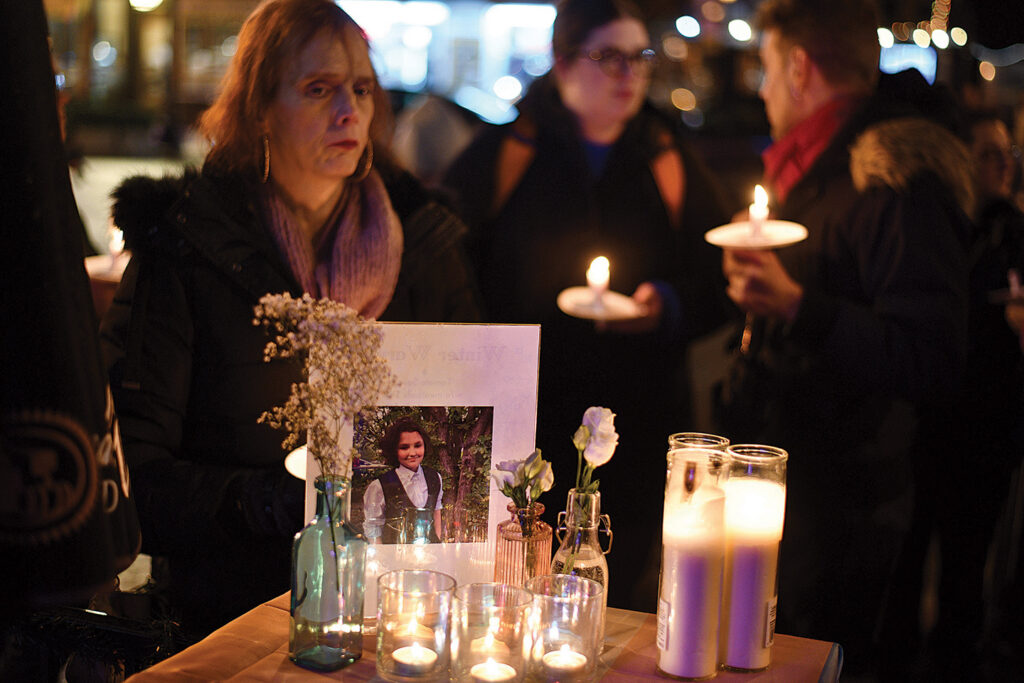
WE HAVEN’T SLEPT well since the news of Nex Benedict’s death on February 8, 2024. We continue to find ourselves awake at night, the sound of traffic orienting us to the fact that this is not a dream. This is real life, and it’s happened again. Into the darkness, the pulverized pieces of broken hearts disperse and drift into the universe, scattered by forces made of hatred, cultural inertia, and religious dogma. We try to make sense of the senseless and ask the question: Why?
The full story of Nex’s death hasn’t been reported and may never be. We know the sixteen-year-old from Owasso, Oklahoma, went into the girls’ restroom at their high school on February 7, 2024, where Nex encountered three girls. An altercation ensued, and Nex was beaten. After seeking medical treatment and being released, Nex died a day later. On March 13, a medical examiner’s report ruled Nex’s death a suicide. According to Nex’s family and friends, Nex and other students at Owasso High School had experienced bullying due to their gender identities.
What’s clear is that Nex may have died as a direct result of living in a world where it’s encouraged for people to act unkindly toward others. In response to questions regarding the child’s death posed during a February 23 public forum, a newly elected Oklahoma state senator named Tom Woods said, “We are a Religious State, and we are going to fight it to keep that filth out of the state of Oklahoma.”
So, too, the state’s superintendent of public instruction, a religious zealot named Ryan Walters, widely betrayed the child’s most private traumas to get the monkey of hateful rhetoric off his back. He has also been notoriously outspoken in his efforts to scrub the “demented ideologies” of children and modern society from educators, books, and ideas in our public schools. Mostly, but not entirely, these ideologies involve gender identity, but also racial history and religious preference, and, sometimes, even basic American history.
We believe kindness matters, and the people who reject it fail young people like Nex Benedict. In the life and death of this child, the difference may have rested on a simple personal preference: how to be considered as a person in the world—grappling with identity—and how to be true to oneself.
A generation ago, gay people were pressured to stay in the shadows and conform to societal norms. They married (or didn’t), had children (or didn’t), and tried to blend in (or moved away). Those who didn’t were ostracized or even beaten, arrested, and sometimes murdered. Not long before the Stonewall riots launched the gay liberation movement in Greenwich Village in 1969, riots at the Black Cat Tavern and Cooper’s Donuts in Los Angeles were episodes of stark police brutality.
Today in the United States, gay and lesbian, homosexual, bi-, trans, queer, non-binary, twin spirit—or however one embraces the right to choose how to describe, or not describe, themselves—face less pressure to conform. In places like Oklahoma, however, where ArtDesk is published and where kids just like Nex Benedict are hounded for being different, certain radicals refuse to accept this fundamental freedom. Conversion therapy seeks to “pray the gay away,” and state legislatures pass anti-LGBTQ+ laws while using rhetoric and dog-whistle terms to couch hate speech.
One thing is for certain. When hate is normalized, the results are devastating. One to one, many to many. For society to progress, we must find our common humanity. We must reject hate and intolerance in all of its forms. We must embrace kindness, which we define as the goodwill and benevolence that supports the wellbeing of others.
In Luke 6:27–28, Jesus says, “Love your enemies, do good to those who hate you, bless those who curse you, pray for those who mistreat you.” How radical to be kind to even those who don’t reciprocate. In John 8, regarding the adulteress, Jesus said: “He that is without sin among you, let him first cast a stone at her;” and, in Matthew 5, from the Sermon on the Mount: “Judge not, lest ye be judged.” With love, kindness, and forgiveness, we remind unseemly outspoken leaders what it really means to live as Christians. After all, Jesus famously fraternized with society’s outcasts. He did what most revolutionaries do: He submitted, surrendered, and made himself a servant unto humanity. So did Buddha, Krishna, and Muhammad.
Kindness is not the exclusive domain of religion. It’s a common garden born and cultivated in the hearts of people—animals, too—that divides cellularly, one act of kindness begetting another and another, until a culture of generosity prevails. That’s the revolution now upon us—decency toward others. There’s room for everyone in this movement. And to do what? To evolve their thinking, smile at a stranger, embrace the fallen, forgive the unforgiven, hug an opponent. Generosity of spirit is not in vogue, but it should be.
As the bedroom window slowly transitions from midnight blue to a pre-dawn haze, we are reminded of those who die by cultures of bigotry. We think about Nex and the countless others who suffered for merely being who they were—and who we all are: imperfect human beings seeking the freedom to find out, and be, who we are. A waking thought rises to the surface of our foggy consciousness. We breathe it into existence, the whispered words filling the dark space around us before we fall back asleep. The words resonate, a hopeful balm that allows us to sleep until morning: We are all the same.
We are all the same, indeed, and we remind any young person and anyone reading this who may feel abandoned by a particularly loud segment of people, you are not alone.