Lights Out
Migratory bird advocates shine a spotlight (just kidding) on the issue of light pollution.
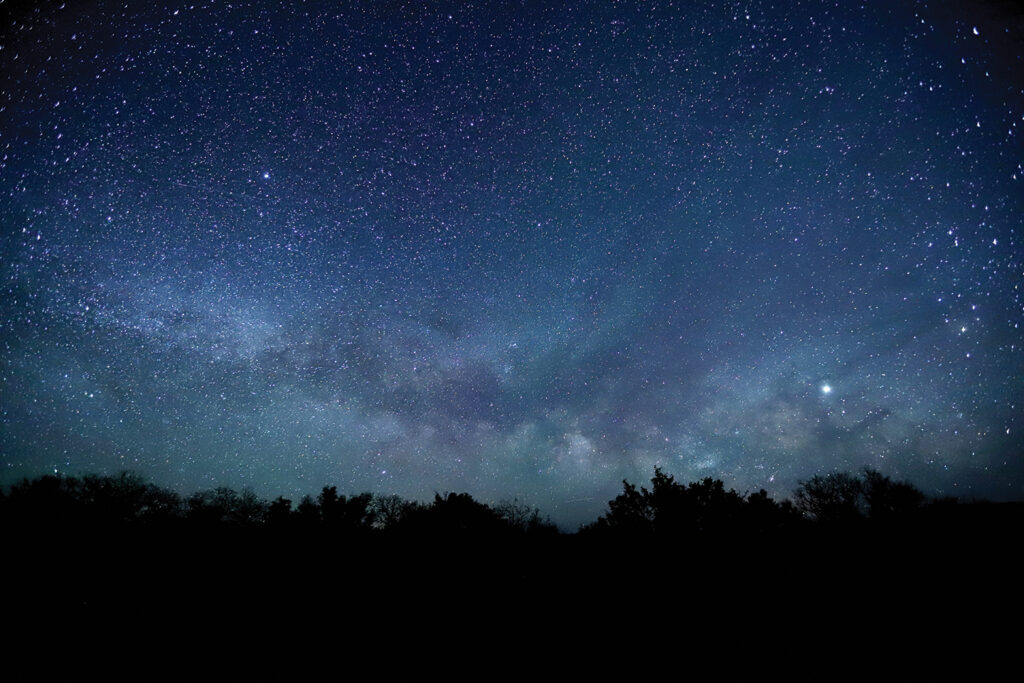
ON THE NIGHT of October 13, 2024—during peak bird migration in Oklahoma—an estimated 74.1 million birds flew over the state, heading south for the winter. This information comes from BirdCast, a collaboration between Colorado State University, the Cornell Lab of Ornithology, and the University of Massachusetts Amherst that provides real-time forecasts and data on bird migration.
The birds—representing dozens of species like the painted bunting, Nashville warbler, and purple martin—flew south by southwest on that Sunday evening, averaging speeds of twenty-nine miles per hour and altitudes of 1,400 feet. They began their journey about forty-five minutes after sunset, with the greatest number in flight two to three hours later.
For many birds, Oklahoma serves as a rest stop along the Central Flyway, one of four North American bird migration routes as designated by the U.S. Fish and Wildlife Service. More than 50 percent of North America’s migratory waterfowl use the Central Flyway, bounded in the north by Canada, Alaska, and Siberia and in the south by Mexico and Central America.
“One of the things that people don’t realize is that most birds migrate at night, so they rely on the moon and the stars,” says Inger Giuffrida, executive director of WildCare Oklahoma, one of the largest wildlife rehabilitation and conservation education centers in the United States. Last year, the nonprofit admitted and treated nearly 8,500 injured, ill, or orphaned wild animals. “Bright lights from cities mimic the rising or setting sun, leading birds off their migratory paths into hazardous urban environments.”
And that’s the problem. Humans are encroaching on bird habitats and disrupting migratory routes and navigational instruments that scientists say are hardwired in their brains. A 2022 report released by the North American Bird Conservation Initiative stated that at least seventy bird species have lost over half their population in the past fifty years. According to Dark Sky International, a worldwide network of advocates working to protect the night sky, light pollution is deadly to many living creatures, including amphibians, birds, mammals, insects, and plants.
Last August, research conducted by the American Bird Conservancy, Fordham University, NYC Bird Alliance, and Stony Brook University estimated that over one billion birds are killed every year in the United States due to building collisions and the disorienting effect of artificial light. “Bird populations across the globe are in steep decline,” says study co-author Dustin Partridge, of NYC Bird Alliance. “If we don’t address artificial light and glass, we’ll continue to lose over a billion birds in the US annually.”
Light pollution results from big things like downtown skylines and football stadiums but also small things like your front porch light. A common critique of environmental conservation is the cost, but turning off unneeded lights saves money. “I think people are resistant to the idea that small changes can make a big difference,” says Giuffrida. “The best hope for birds is what we choose to do as individuals, because we can’t necessarily rely on the consistency of political leadership to do the right thing.”
Nonetheless, Giuffrida and others are working to find a political solution. The Oklahoma Animal Coalition is collaborating with lawmakers to introduce a resolution in the Oklahoma Legislature calling for municipalities, institutions, businesses, and residents to turn off their lights during spring migration, March 1–June 15, and fall migration, August 15–November 30. By turning off lights from 11 p.m. to 6 a.m. on front porches, inside buildings, in parking lots, and in sports venues—or by using shielded light fixtures and motion sensors when exterior illumination is needed—birds can safely pass through Oklahoma on their way to summer breeding grounds or winter homes, says Giuffrida.
In the end, everything on Earth is connected, and if humanity does not reverse course on environmental issues such as light pollution, climate change, and mass extinction, then our collective future may be unnavigable, Giuffrida says. “We’re writing our own demise by the choices we’re making today.”
A Dark Canvas
While the night sky has been an inspiration for countless artists across centuries, few have understood the value and precarity of its natural light as much as James Turrell. The California artist has cut oculi into viewing rooms in his Skyspace series and spent decades transforming the cinder cone of an extinct volcano in Arizona into an observatory experienced with the naked eye. In 1989 he told the Los Angeles Times, “Even though light pollution isn’t high on the list of ecology problems, I think it has an enormous impact because it warps our perception of the universe we feel ourselves a part of.” The issue of artificial light invading the night has only increased since then, with recent research stating that more than 80 percent of the planet lives below skies that are light-polluted. In response, some contemporary artists are drawing attention to the growing scarcity of dark skies. The World At Night, a project founded in 2007 by photographers Babak Tafreshi and Mike Simmons, unites night-sky photographers around the world in supporting dark sky places. Others are visualizing what we miss when we never experience natural darkness, such as French photographer Thierry Cohen, who composes urban scenes showing the dazzling stars that could be witnessed without light pollution. – ALLISON C. MEIER