Ill River
Oklahoma Attorney General Gentner Drummond and Governor Kevin Stitt play a game of chicken while Big Poultry continues to pollute.
BY Clifton Adcock | PHOTOGRAPHY BY Shane Bevel
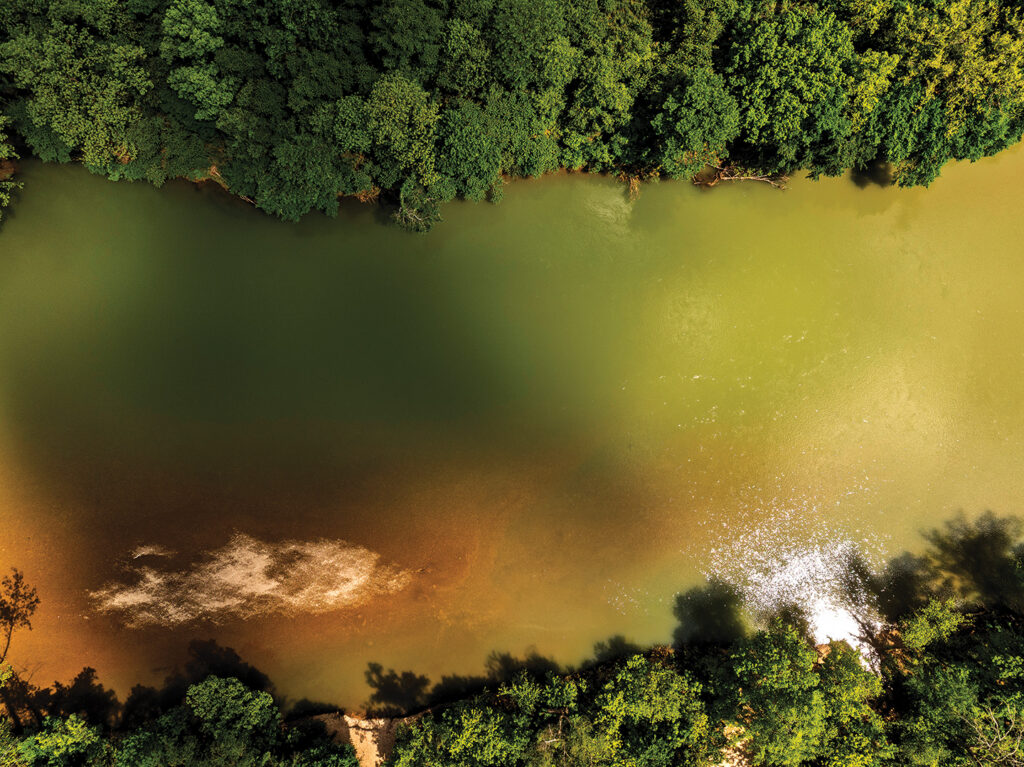
OKLAHOMA STATE OFFICIALS are clashing as the fate of a major water source hangs in the balance. A lawsuit between the state and major poultry companies began in 2005 out of concern that farm waste was contaminating the Illinois River watershed. The state and poultry companies are now waiting on a federal court ruling to decide whether evidence from a trial fifteen years ago still holds true. The decision could have far-reaching consequences for the Illinois River and its surrounding region.
In 2023, Federal Judge Gregory Frizzell determined that the evidence from this trial showed poultry companies were liable for decades-long damage caused to the Illinois River watershed by spreading poultry waste on fields and allowing it to wash into the rivers and streams. Previous talks between state and poultry companies to come to an agreement on proper waste management were unsuccessful. “My observation is that poultry would rather litigate and appeal and delay,” Oklahoma Attorney General Gentner Drummond says. “It’s economically beneficial. I wish they would change that.”
Drummond says he wants a clear plan in place that would restrict poultry producers from spreading bird waste on farmland in the Illinois River watershed. Drummond has been at odds with the poultry industry over who, exactly, is to blame for the pollution in the region. He admits that there are other sources of pollution besides the poultry companies, including wastewater treatment plants that discharge into the river and population increase in northwest Arkansas—though their overall part in contaminating the water is not as dramatic as poultry companies contend. “Poultry is still complicit,” Drummond says.
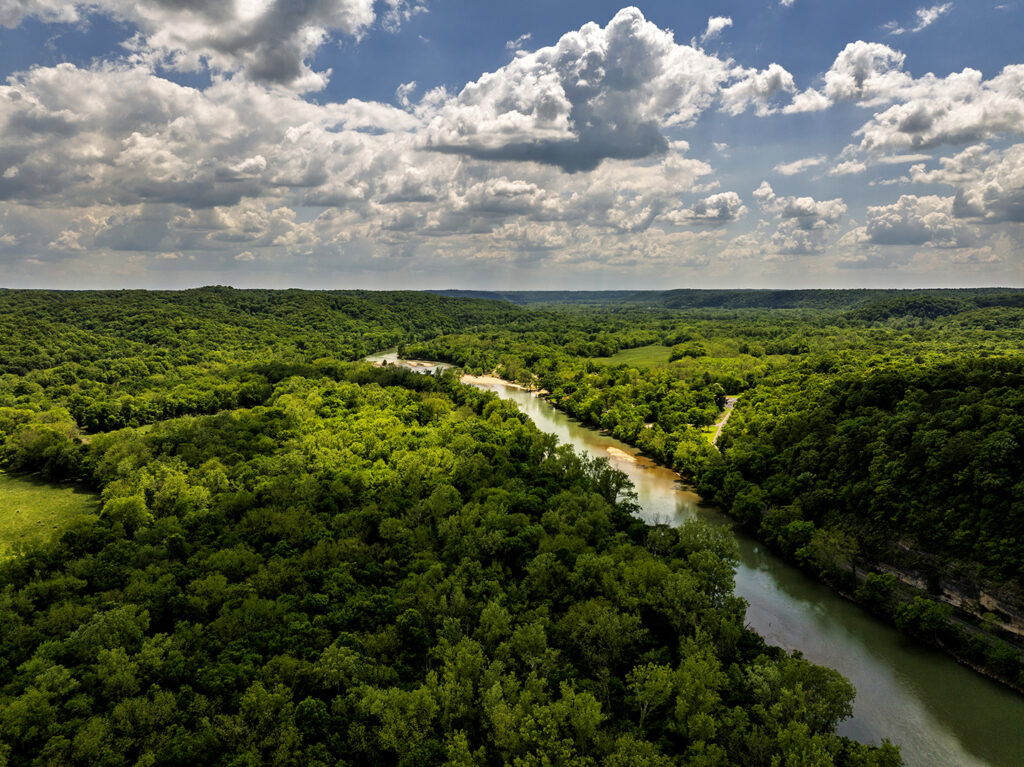
THE ILLINOIS RIVER runs about one hundred miles along the border of Oklahoma and Arkansas. About half a million people live in the surrounding watershed that spans parts of the two states. In Oklahoma, the river flows into Lake Tenkiller, which is a destination for boating, fishing and a source of public drinking water.
Since the poultry industry boom of the 1940s, eastern Oklahoma and Arkansas poultry farmers and cattle ranchers have used chicken litter to fertilize their pastures, hay meadows, and crops. During rain events, excess phosphorus from this excrement washes off the fields into streams and rivers, and can end up in bodies of water through stream bank erosion where litter has been over-applied in years past. The phosphorus pollution, produced by waste from poultry farms that dot the region, can kill fish and cause algae blooms, reduced water clarity, and foul-smelling and -tasting drinking water.
In 2005, under then-state Attorney General Drew Edmondson, Oklahoma sued poultry companies including Tyson Foods, Simmons Foods, and Cargill over pollution to the Illinois River watershed.
For years, Edmondson and his team were in negotiations with the poultry companies, the state of Arkansas and Arkansas cities, and the wastewater treatment plants that discharge into the river. Edmondson told The Frontier he was able to work out deals with the state and cities, but not with the poultry companies. He doubts the poultry companies would willingly reach an agreement with the state now, and he thinks they would likely try to get the case overturned on appeal. “Over twenty years ago—and it’s still true today—the industry is not going to do anything in regard to protecting water unless they are paid to or made to,” Edmondson says, “and we can’t pay them, so we’ve asked the court to make them.”

At present day, other state leaders have not been supportive of Drummond’s continued pursuit of the poultry industry. In a statement, Oklahoma Governor Kevin Stitt says the lawsuit jeopardizes the state’s close relationship with corporate interests and called for the immediate dismissal of the case—although the judge already ruled in the state’s favor.
“This twenty-year-old lawsuit is simply an attempt by radical environmental extremists and greedy out-of-state trial lawyers to attack industries trying to follow the law,” Stitt says. “Businesses need certainty, not lawfare. The only rational outcome is an immediate dismissal. Anything less threatens the state’s business-friendly environment that Oklahomans value and overwhelmingly support.”
Stitt, who is in his last term, accused Drummond, a fellow Republican who is running for governor in 2026, of extorting the poultry companies and trying to curry political favor with attorneys. “There’s no possible way I would be for playing Monday morning quarterback, going to a business and saying, ‘You’ve got deep pockets, you can afford it—even though you followed all the rules and had all the permits and you did everything we told you to do—now we don’t like it and want you to give us a billion dollars,’” Stitt says. “That’s basically what these trial attorneys are doing.”
However, such a deal wouldn’t be unheard of. In Tulsa where Stitt lived before he became governor, a 2004 settlement limited the amount of poultry litter that can be spread in the Eucha-Spavinaw watershed, the main source of drinking water for the area. The agreement was reached after the city and state sued most of the same poultry companies in the Illinois River watershed lawsuit because of poor water quality.
Without a settlement, any resolution to the case is still likely years away. “We’re hopeful the judge comes out in favor of the state and sets out certain requirements for the poultry industry,” says Denise Deason-Toyne, president of the environmental group Save the Illinois River. “There will be an appeal, so we’ll have several more years of waiting.”
Deason-Toyne says she believes the Arkansas-based poultry companies have been able to hold sway over some legislators as well as the governor. Campaign finance records show poultry executives donated heavily to Stitt, as well as former and current state political leaders over the years. That political influence, she contends, has caused government officials to side with the out-of-state corporations, rather than their own constituents. “The governor wants this lawsuit dropped. Period,” Deason-Toyne says “And the agencies that are participating are doing so cautiously because they’re all afraid they’re going to get fired.”
Drummond agrees that the poultry industry has a “disproportionate” amount of influence in Oklahoma’s government. “There’s a general fear of poultry by legislators and the governor,” he says.
Poultry companies involved in the lawsuit did not respond to requests for comment. Marvin Childers, president of the Poultry Federation, an advocacy group for poultry and egg producers in Arkansas, Oklahoma, and Missouri, says his organization is concerned that activists and attorneys are using the lawsuit to “end farming and ranching in the Illinois River watershed—and potentially far beyond—for years to come.”
“The Attorney General’s office continues to pursue an outdated lawsuit originally filed two decades ago by a prior administration whose goals do not reflect those of most Oklahomans,” Childers says in a statement. “This legal effort unfairly threatens the livelihoods of farmers, ranchers, and landowners who acted in full compliance with state regulations. The Attorney General refuses to recognize that Oklahoma’s own responsible agencies report the Illinois River to be a scenic jewel with quality measurements having improved steadily in the last fifteen years.”
The governor berated and fired his former Secretary of Energy and Environment, Ken McQueen, on social media after he found out McQueen attended the December 2024 evidentiary hearing. McQueen, who was already set to resign a few weeks before his firing, says the governor had said nothing about him attending the hearing beforehand. However, Stitt’s spokeswoman, Abegail Cave, says the governor had explicitly instructed McQueen not to attend.
Miles Tolbert, the state’s Secretary of Environment at the time the lawsuit was filed in 2005, says the issue drew a lot of political attention at the time, but the lines were not partisan. Former Republican Governor Frank Keating had pushed for more regulation of the poultry industry. “He set an example on the Republican side about how you could care about Oklahoma’s rivers and lakes and still be true to your principles,” Tolbert says.
Stitt replaced McQueen with Jeff Starling, a corporate attorney and former general counsel for Devon Energy. Starling, whom the governor’s office declined to make available for an interview, did not attend the nearly two-week-long poultry hearing. In January, Starling told Oklahoma Farm Report that Drummond should fire an outside law firm that helped with the case, describing it as a “plaintiff’s law firm.”
Drummond dismissed the idea of firing the firm from the case, explaining that “there’s nothing to do. It would be like firing a surgeon after he’s cut your arm off.”
For the moment, Oklahoma has already won its case, at least until an appeals court takes the matter up. But the state is now asking a judge to order the poultry companies to reduce its distribution of bird waste in the region and pay for clean-up costs. A ruling could come at any time, but according to Drummond, a compromise could help speed things up. “We can find a path where we have a strong poultry industry and clean water.”
This story was produced in partnership with the nonprofit newsroom The Frontier, a grantee of Kirkpatrick Foundation.