Complete Curriculum
THE HUMANITIES AT THE UNITED STATES AIR FORCE ACADEMY
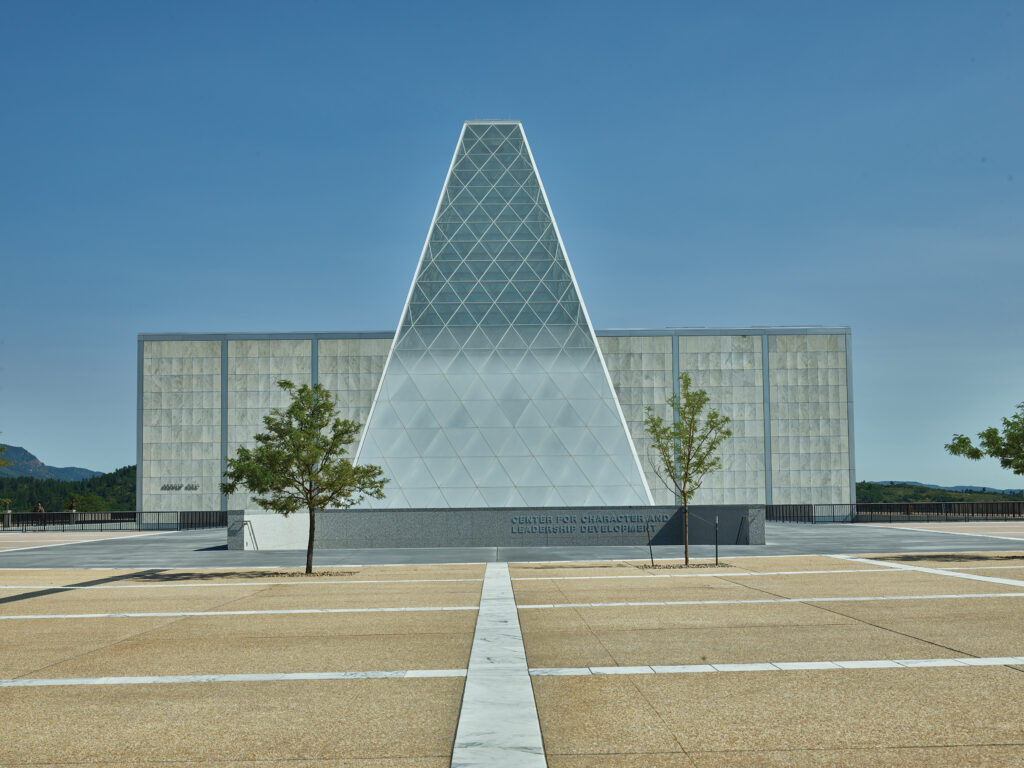
FOR PEACEKEEPING, A FULL spectrum education is key. At the United States Air Force Academy, the military service institution is tasked with educating future Air Force officers, and recognized for its core curriculum based in math, science, engineering, and technology. But USAFA also cultivates the study of literature and the arts, emphasizing the importance of humanistic inquiry.
While every graduating cadet earns a bachelor of science degree, even those who major in English literature, all students will also have taken at least two classes in the Department of English and Fine Arts. Offering courses including painting, drawing, and creative writing, the department also curates a gallery on USAFA’s campus and houses the internationally recognized humanities journal War, Literature & the Arts.
This inclusion of the humanities into the core curriculum might not be surprising—USAFA was conceived as a symbol of cultural innovation formally expressed in its very architectural design. While West Point’s collegiate Gothic buildings and the Naval Academy’s Beaux-Arts influence connected those institutions to a sense of tradition, USAFA’s design turned to modernism’s future-looking International Style.
A controversial decision, as modernism’s vocabulary is not always accepted, the use of rectilinear steel and glass shows the influence of the twentieth-century Bauhaus. The Bauhaus boasted an idealistic and practical pedagogy that sought to merge the fine arts, crafts, and industrial design. Its influence remains visible throughout USAFA’s buildings decorated with the primary colors of red, blue, and yellow so important to Bauhaus pedagogy.
But USAFA is not the Bauhaus, as it reverses Walter Gropius’ declaration that “technology does not need art, but art needs technology.” With courses in BioArt, 3D printing, and digital photography, USAFA makes use of technology, but it does so to ensure that technology-minded students consider the importance of art. “I was often asked at the Academy why I wanted to pursue a degree in art and literature at a technical school,” says USAFA graduate Jordan Brown. “The initiative required in creativity is difficult to be taught in any way but through art, and once you’ve learned it, you can apply that initiative to any number of fields.” This belief in the value of higher education does not treat an undergraduate education as a trade or vocation. An education that includes the study of art, and not just as a decorative veneer, can expose students to the conventions that make meaning possible.
US Army veteran Katherine Fiorillo had the opportunity to experience this type of education firsthand. As a visiting army officer, Fiorillo experienced USAFA with an outsider’s perspective, and it reinforced her belief in the importance of a humanities education. “to be truly excellent leaders we must also be well rounded, diverse, insightful, dynamic—and at the core of all this is art,” Fiorillo says. “Art is the key to understanding humanity, to finding motivation, to expressing empathy, and, ultimately, to thoughtful and intentional military leadership.”
The value of higher education is often filtered through economic metrics, wherein the study of a field is valued for the money it can make. The study of art presents a competing value based on understanding socially shared meaning. When too many schools are slashing the budgets of humanities programs, USAFA offers an unlikely source of inspiration to do otherwise. – JOSÉ ANTONIO ARELLANO
José Antonio Arellano is an assistant professor in the the Department of English & Fine Arts at the United States Air Force Academy