Illumination
Coal Carriers: The Lightbulb Moment
Seven artists, curators, and patrons on the moment the light came on, from three words of advice in a museum career to a tribe carrying coal from one fire to the next.
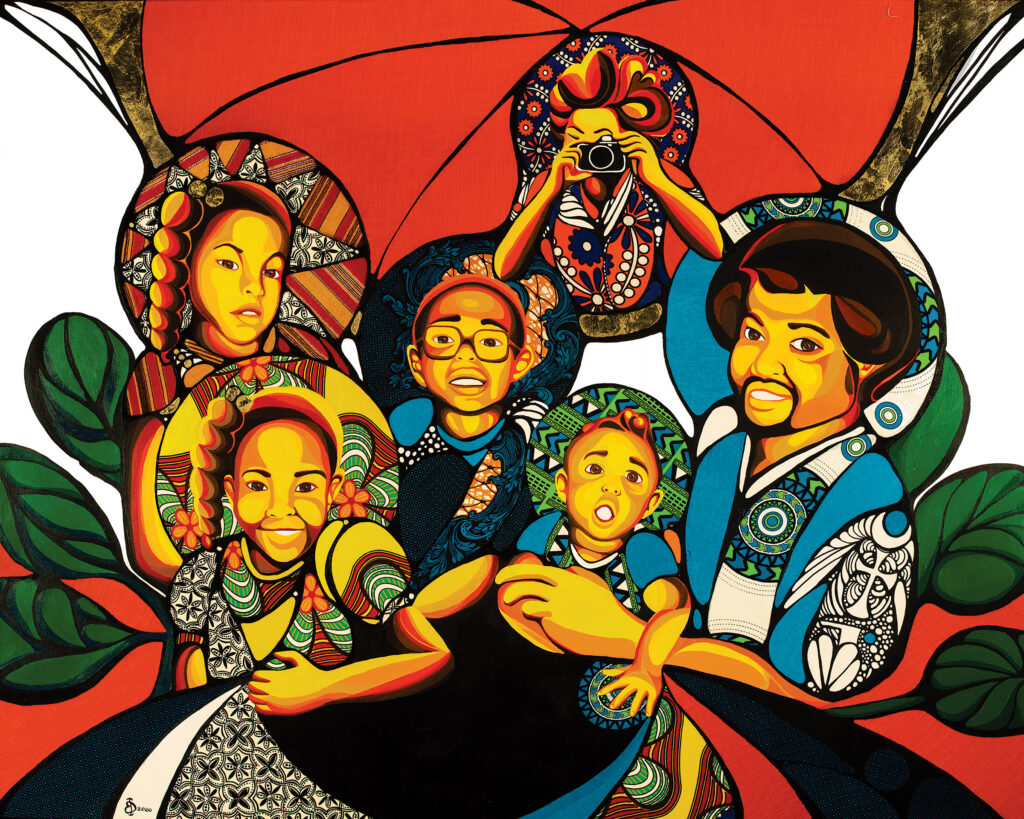
DON’T BE DEFERENT. Important words of advice I received at a critical juncture in my career. Those words, as plain and un-minced as they were, taught me a great deal about commanding space, building my own table, and grounding myself with an affirmation that I belong. In the world of culture, one that is rampant with hierarchy and historical exclusion, hearing that directive was my paradigm shift. At every level of personal growth in our journeys, we have the choice between fearfulness and expansion. Those three words have been the warm glowing light in the distance, guiding me along the path toward the best version of my ever-evolving self.
— JESSICA BELL BROWN
Ms. Brown is the associate curator of contemporary art at the Baltimore Museum of Art.
WHEN I WAS sitting in the middle of Joshua Tree during sunset thinking about Lucid Stead, or watching the Pacific Ocean meld with the sky on the horizon line, or thinking about 1/4 Mile Arc in Laguna Beach, I thought: How can I ever make anything more beautiful than this? Through the use of reflection, I was able to use that existing sublime beauty as artistic material within my work—the sunset, the ocean, and the shifting atmosphere became ever-changing functional materials that I could interact with.
— PHILLIP K. SMITH, III
Mr. Smith is an artist in Palm Springs, California.
IN THE 1980s after agreeing to edit a new academic journal on anthrozoology (Anthrozoos), a colleague introduced me to a 1964 paper by anthropologist Edmund Leach. Leach wrote about swear words and noted that there are basically three categories of words we use when swearing—profanities (about God), obscenities (about sex), and animal terms. He said it did not take much to understand why we use profanities and obscenities but that animal terms were a real puzzle and then he offered his thoughts on the matter. His analysis has been a central feature of my understanding of human-animal interactions ever since, that the only consistency in the way humans think about animals is inconsistency.
— ANDREW ROWAN
A Rhodes Scholar, Dr. Rowan is an animal advocate in Washington DC.
THE CHALLENGES PRESENTED last year have resulted in new ways of working I never thought possible. My art is about manifesting digitally created light sequences as sculpture in the physical world. It’s very important that I am able to spend time in-person with my work, adjusting subtle parameters such as tempo and brightness. I never thought I would be able to do this work remotely. Because I could not travel, and we were working toward launching phase two of Illuminated River in London, we had to develop a new workflow. We engaged a very talented videographer with a great camera. We then found a video encoding solution that could beam real-time 4K video signals from the banks of the Thames to my studio in Brooklyn. For more than a month, I would spend several hours each day connected remotely to the artwork, trying out sequences and fine-tuning the results. I was amazed that we were able to accomplish as much as we did. The lesson here is that constraints lead to new and exciting ways of being creative that we can build into our process moving forward.
— LEO VILLAREAL
Mr. Villareal is an artist in New York.
ART HAS ILLUMINATED my life. Gazing at an Alma Thomas painting, resting in a James Turrell Skyspace, walking around a Ruth Asawa sculpture—these are all moments that stir my soul, that inspire me to learn more about the artists, their times, their lives. Art provides a glimpse into the world through the eyes of the artists creating it, offering new perspectives and empathy as we learn their stories. It’s that spark that motivated me to found Crystal Bridges Museum of American Art and the Art Bridges Foundation, to provide access to illuminating experiences for all.
— ALICE WALTON
Ms. Walton is a philanthropist in Bentonville, Arkansas.
I WAS CONVINCED I wanted to leave Pittsburgh for Seattle after college. I would work at the Seattle Art Museum and go to concerts at night. To help facilitate my dream, my father introduced me to a corporate recruiter. Mr. Donnelly was eccentric. He had mad energy, referred to himself as the “Warrior King,” moved between subjects with lightning speed, and forced me to make decisions I wasn’t prepared to make, including a move to Seattle. I can’t imagine my life without him. I wouldn’t have moved from Pittsburgh to Washington, DC, found the best job ever at FAPE, and be working with some of our country’s most extraordinary artists.
— JENNIFER ANN DUNCAN
Ms. Duncan is director of the Foundation for Art and Preservation in Embassies in Washington, DC.
FROM THE EARLIEST times, the tribes had someone to carry the coal from one location to the next in order to light the fire that allowed the community to thrive. Today, the carriers of the coal are our artists, musicians, writers, and creatives. In the last year, when we needed connections and courage the most, I saw just how essential these many individuals are. Whether the community is gathered around a screen or in-person, these coal carriers are vital voices. Their work gathered our tribe and gave us a chance to breathe together and be in the moment. I had the full realization that without these creatives—who allow us to make sense of the world, connect to one another, and share our journeys—our path would be dark and lonely, and the way would be perilous. The arts lead and light the way for us all.
— DEANA McCLOUD
Ms. McCloud is director of the Woody Guthrie Center in Tulsa, Oklahoma.
Send us your lightbulb moment at editor@readartdesk.com