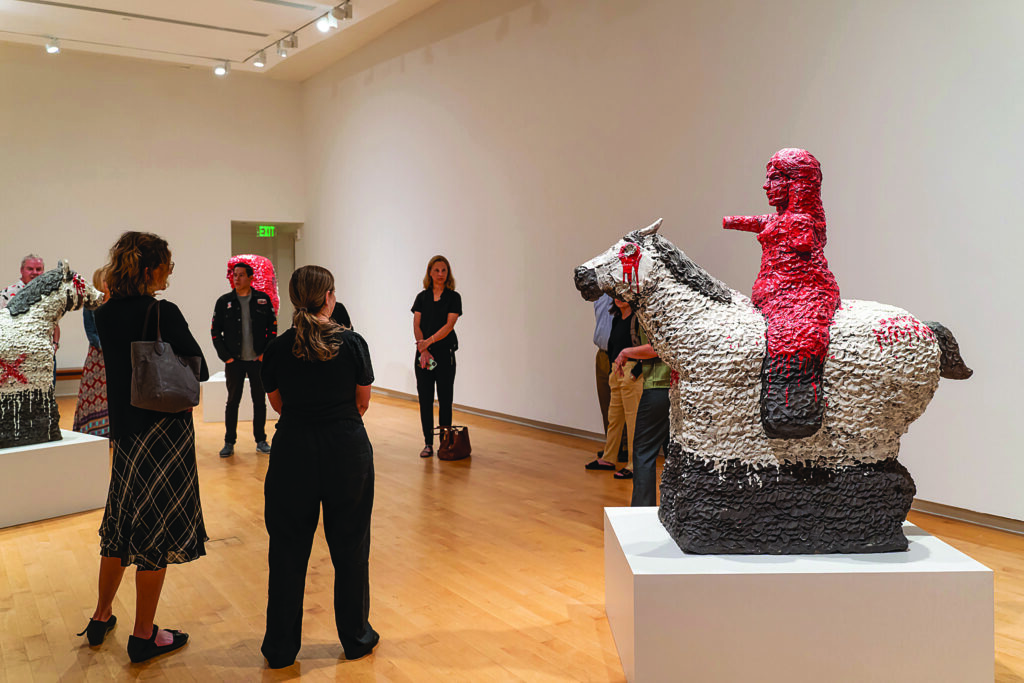
LATELY RAVEN HALFMOON has been inspired by riding her horses at sunset. Warm hues and equine shapes appear in some of her newest large-scale stoneware sculptures which draw on influences ranging from Caddo pottery to street art tags. After about a decade away from her home state, she returned to Oklahoma a couple of years ago and now has a studio in Norman, where she was born and raised.
“It’s been nice to lay down roots,” she says. “This is where my family is. This is where I want to give back to the community. I want to bring back all that I’ve learned in my travels and what I’ve gained in my career. And I want to help others here because I think a lot of people don’t understand that you can do what I do, you can be an artist and be successful. I think that’s a hard dream for people in this area to realize. And I just love the atmosphere and how wide and open and green it is.”
Some of her recent works are joining those traveling in Raven Halfmoon: Flags of Our Mothers for the show’s stop at Oklahoma Contemporary Arts Center in Oklahoma City. The exhibition is supported
by the Art Bridges Foundation and organized by the Aldrich Contemporary Art Museum in Ridgefield, Connecticut, and Bemis Center for Contemporary Arts in Omaha, Nebraska.
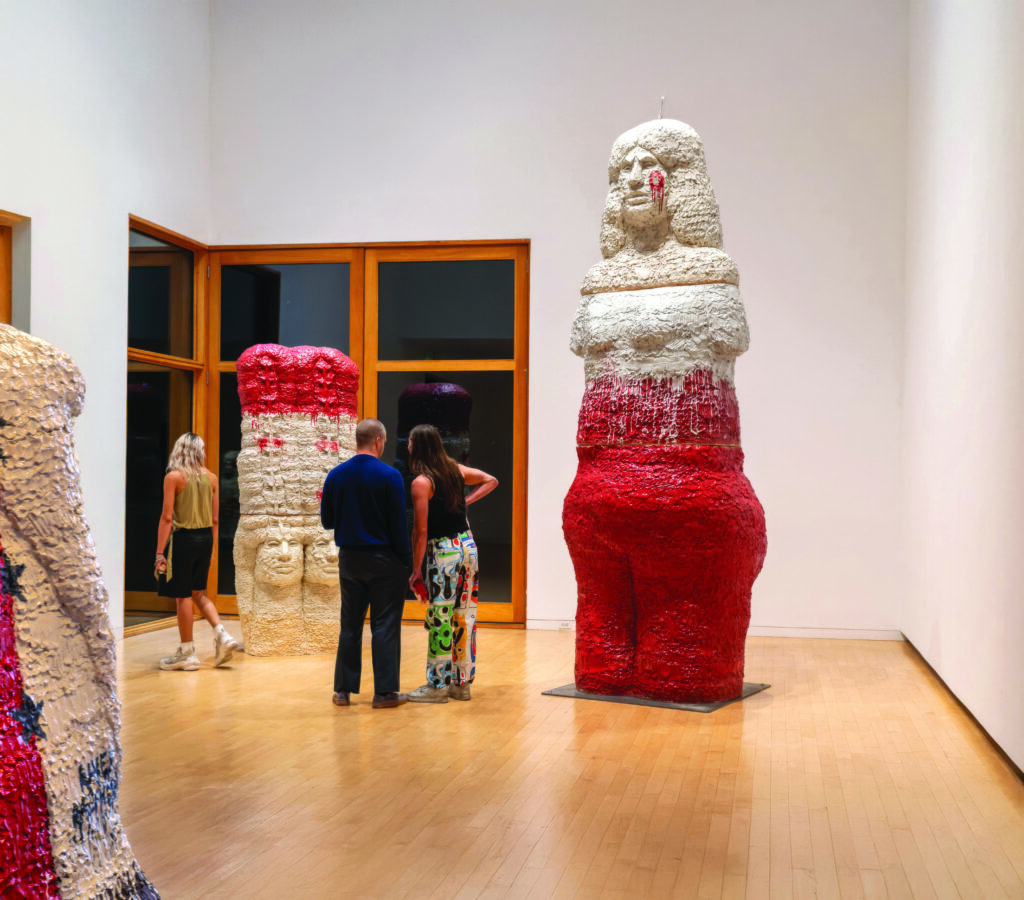
A citizen of the Caddo Nation, Halfmoon learned traditional techniques from a Caddo elder before studying ceramics, painting, and cultural anthropology at the University of Arkansas. Family trips to Mississippian earthworks such as the Cahokia and Spiro mounds—these “huge metroplexes that were built by community and for community”—were formative in considering how she could draw on the immensity of Indigenous traditions. Halfmoon’s colossal figures, which stand up to twelve feet tall, have the stature of Easter Island Moai heads but with forms expressing feminine power. She builds each clay body with a coil method, giving them glazes that drip down the textural surfaces, where traces of her fingers are visible. These materials and colors often reflect where she is making her art.
“It’s important for me to use the materials in the community, because that’s what changes the work,” she says. “I totally will change my entire palette depending on the region. Oklahoma has that super-red dirt, so
that’s where a lot of that red comes from.”
The minimal palettes in Flags of Our Mothers have white, black, and red evoking that earth and the violence against Indigenous people perpetuated on it. Her Sun Twins, which was in the 2026 Whitney Biennial, has a buttery yellow that caught the sun from a museum window, while the layered hues of the stacked-stone Dancing at Dusk in the newly reopened Hirshhorn Museum and Sculpture Garden in Washington, D.C., resembles a geological stratum.
“Raven has an extraordinary ability to transform clay into monumental sculpture without losing the intimacy and humanity of the medium. She draws upon generations of Indigenous ceramic traditions while creating a distinctly contemporary body of work that is entirely her own,” says AnnaVittoria Pickett, director of exhibitions at Oklahoma Contemporary. “It is rare to experience an exhibition devoted entirely to ceramics on this scale, making this a remarkable opportunity for our community to engage with one of today’s most exciting artists.”
Flags of Our Mothers invites visitors to get up close to her imposing yet tactile female figures, who are unapologetically formidable in taking up space with their presence. “I want them to feel overpowering to us in a way that’s a breath of fresh air,” Halfmoon says. “They’re made to feel all powerful, almost like a deity. They’re made to help and made to have our backs when we need them.”
Raven Halfmoon: Flags of Our Mothers will be on view at Oklahoma Contemporary Arts Center
in Oklahoma City from November 18, 2026–May 24, 2027. oklahomacontemporary.org