BY BRIAN TED JONES WITH LOUISA McCUNE
ON MAY 7, 2015, The Washington Post quoted a tweet by Adam Barnett of Tulsa. This was the day after a rash of severe weather pounded Oklahoma for more than eight hours straight. The storm snapped trees and power lines, tore roofs off buildings, and flipped vehicles.
It also may have freed tigers.
“Today’s storms have freed animals from Tuttle, OK’s Tiger Safari,” Barnett’s tweet said, before listing the
storm’s effects:
1. Tornadoes
2. Flooding
3. Hail
4. Lightning
5.Tigers
“This is Oklahoma,” Barnett concluded.
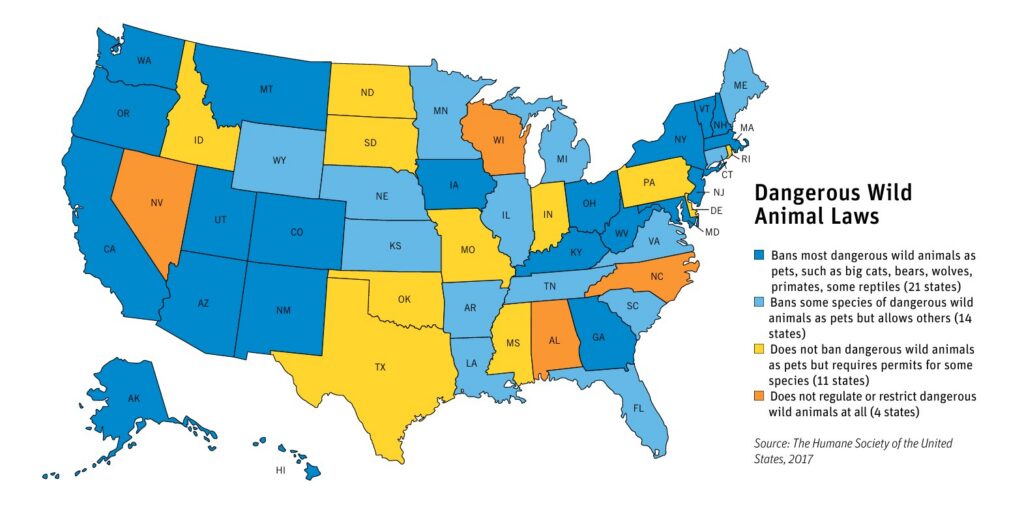
KFOR, a local Oklahoma City TV station, reported from the town of Tuttle on the evening of May 6 that “the owners of Tiger Safari have confirmed that some of their exotic animals are on the loose.” Within a half-hour, KFOR followed up and the county sheriff’s office explained that Tiger Safari was able to account for all its creatures, which included a seemingly anxious hyena. Still, the incident—dubbed “Tigernado” on Twitter and elsewhere—raised serious questions about the way the state of Oklahoma regulates exotic animals. The state is considered among the worst for exotic animal oversight. Because other neighboring states do have laws, breeders and owners are moving to Oklahoma to accommodate their market and desires.
In 2016, the authors of The Oklahoma Animal Study reported that of all the animal categories they examined during their three-year investigation, exotics in private possession were the least documented in the state. (The report was published by the Kirkpatrick Foundation, which also publishes ArtDesk.) This is true, in part, because Oklahoma law on exotic animals is virtually non-existent.
Federal standards apply to businesses that exhibit exotic animals, like Tiger Safari, and municipalities will sometimes impose local ordinances that restrict exotic ownership. But Oklahoma lies in a minority of sixteen states that do not ban outright the ownership of dangerous exotic animals as pets—a list that would include tigers, lions, bears, chimpanzees, and many more.
Moreover, Oklahoma state director of the Humane Society of the United States, Cynthia Armstrong, says governing dangerous, wild exotics isn’t just about public safety. “Most wild animals kept as ‘pets’ are confined to backyards, basements, or garages and lead barren, boring lives—devoid of anything that they would experience naturally in the wild,” she says. “With no means to meet their instinctual needs and desires, many develop psychotic behaviors such as self-mutilation, head-bobbing, and incessant pacing.”
Lisa Wathne, a captive-wildlife specialist with the Humane Society says, “Cute and agreeable baby animals purchased as pets become aggressive and territorial when they mature. They quickly become unmanageable and inevitably must be relegated to life in a cage and often end up being shuffled from home to home or discarded at roadside zoos or auctions. Others are turned over to breeders who supply the pet trade and keep this vicious cycle going.”
And especially in a state with as much severe weather as Oklahoma, Armstrong says, “It’s not a question of if they get out, but when.”
