Oklahoma’s Data Center Reckoning
Google and other companies want to wire the heartland. The people who live there have questions.
BY Ben Fenwick
THE ROAD TO GOOGLE in Oklahoma slips off U.S. Highway 412 without much notice, a two-lane turn into the green sprawl of Mayes County, about forty-five miles northeast of Tulsa.
The drive there from central Oklahoma unfurls through fields and low hills, past fading barns and signs that read variations of Jesus Saves. This is the country of Will Rogers and part of the Cherokee Nation—land that carries its history quietly.
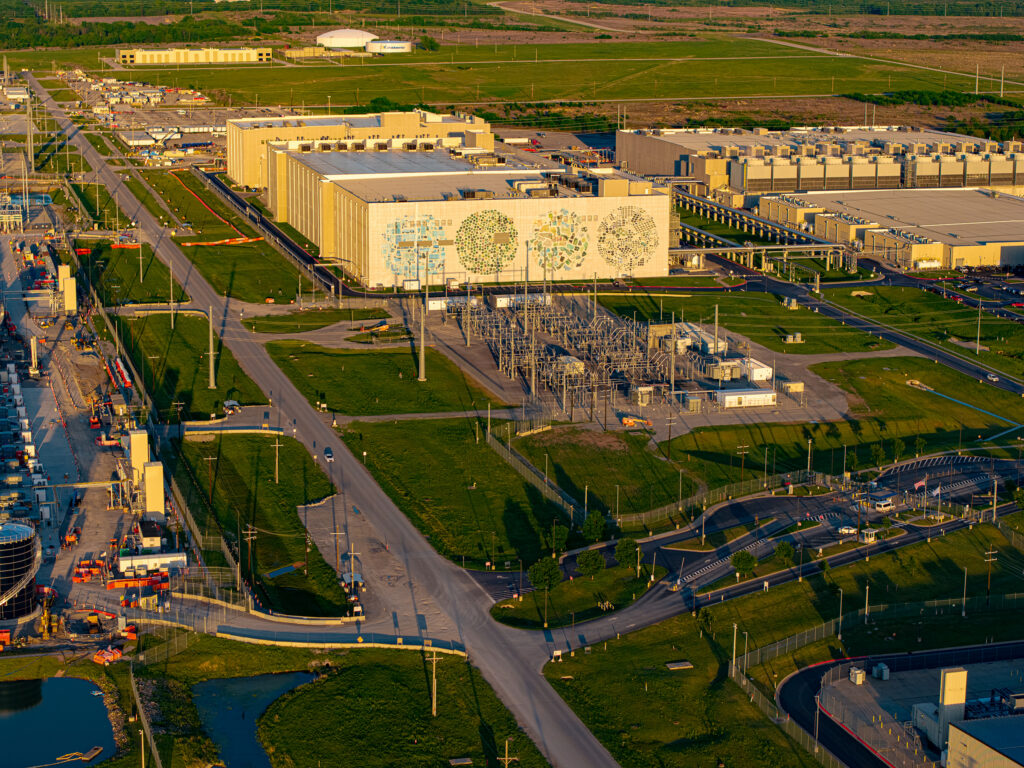
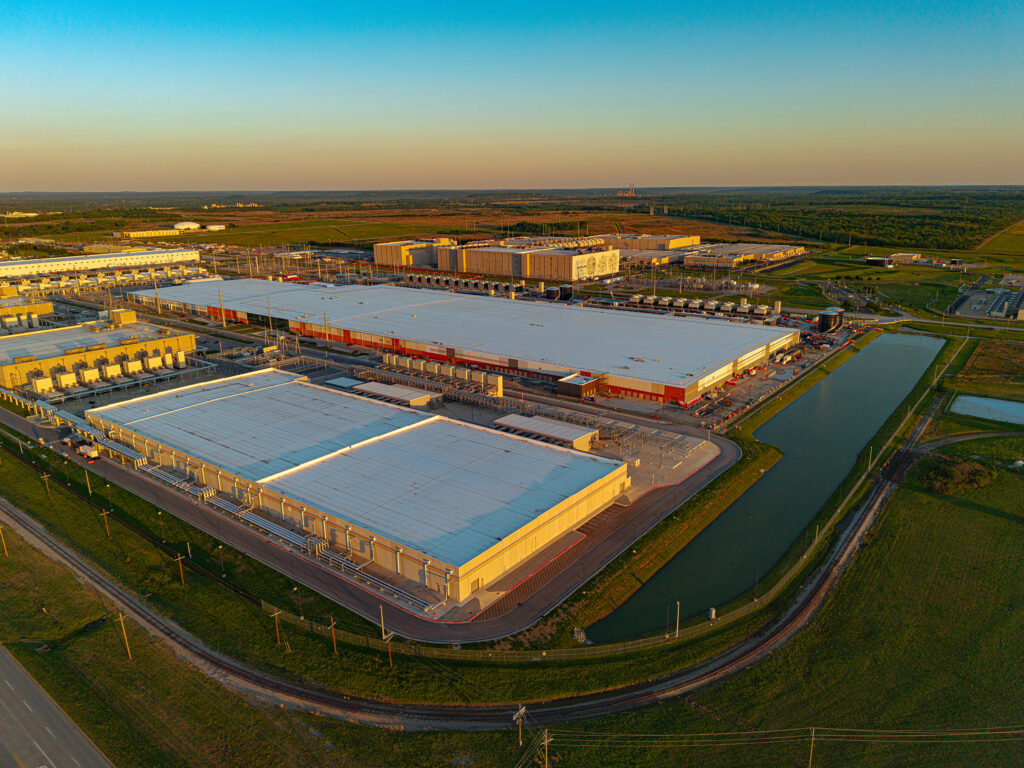
For miles, there is little to suggest anything unusual. Then, near the entrance to the MidAmerica Industrial Park, smokestacks rise above the trees at the Grand River Energy Center, overlooking the Neosho River, which moves wide and fast. Farther in, past crumbling World War II–era ammunition plants and rusting barbed wire, the landscape changes. A vast, windowless building stretches across the horizon, wrapped in fresh security fencing, its pipes and ducts coiled around it.
This is Google’s second-largest data center in the world. And here, in a quiet corner of Oklahoma, a fight over energy, water, land, and power is taking shape—one that foreshadows a broader reckoning across the state and the nation.
In MidAmerica’s Welcome Center, Sherry Alexander, director of business development and communications, acknowledges that the Google facility across the street can look forbidding.
“It’s massive, and it looks like a prison,” she says, then points to the vast building. “This is the best way we know how to explain this—that it is the cloud. Everything that you’re doing on your little phone and all your pictures and all your stuff that you send to the cloud, that’s where it’s going.”
Hard Drives All the Way Down
The saying goes that the cloud is another word for somebody else’s hard drive. Hyperscale facilities store and process information from across the web in enormous warehouses of servers, stacked row upon row. Google’s Pryor hyperscale facility spans more than 1.4 million square feet, roughly the size of 8.5 Sam’s Clubs, and extends underground.
All those servers require power—hundreds of megawatts. And they generate immense heat. Google cools its Pryor facility with water drawn from the Neosho River. According to an investigation by The Frontier, water utility records show the center uses about 1.1 billion gallons a year—roughly three million gallons a day. About 253 million gallons are returned to the river after treatment. Approximately three-fourths of the water is lost to evaporation.
On an average day, that’s manageable. The Neosho typically flows past MidAmerica at several billion gallons per day but can drop to roughly 65–200 million gallons per day during low-flow conditions, according to the U.S. Geological Survey. Under those conditions, Google would consume around 4.6 percent of the water flowing past.
MidAmerica’s infrastructure, built for wartime munitions production, can handle this kind of tenant. David Stewart, chief administrative officer of MidAmerica Industrial Park, says the park is well positioned.
“We’re fortunate to have plenty of water, plenty of power here with [the Grand River Dam Authority] in a very robust and durable infrastructure system within the park,” he says.
Small towns facing their first data center proposal may not have that, he says.
“These projects are years in the making, and to approach a rural community with all of these demands at once, it just seems overwhelming at times, I think, for councils and city administrators to handle because it just touches a lot of different aspects of the community,” he says.
But a change to state law has sent data center developers looking far beyond purpose-built industrial parks—and into those small towns that may not be ready for them.
God and Money
Shouts, jeers, and catcalls met Kate Franko, Google’s public affairs senior manager, at the Charles Page High School cafeteria in Sand Springs, Oklahoma, on January 20, 2026, during a special city council meeting on Google’s proposed data center. Part of a two-year $9 billion investment in Oklahoma announced by Google in August 2025, Project Spring—developed by the Dallas-based digital infrastructure development firm White Rose Partners—would occupy 827 acres of farmland along Highway 97.
Franko faced the crowd and made her pitch: “I truly believe—and part of the reason I do this job—is that I really think that data centers are a golden ticket for communities across America.”
She said Sand Springs, Osage County, Sand Springs Public Schools, and Tulsa Tech would receive millions of dollars per year. Superintendent Sherry Durkee said the district’s building fund would get at least $1.1 million annually.
Not everyone was buying it. Candace Slaten, whose property sits about two hundred feet from the proposed site, addressed the council in sharp religious tones.
“I ask you to remember that one day we will all stand in front of the judgment seat. Will you be known for protecting the least of these and hear the words, ‘Well done, my good and faithful servant,’ or will you choose a different path out of a love for money and hear, ‘I know you not, depart from me?’”
Cheers greeted her statement. Charley Pearson, fire chief for the Rock Volunteer Fire Department, which turned down a $250,000 donation from Google, was blunt and also biblical.
“Money is the root of all evil. There’s other ways to grow Sand Springs.”
As the meeting wore on for more than two hours, Franko fielded questions on noise, chemicals, and water. No chemicals would leach out of the facility. No poisonous vapors would spew from the center. Noise would be, at worst, the level of a normal office building.
“We have operated in Pryor with great success for a very long time,” she said. “I urge you to drive around the public roads there and listen to the campus there or see it.”
Members of the crowd frequently interrupted Franko, prompting Mayor James Spoon to chastise them.
“This is not being very productive when you keep yelling stuff out,” Spoon told them. “She’s trying to answer the question, and you’re just yelling, and people can’t hear. Please listen. If you’re going to ask a question, please listen.”
The meeting was bruising for Google and the council. Following the drubbing, Frontier investigative reporter Clifton Adcock approached Franko for comment.
“I don’t do interviews,” she said.
Fallout
On February 3, the Sand Springs City Council voted 6–1 to rezone the property, over the objections of outspoken residents who packed the meeting. The lone dissenter was Councilman Beau Wilson.
Kyle Schmidt, with the Protect Sand Springs Alliance, says the problem isn’t data centers per se—it’s how this one was handled.
“The city broke several state laws when they annexed this property six miles outside the city limits to try and build an industrial park, essentially right in the middle of homes and ranches,” he says. “And they kept the secret while they were doing it so that nobody could catch ’em doing it.”
Schmidt and the alliance have launched a recall effort against the entire city council. Slaten and others have filed a lawsuit in district court challenging the annexation. Both efforts are ongoing. Google has not yet purchased the land.
City Manager Mike Carter dismisses the lawsuit as meritless.
“We believe [the data center] is fully going forward,” he says. As for the recall: “[In] my personal opinion, recalls should be saved for times when you have corruption or something like that. That’s not the allegation here.”
Sand Springs is not alone. As many as eighteen data centers have been proposed across the state, but resistance is mounting. Project Atlas, a Beale Infrastructure proposal in Coweta, was withdrawn after the planning commission voted to deny rezoning. A proposed facility in Lawton had its lease canceled in December 2025. A Gamma Resources project near Yukon has been repeatedly delayed due to community outcry. In March, the Tulsa City Council unanimously passed a nine-month moratorium on new data center developments, though the proposed $800 million Project Anthem in East Tulsa will move forward, although with Phase 2 paused.
Unintended Consequences
The influx of data centers into small towns traces directly to a change in state law. According to Alexander, Google arrived in Pryor in 2007 and availed itself of a voter-approved manufacturing incentive—a five-year ad valorem tax abatement, renewed each time a company upgraded its equipment. Google, which swaps out servers every three years, Alexander says, was able to renew the abatement continuously while the state footed the bill.
“It about broke the state,” Alexander says. So in 2021, the legislature passed Senate Bill 609, removing data centers from the manufacturing incentive. Google’s existing facilities were grandfathered, Alexander notes, but new projects would have to find another way.
And they have. Data center developers now seek out rural land bordering cities, promising millions to small school systems and local governments. The communities, Alexander says, are struggling to cope.
“The communities are having trouble keeping up with the water that’s needed and the power that’s needed,” she says. “The infrastructure seems to be what the problem is.”
In Sand Springs, as in towns across Oklahoma, the question isn’t whether the cloud is coming. It’s who gets to decide where it lands—and what it costs the people already there.