WHEN HEATHER WATTS arrived as a dancer in the corps de ballet at New York City Ballet in 1970, Leonard Bernstein’s album for West Side Story was already a hit and in nearly everyone’s record collection. “The red album was our classical album,” Watts says. “We grew up to the music of West Side Story. Lenny was a fixture of my time at Lincoln Center, and when someone is around you all the time—even a famous person—you take it for granted. You don’t know a golden age when you’re living in one, and so it was a terrible shock when he died.”
“The most wonderful thing of all is that there’s no limit to the different kinds of feelings music can make you have. And some of those feelings are so special and so deep they can’t even be described in words. You see, we can’t always name the things we feel. Sometimes we can. We can say we feel joy, or pleasure, peacefulness, whatever—love, hate. But every once in a while we have feelings so deep and so special that we have no words for them, and that’s where music is so marvelous, because music names them for us, only in notes instead of in words.”—Leonard Bernstein in 1958 during the Young People’s Concert, What Does Music Mean?
AN EVENTUAL PRINCIPAL dancer for the company, Watts appeared in the premiere of The Dybbuk, Bernstein’s atypical collaboration with choreographer Jerome Robbins. Bernstein had written the music using kabbalistic numerology, making for a much different experience than his already famous West Side Story, for which Robbins had been the original choreographer.
“I knew Lenny from around town,” Watts says. “He was a larger-than-life figure and was well known on the Upper West Side. Jerry was much quieter and more contained, but the two worked well together, especially when they were plumbing Jewish history in music and dance.”
To commemorate his life and career, the Leonard Bernstein Office has organized a worldwide celebration called Leonard Bernstein at 100, including more than a thousand events on six continents. The centennial of Bernstein’s birth is August 25, 2018, and the events will continue through August 2019.
“He was the first American-born, American-educated musician to head an important American orchestra,” Paul Epstein, senior vice president of the Leonard Bernstein Office, says. “[Eugene] Ormandy went before him, and [Gustav] Mahler, [Bruno] Walter, [Serge] Koussevitsky—not a single American!”
At age forty, Bernstein was named director of the New York Philharmonic, a position he held for ten years. In terms of his legacy and effect on conducting, Alexander Mickelthwate, former musical director of the Winnipeg Symphony Orchestra and director designate of the Oklahoma City Philharmonic, spoke of Bernstein’s impact on American music.
“To me, his legacy first is to have elevated American contemporary classical music and put it on par with European contemporaries,” Mickelthwate says, “and second, inspiring several generations of Americans toward classical music. There is an absolutely genius performance of Bernstein conducting Stravinsky’s Rite of Spring. He did it from memory. He channeled the composer.”
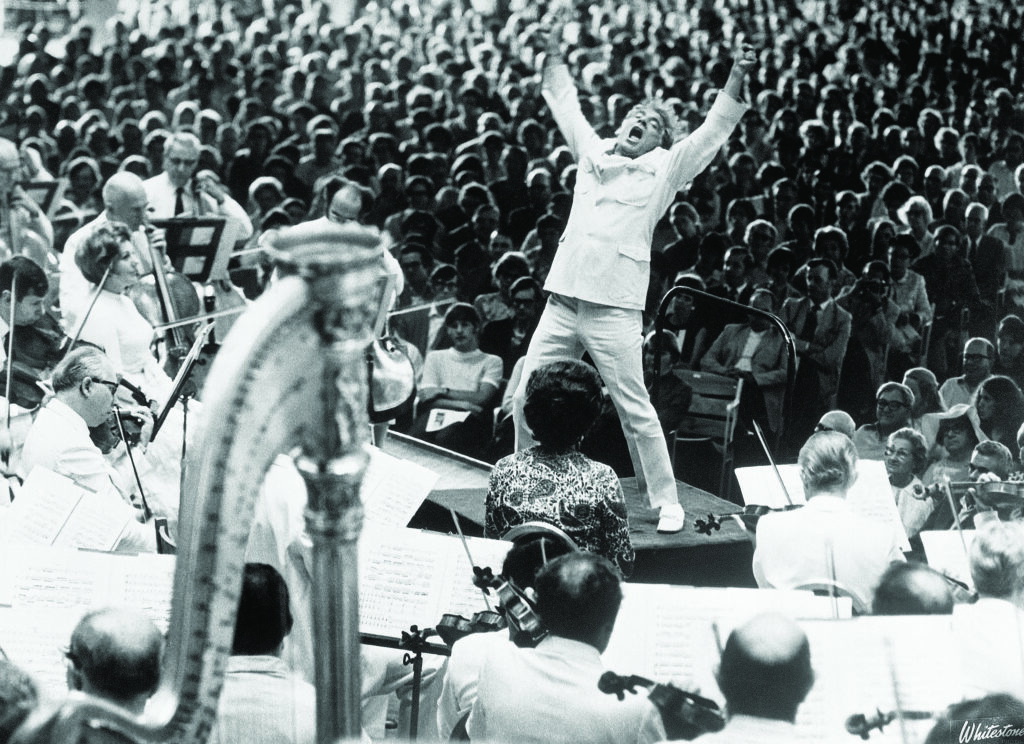
Bernstein’s conducting was untraditional. He famously fell off the stand twice, earning only a bruise as a sign of his “animated” style, and critics are still divided over many of his earlier performances, if only because he refused to follow the traditional semaphoric techniques of the craft. In every field of endeavor, his iconoclastic bent coupled with multifaceted genius led to a revolution in how the field understood itself.
Mickelthwate says Bernstein’s ability to work seamlessly between musical genres, including pop, classical, and opera, is “normal for today.”
“In this case, he was a visionary,” Mickelthwate says. “Many of the generation of young composers nowadays just compose music and judge less in regard to classical and pop. He was very inspiring.”
Beyond inspiring young musicians and conductors, Bernstein also developed music programs that took advantage of the technology of his day.
“Bernstein was the first person to see the educational possibilities of the developing ‘new media,’” Epstein says. “The programs he did to be broadcast on television for youngsters—the Young People’s Concerts—nothing like them had come before, and nothing like them has been done since.He didn’t talk down to young people.He talked to them as though they were adults, and they adored it, gobbling up what he fed them: sonata, form, modes, the Sound of an Orchestra, nationalism, for fifty-three programs!”
Bernstein’s music is now widely believed to translate well to dance. ArtDesk dance editor Larry Keigwin’s dance company, Keigwin Company, will perform Bernstein numbers around the country as part of the centennial celebration, including a performance at the Green Box Arts Festival. While Bernstein was not a choreographer, he did influence dance.
“He was the master of the melody,” Keigwin says. “They have such lushness, combined with sweeping, dramatic melodies. They make for wonderful collaborations with ballet and modern dance.”
Bernstein’s tireless advocacy for social-justice causes is one ofthe most under-appreciated of his contributions to the arts. He helped develop the Israel Philharmonic Symphonic Orchestra shortly after statehood was achieved, raised funds and awareness for HIV/AIDS, and, while he was musical director, welcomed the first African American musician to the New York Philharmonic.
The New York Times concludes its obituary of Leonard Bernstein with a quote from the maestro concerning his desire to be prolific across a variety of creative fields: “I want to conduct. I want to play the piano. I want to write for Hollywood. I want to write symphonic music. I want to keep on trying to be, in the full sense of that wonderful word, a musician. I also want to teach. I want to write books and poetry. And I think I can still do justice to them all.”
An array of music, dance, and theater being performed around the world can be found by visiting leonardbernstein.com.

Continuing Education
THE ACADEMY FOR THE LOVE OF LEARNING | By ALLISON MEIER
LOCATED IN SANTA FE on a sustainably designed campus of spaces for meeting and contemplation, the Academy for the Love of Learning promotes learning as a lifelong pursuit. The nonprofit was established in 1998 and grew out of a ten-year collaboration between musician and educator Aaron Stern and his mentor, Leonard Bernstein.
“In the last decade of Leonard Bernstein’s life, his overriding question was ‘Don’t we never learn?,’” says Stern, founder and president of the academy. “I took this to mean, ‘Can we humans transform, truly become better at being human?’ Lenny’s question met my own deep, passionate exploration of transformative experience and pedagogy. I was convinced then, as now, that in fact we can and do transform, become better at being human.”
Bernstein died in 1990, eight years before the academy’s debut, but his inquiry into learning is foundational to its programming. “At its heart is this very deep, ever-present question—as well as fervent hope and emerging evidence that, indeed, the answer is yes!,” Stern says.
The academy is hosting a 100th-birthday celebration for Bernstein on August 25 and is marking its own twentieth anniversary this year. aloveoflearning.org