String Theory
JANET ECHELMAN’S ethereal creations are feats of engineering, architecture, and environmental design.
IN 1997, A young painter named Janet Echelmanwon a Fulbright scholarship to make and show her paintings in India on behalf of the US Embassy. It was a dream come true for Echelman, but she soon ran into a problem: the box that Echelman had shipped to India containing her paints and painting equipment never arrived. With the deadline for her first exhibition quickly approaching, she had to come up with something fast.
“I was staying in a South Indian fishing village, and each afternoon I walked the long beach, watching the fishermen bundling their nets into mounds on the sand,” says Echelman from her studio in Brookline, Massachusetts. “I’d seen it every day, but this time I saw it differently—anew approach to sculpture, a way to make volumetric form without heavy solid materials.”
Falling in love with the overlaid colors and constantly changing shapes of those fishing nets in the coastal breeze, Echelman quickly decided to get to work on a series of outdoor net sculptures that would be informed by their environment. By collaborating with the locals on these artworks, she would also soon discover a synergistic process that she would go on to use for years to come.
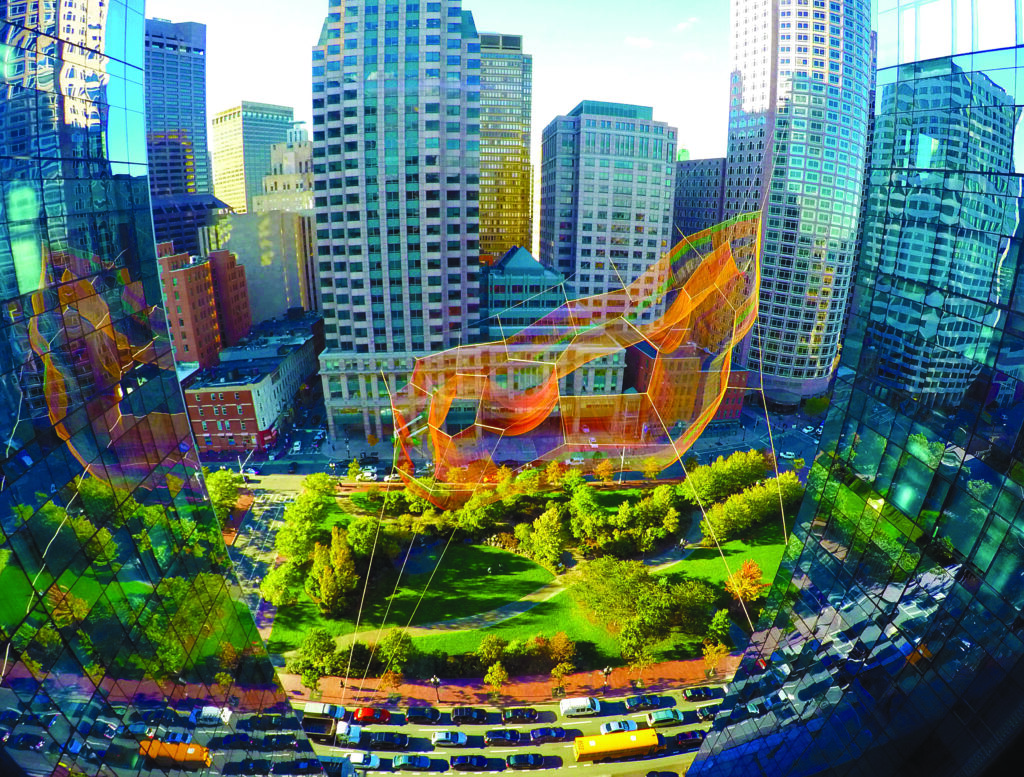
Today, her ethereal installations can be seen on a massive scale, as they shift and shimmer delicately in wind and light, and their radiant colors are often mutated by light projections when day turns into night. She counts permanent installations at institutions all over the world, in places like the Bill and Melinda Gates Foundation in Seattle and Dilworth Park in Philadelphia, and she has received commissions from locales as varied as the Rose Kennedy Greenway in Boston and the Vancouver Olympic Winter Games speed-skating venue.
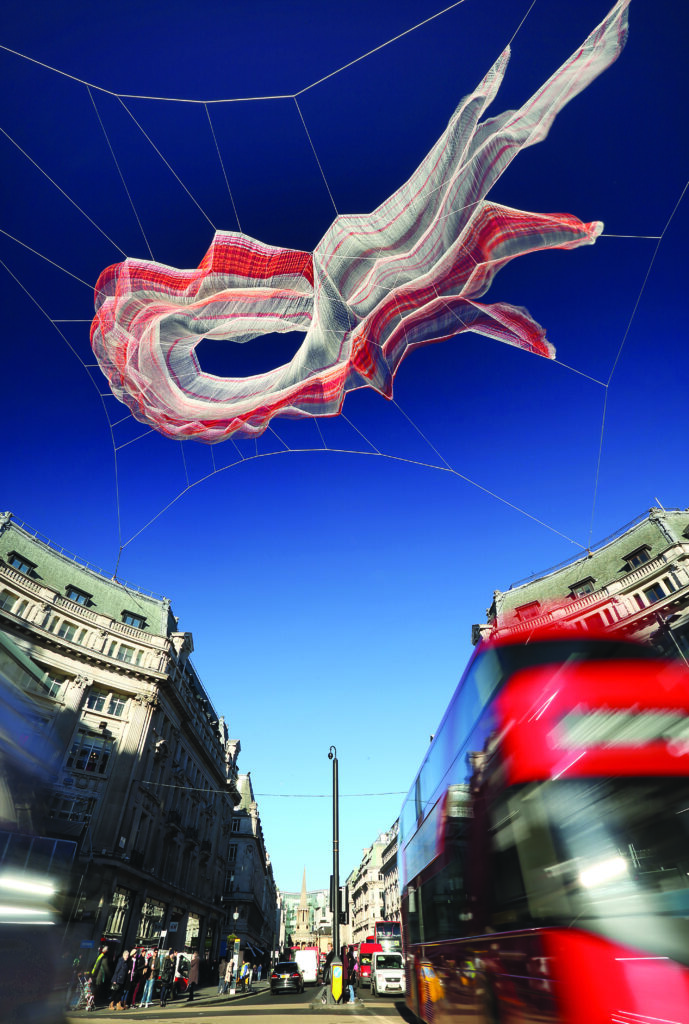
Ever since working alongside those Indian fishermen on her first series of netting sculptures, Echelman has continued to seek out a range of professionals in a variety of fields to help fuel her technologically ambitious visual wonders—fields which include aeronautical and mechanical engineering, architecture, lighting design, landscape architecture, and fabrication. A piece titled 1.8 London from 2016, which was suspended between buildings 180 feet above awe struck onlookers at Oxford’s Circus in London, is a good example of just how collaborative Echelman’s work can be. A joyful piece of red, orange, and white fabric, it danced across blue skies during the day and was enlivened by a new palette of brightly projected lights at night. To get 1.8 off the ground—literally—Echelman had to work alongside an engineer, a software engineer, a festival production company, a lighting specialist, and other experts. In the end, the visual magic created by 1.8 London made all of her efforts worthwhile.
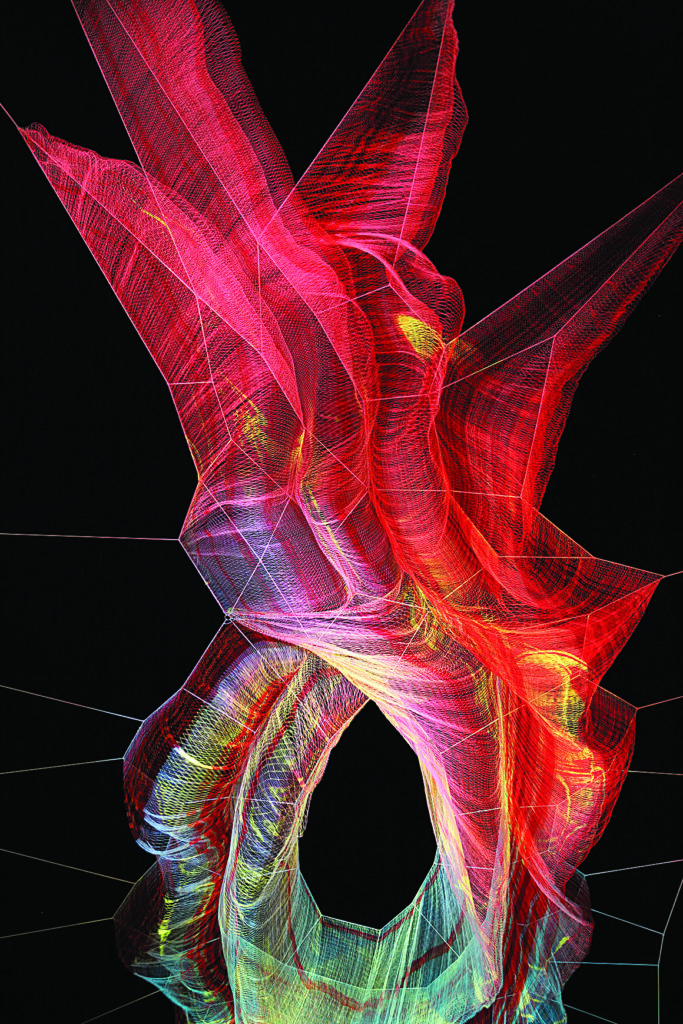
Her latest piece, 1.8 Green Mountain Falls, will be unveiled this summer at the eleventh-anniversary edition of the Green Box Art Festival: a 150-foot-long floating form made of soft-fibers that will span Gazebo Lake Park in idyllic Green Mountain Falls, Colorado.
“With the outdoor installations, I really want to challenge people. I think some people feel like art isn’t for them because they don’t like art museums, but not everything has to be viewed in that context,” says Julie Maguire, curator for the arts festival.
The Green Box artwork will be a reinterpretation of 1.8 London and is a part of Echelman’s Earth Time series, which takes the number of microseconds that an earth-day is shortened after a single earthquake—1.8—and uses it as a jumping off point for the artist to design her mesmeric creations.
“The monumental floating form will move with changing wind and weather to create a choreography of undulating color,” Echelman says, “and at night, the sculpture pulses alive with projected colored light.” Like the earthquake that inspires it, this work references “the complex interaction of the many systems of our physical world with one another and our experience of time,” according to Echelman.
Her work is clearly influenced by many modern masters of color and line such as Alexander Calder, Eva Hesse, and Mark Rothko, but the conceptual framework of Echelman’s art also connects with interventionist sculptors like Gordon Matta-Clark and Robert Smithson and collaborative performers like Trisha Brown and Robert Rauschenberg.
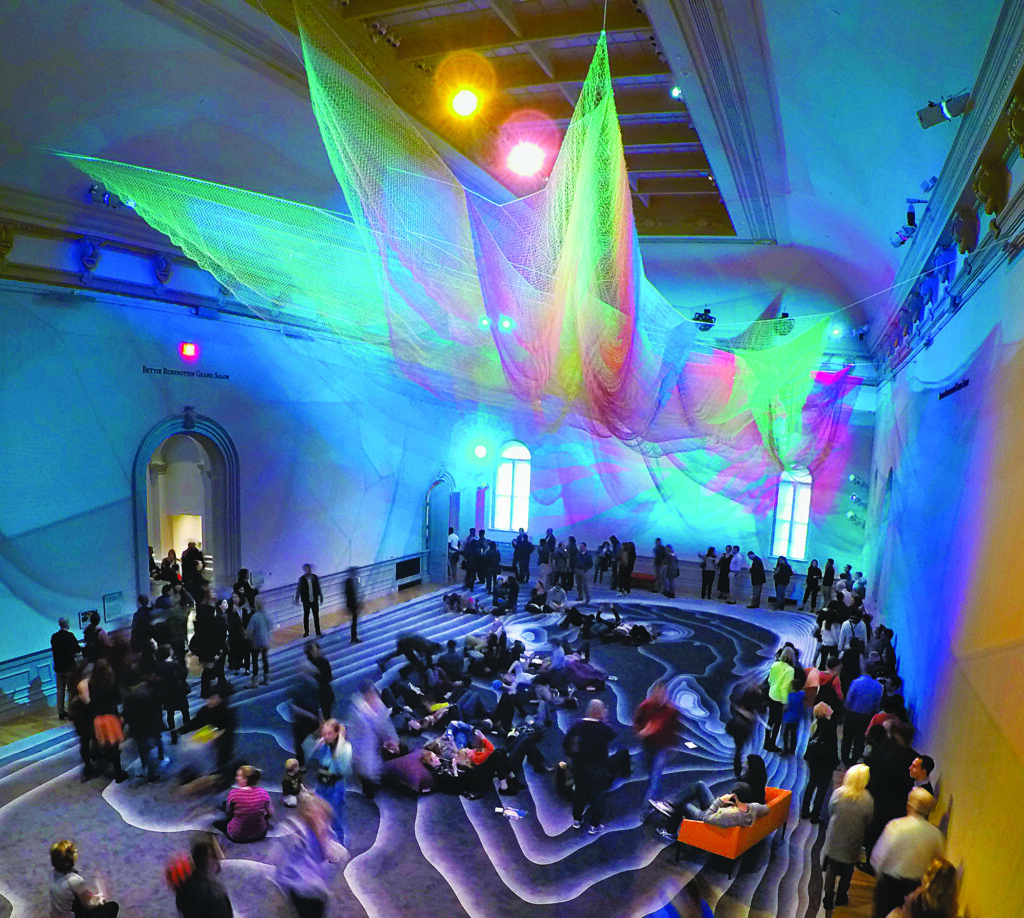
“The spectacle of the work seemed like it would be able to hold its own in the beautiful Colorado setting,” says Maguire. “I was happy to find a woman working at the scale Echelman works. I also liked the idea behind the piece, that such a brief moment in time can impact the entire world.” Unsurprisingly, the nature of our world—both on a macro and micro level—is Echelman’s biggest inspiration. “I look at the patterns of life and living systems, the measurement of time, weather patterns, the paths created by fluid dynamics, or a city’s subway system moving in real time,” she says. “I am constantly in search of inspiration from 1.8 Renwick (2015) was commissioned by the Smithsonian American Museum of Art in Washington, DC, and has since been acquired for the museum’s permanent collection. daily life. I guess this is my way of making sense of the world—finding a tiny little moment within the larger unfolding story of humanity on our planet.”
In the lush green surroundings of Green Mountain Falls, which will provide a natural environment for the installation, Echelman’s themes of interdependence and natural cycles should ring even truer. “When any one element in the sculpture’s network moves, every other element is affected,” she explains. “The artwork reminds us of our complex interconnectedness with larger cycles of time and the systems of our physical world.” And perhaps even each other.
Janet Echelman’s 1.8 Green Mountain Falls will be on view this summer at the Green Box Arts Festival in Green Mountain Falls, Colorado, July 4 through July 13, 2019. greenboxarts.org