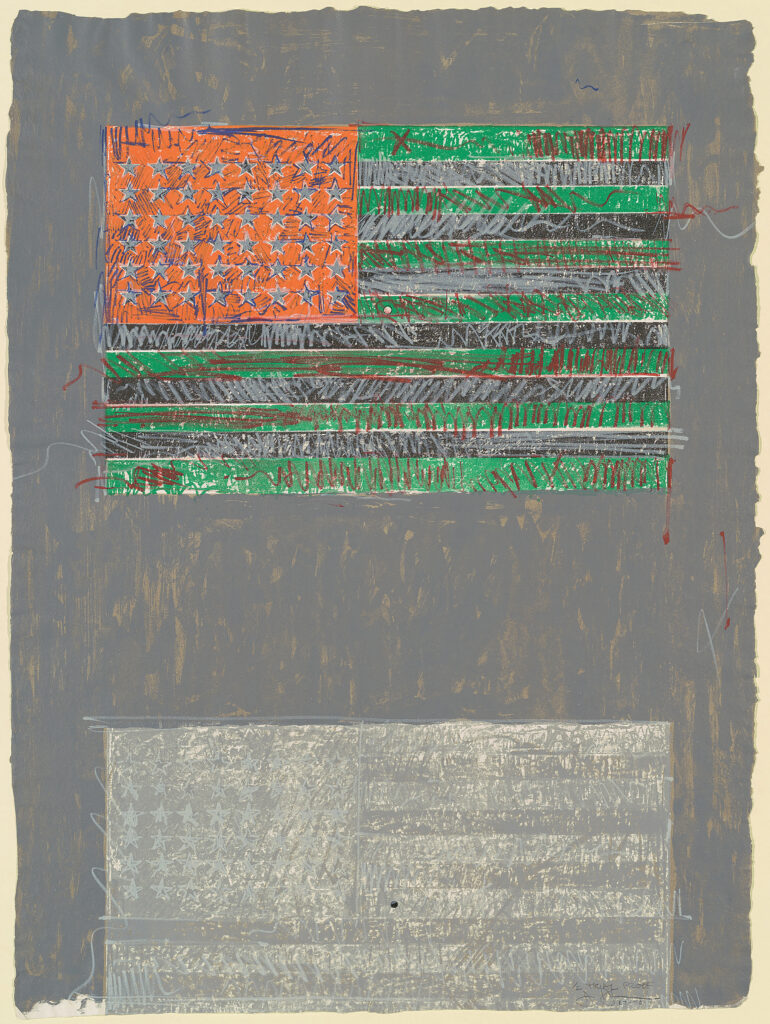
JASPER JOHNS HAS painted the stars and stripes of the American flag since the 1950s, abstracting them from one of the world’s most familiar symbols through their repetition. He stated that, in its ubiquity, the national emblem was something “seen and not looked at, not examined.” During the Vietnam War, he created Flags with Universal Limited Art Editions. The print depicts two American flags: one sickly green, black, and orange, with a small white dot in the center, above a grayscale version with a small black dot. Staring at the white dot and then looking at the black dot below reveals a red, white, and blue after-image, turning this embodiment of patriotism into a fleeting ghost.
“Across generations of American art, artists have approached the flag as a powerful visual motif, shaped by their own lived experiences as well as the broader social and cultural contexts in which they were working,” says E. Carmen Ramos, chief curatorial and conservation officer at the National Gallery of Art in Washington, D.C. “In doing so, their work traces how this iconic image has served as a throughline during periods of national transformation, cultural change, and technological progress.”
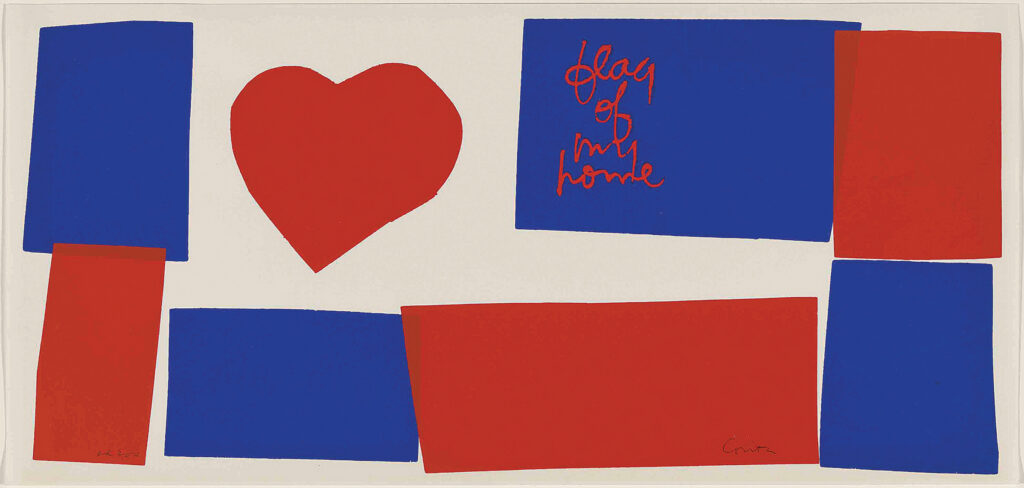
Through December 6, 2026, the National Gallery is presenting American Icon: The US Flag in Art, coinciding with the 250th anniversary of the signing of the Declaration of Independence and featuring around thirty pieces from the late 1800s to the present day. A trial proof of Johns’s haunting flag print is displayed among works by Gordon Parks, Childe Hassam, Dorothea Lange, and Faith Ringgold, expressing both pride and protest across shifting political tides. In 2021, the museum acquired Ringgold’s visceral The American People Series #18: The Flag Is Bleeding (1967), one of her many works that engaged with the flag’s potency. Created amid racial violence during the civil rights movement, the painting questions whether the American flag can ever truly be a banner of peace.
More recently, the Oklahoma-born artist Ed Ruscha painted Our Flag (2017), depicting the American flag in tatters against a murky sky. Others have created alternative versions that, like Johns’s optical illusion, challenge the solidity of this icon. In 2021, Austin-based artists Adrian Aguilera and Betelhem Makonnen installed the washed-out untitled (a flag for John Lewis or a green screen placeholder for an America that is yet to be) at Tulsa’s Philbrook Museum of Art in honor of the late congressman’s fight for justice. David Hammons’ Untitled (1990) flies outside the new Studio Museum in Harlem, merging its form with the colors of the Pan-African flag to claim a place for marginalized people in the freedom it symbolizes. Now, as the United States becomes increasingly fragmented, artists continue to grapple with what values “Old Glory” represents—and whether the flag can ever stand for a country indivisible rather than divided.