Pregnant Pause
Teen pregnancy prevention takes center stage with federal funding woes met head on by leadership in the education and medical communities.
2020 VISION
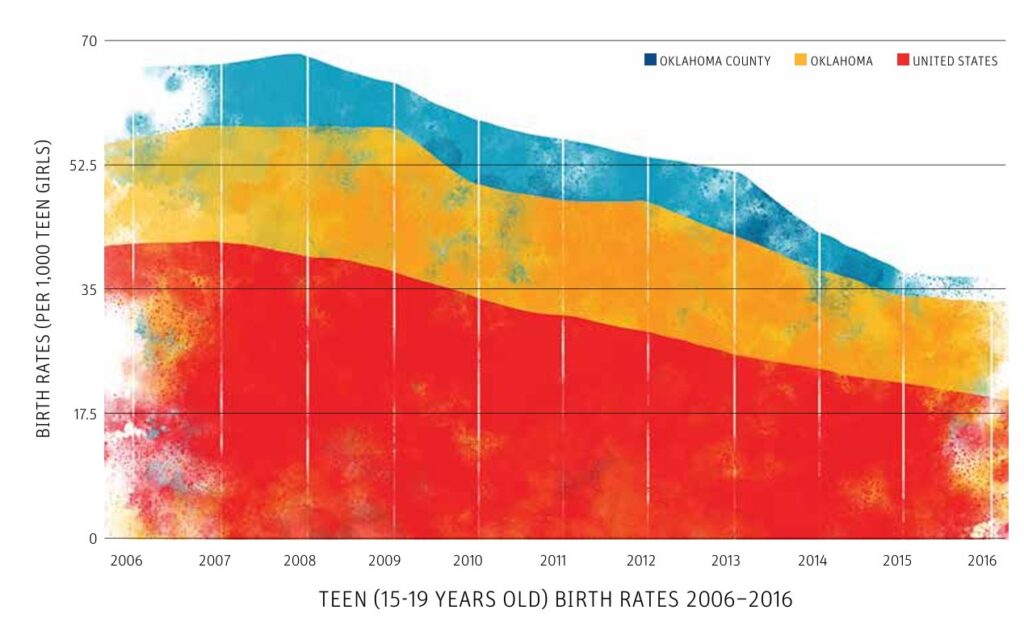
As shown in the graph above, despite the sharp decline in Oklahoma County’s teen birth rate beginning in 2013 (the baseline year for Thrive’s Comprehensive Plan), the county still outpaces the national average. The birth rate equals the number of births per 1,000 girls.
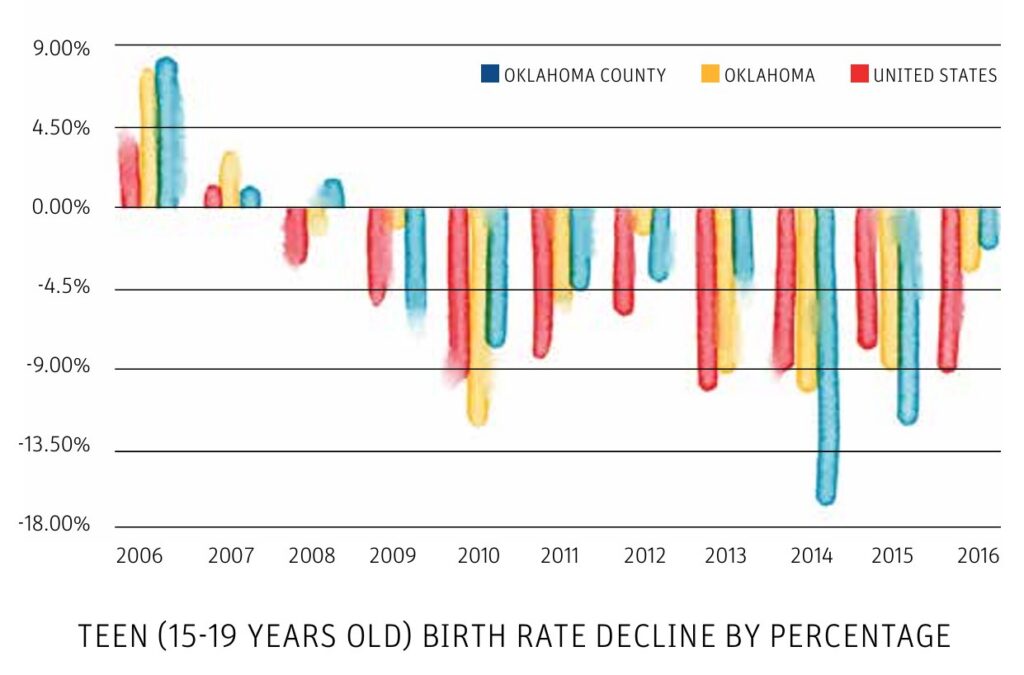
Below, local interventions produce significant results—the rate of change in the teen birth rate for Oklahoma County shows significant progress since Thrive’s community engagement in 2013.
The Oklahoma data is compiled from the OK25SHARE Vital Statistics website, and the United States data is gathered from CNN and the National Campaign to Prevent Teen Pregnancy.
Despite tremendous progress, the US Department of Health and Human Services Office of Adolescent Health announced in July 2017 it is ending its evidence-based Teen Pregnancy Prevention (TPP) program. TPP provides funding for evidence-based sexual health programs nationwide. This move puts communities across the United States at risk for losing the momentum achieved over the last seven years.
These five-year research grants will end on June 30, 2018, in year three, rather than carrying out the intended
time frame and completing evaluation results. The Personal Responsibility and Education Program (PREP) also remains at risk.
With more than 200,000 teen births reported in 2016, the United States has one of the highest teen birth rates in the industrialized world. After decades of steady decline, rates have now hit the lowest point since the government began collecting consistent data on teen births. According to the National Campaign to Prevent Teen and Unplanned Pregnancy, the teen birth rate has dropped by 67 percent since its most recent peak, in 1991.
Significantly, the largest and most rapid teen birth rate declines have occurred since the implementation of the TPP and PREP programs. The $114 million allocated for a new evidence-based TPP initiative in the Labor- Health and Human Services, Education and Other Agencies appropriations bill, signed into law in December 2009, marked the first large-scale investment by the US government for research- and evidence-based teen pregnancy prevention methods, according to “Abstinence-Only Education and Teen Pregnancy Rates: Why We Need Comprehensive Sex Education in the US,” published in PLOS ONE, a multidisciplinary research journal.
As a result, the teen birth rate dropped 41 percent between 2010 and 2016, according to the National Campaign to Prevent Teen and Unplanned Pregnancy, which is nearly twice the rate of decline of any other six-year period.
Community-based and statewide coalitions have formed throughout the nation and provide local interventions that can significantly reduce teen birth rates and improve the health and well being of the community.
With one of the highest teen birth rates for many years, Milwaukee has reduced its rate by more than 60 percent since 2006 through a community-wide collaborative approach.
The state of South Carolina reduced its teen birth rates over more than two decades, through a set of interventions that include evidence-based teen pregnancy prevention curricula and by engaging teens, their parents, and other key community members in its prevention efforts. South Carolina’s approach also makes sexual health medical care available and sensitive to the needs of teens.
Oklahoma provides another set of collaborations that are making headway on the statewide teen birth rate which is currently the second highest in the nation.
Thrive, a sexual health collective for youth in central Oklahoma—for which I serve as CEO—leads a public-private collaboration with the objective to reduce the teen birth rate in Oklahoma County by one-third by 2020. Following a comprehensive strategic plan called “As a Matter of Fact: Central Oklahoma’s Plan to Reduce Teen Pregnancy,” the collaboration has already made a significant dent in the area’s high teen birth rates, realizing a decline of 29 percent from 2013–16.
The plan has three domains, referred to as pillars: education, medical, and community. The education pillar aims to provide students with an age-appropriate, evidence-based sex education curriculum, focusing on school districts with the highest teen birth rates. The medical pillar’s goal is to develop and market teen friendly family planning services. And finally, the community pillar plans to engage youth, parents, families, faith communities, and youth-serving nonprofit organizations in the planning and implementing of teen pregnancy prevention efforts.
Thrive is the leader of the collaboration, which includes key partners Variety Care (a local Federally Qualified Health Center with multiple locations), the Oklahoma City-County Health Department, local sexual health education nonprofit Teen emPower!, Oklahoma City Public Schools, the Oklahoma Health Care Authority (the state’s Medicaid agency), and the Kirkpatrick Family Fund. Additionally, dozens of community organizations, professionals, and volunteers are working together to help implement the plan through a set of working groups that align with the three pillars.
On track to reach—and perhaps surpass—the collaboration’s goal prior to its self-imposed deadline of 2020, the group is slated to become another example of an effective, community-based strategy that can have significant results, despite the shifting sands of federal policy on teen pregnancy prevention.
Although federal funding has been key to the recent successes of local efforts, Thrive is taking a long-term
view of sustainability for its efforts, creating infrastructure involving both professionals and community members, seeking public and private support from diverse sources, and working on policy changes that will build community investment so it will survive and, yes, thrive for years to come.
Laura Lang is the CEO of Thrive, a campaign to prevent teen pregnancy in central Oklahoma.
Please visit thriveokc.org and thenationalcampaign.org for more information regarding
nationwide teen pregnancy prevention and sexual health.