Pig Pen
Writer Mark Essig, author of Lesser Beasts, checks in with ArtDesk about Asheville, his mother, and The Simpsons, addressing society's most vexing pig predicaments.
BY Mark Essig
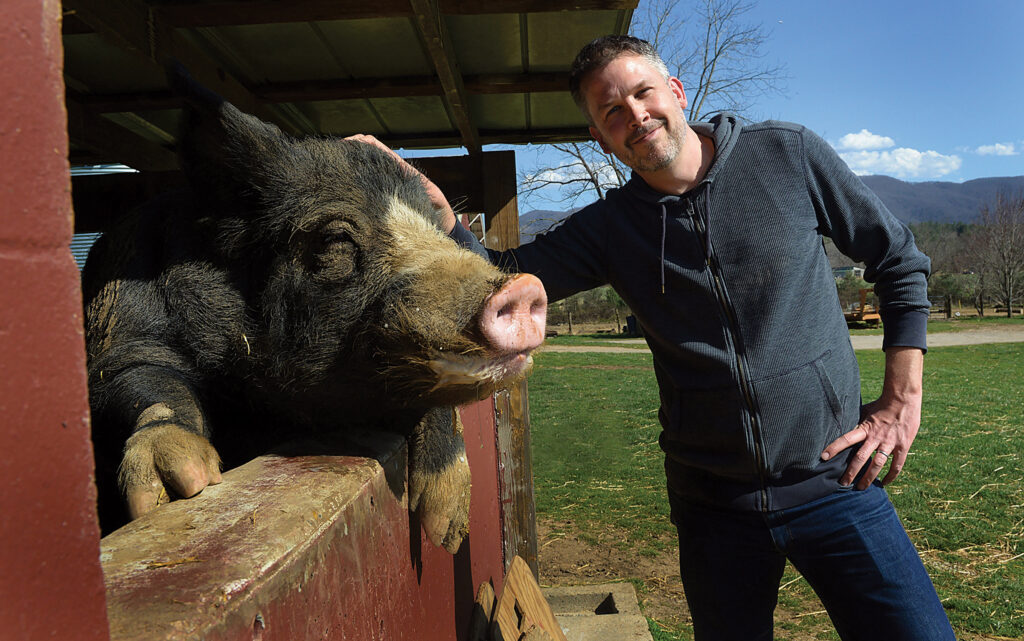
Writer Mark Essig, author of Lesser Beasts, addresses society’s most vexing pig predicaments. “We tolerate modern hog farming,” he says, “because we’re kept in ignorance of it. If we had a chance to look pigs in the eye, we might have trouble looking at ourselves in the mirror.” Here, Essig checks in with ArtDesk about Asheville, his mother, and The Simpsons.
What should everyone know about the pig?
They are incredibly intelligent. They reproduce at an astonishing rate. They will eat just about everything people eat, and quite a few things we won’t. They have been raised in forests, on pasture, in backyard sties, and in city streets. They grow to slaughter weight quickly. Their meat preserves well with salt and smoke. When slaughtered, their squeals will pierce your soul.
What prompted you to write Lesser Beasts?
In 2007, I moved to Asheville, North Carolina, and started reading local history. I learned that every winter as many as 150,000 hogs walked through the center of town. My first reaction was sheer delight. We’ve heard of cattle drives and cowboys. Did this mean there were pig boys, and did they lasso pigs?
But I discovered this phenomenon was serious business. Why were the pigs walking? Fifty miles to the north of Asheville, farmers were growing corn and fattening pigs. Fifty miles to the south of Asheville were the plantations of the slave South. Those plantations grew cotton, not food, and they needed to feed many enslaved workers.
On one side of the mountains was the supply of pigs, on the other side was the demand, and the only way to get across the mountains was to walk. In a significant sense, the global textile market depended on pigs walking across the Blue Ridge Mountains.
I found this fascinating, so I started following the pigs, and they led me all over the earth and far back in time.
What do you love the most about pigs?
They are boundlessly curious and playful. Also, they are delicious.
What worries you for pig’s sake?
The vast majority of pigs today are raised in cruel conditions. Don’t believe the experts who claim otherwise. Breeding sows are confined to tiny crates. Market hogs spend their entire lives on hard slatted floors, trampling their waste into gutters below. Pigs today aren’t allowed to live like pigs.
Do you eat pork?
Yes, but only occasionally, and only if it came from a good farm. Meat eating is so common now it’s easy to forget that a sentient animal died for your meal. I think it’s important to keep that fact in mind.
Do you have a special pig memory or story?
I’ll tell you my mom’s pig memory. She grew up in a farming community in central Missouri, and she told stories about her family’s annual pig slaughter. You can hear very similar stories from all over the world: the neighbors arriving early to help, the sticking, the scalding, the scraping, the gutting, the butchering. Salting hams and bacon, stuffing sausages, making headcheese, which they called souse because they were German. And then feasting on ribs and liver and other organ meats.
To me it sounded wonderful, and I wished I’d been born in time to see it. But my mom had hated it, because of the gendered division of labor: her job was to clean the intestines, which were used as sausage casing. Processing a pig was dirty work, and the most disgusting job fell to her because she was a girl. She resented that, and who could blame her?
Do you have a favorite pig pop culture moment?
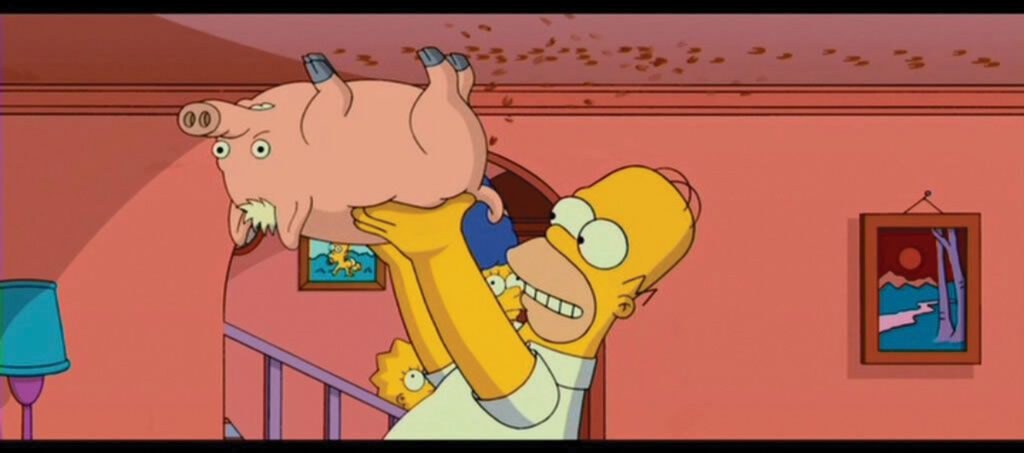
The Simpsons is good on pigs. I sometimes find myself singing Homer’s “Spider-Pig” song. And I highly recommend the episode where Lisa goes vegetarian.
Do you know any pig jokes?
I do! This one’s in my book. While visiting a farm, a man spotted a pig with a wooden leg. The pig, he learns, has saved the farmer from drowning, scared away a bear, and rescued all the other farm animals from a barn fire. “Amazing!” the visitor says. “But how did he lose his leg?” The farmer responds, “Well, a pig like that, you don’t eat him all at once.”
On the Cover
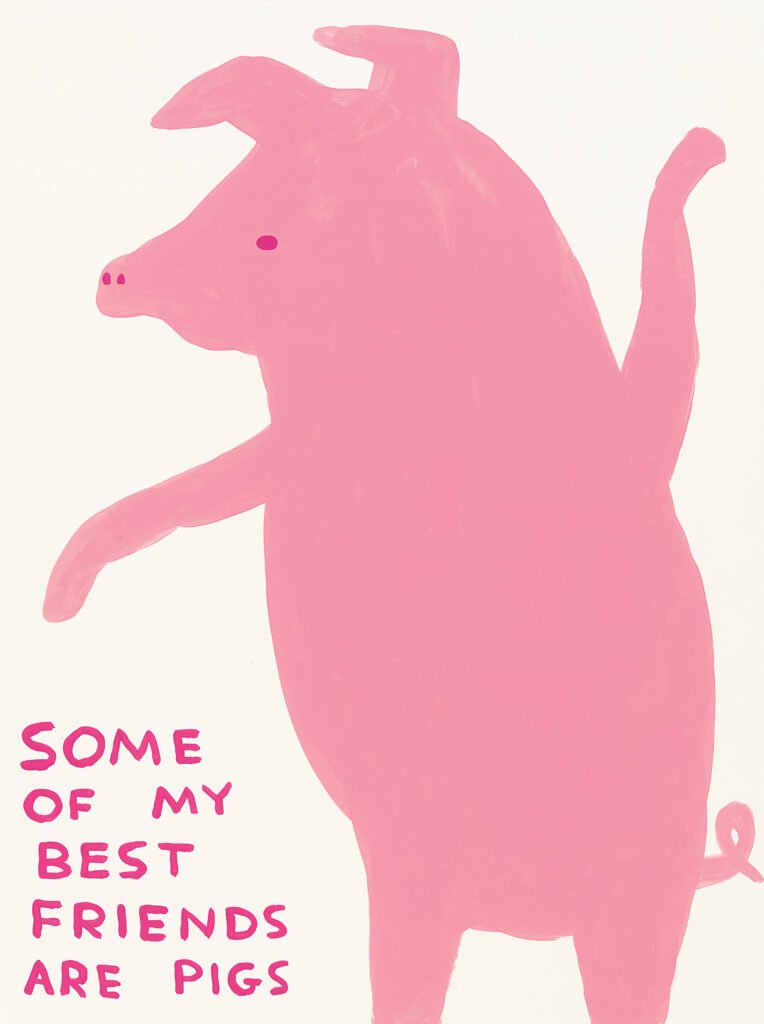
DAVID SHRIGLEY, Untitled (Some of my best friends are pigs) (2019). Shrigley’s irreverent works are currently on display in the exhibition Everything Is a Bit Shit at Extraordinary Objects, a gallery in Cambridge, England. The exhibition is a group show celebrating England’s distinct brand of humor and wit. His work last appeared in ArtDesk’s Winter 2021 issue.