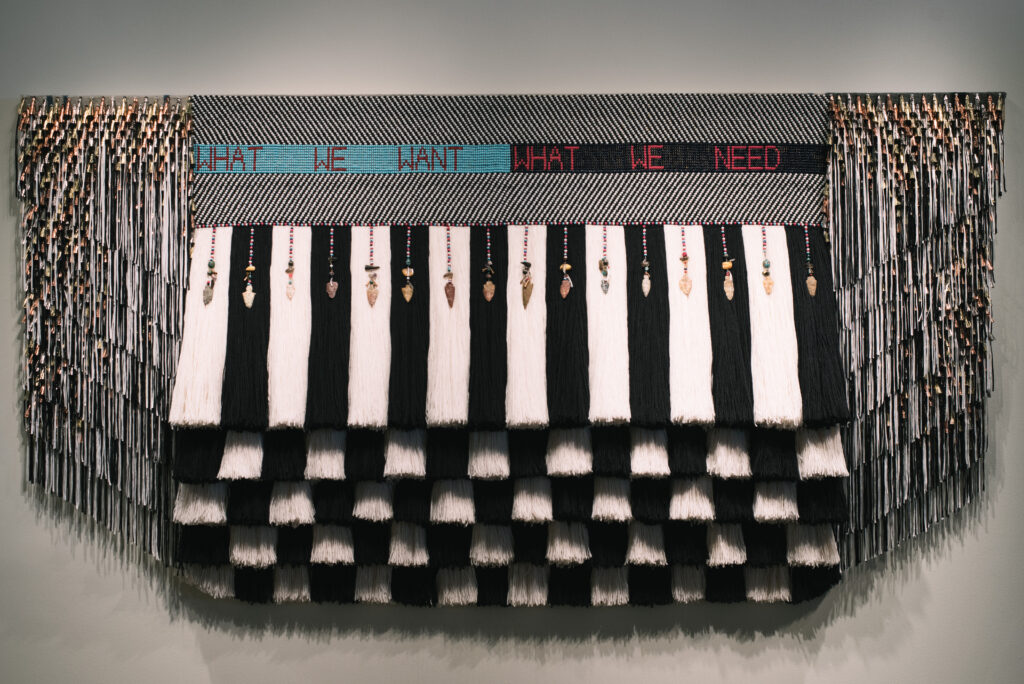
THERE IS AN “outsiderness” to Jeffrey Gibson’s work that is palpable. The half-Cherokee, half-Choctaw artist references not only our country’s first tenants via sculptures that incorporate traditional Native American materials, but also cultural motifs to both low (pop music) and high (the Bauhaus). Yet Gibson’s outsider nature is more varied and complex than even this lets on.
At forty-five, the Colorado native has come a long way since his days as an emerging painter living in New York City at the turn of the millennium. “I was feeling very unsatisfied as an artist in New York,” said Gibson the day after opening his solo show, Speak to Me, at Oklahoma Contemporary Arts Center in Oklahoma City.
Fortunately, Gibson got a much-needed break from the city when he was given a visiting-artist position at the California College of the Arts. San Francisco was incredibly welcoming to Gibson and his husband, Norwegian sculptor Rune Olsen. Years later, after a short residency in a countryside studio off the coast of Brittany in France, in 2012, he secured a teaching position at Bard College in upstate New York. Gibson has settled his base of operations in nearby Hudson, where a team of assistants diligently works on the slew of exhibitions Gibson has on the horizon.
While studying at the Art Institute of Chicago in his early twenties, Gibson worked at the Field Museum as a research assistant for the Native American Graves Protection and Repatriation Act. It was here that he found the intense and personal connection to art and artifacts he’d always been looking for—though he didn’t realize it at the time.
“My job was to collect all of these objects, put them into one room for visiting Native American tribe delegations, and prepare all of the appropriate documents so that people could research them,” Gibson says. “Sometimes elders would come in and ceremonies would take place, because they viewed some of those objects as their living ancestors, and as having not been fed or sung to in many years.”
SOMETIMES ELDERS WOULD come in and ceremonies would take place, because they viewed some of those objects as their living ancestors, and as having not been fed or sung to in many years.
This connection became crucial to how Gibson’s work would evolve.
“I had three years of these experiences which were really intense, and it overshadowed art school, to be quite honest,” he says. “I didn’t realize how much of an impact it would have, and that was what made being an artist in New York City sort of unfulfilling, because I just didn’t see art as having that level of commitment in the commercial gallery system.”
By 2012, Gibson would return to traditional Native American crafts for a series of works that became a pair of breakout shows in New York City at venerated galleries Participant Inc. and the now-defunct but influential American Contemporary. The exhibitions were an immediate hit with critics and collectors and featured objects such as larger-than-life drums and a neon-infused quiver—an object meant to hold arrows. Despite the immense success of those exhibitions, along with the growing appetite collectors have for his series of elaborately decorated Everlast punching bags—his signature artworks—Gibson is not afraid to move on from earlier ideas.
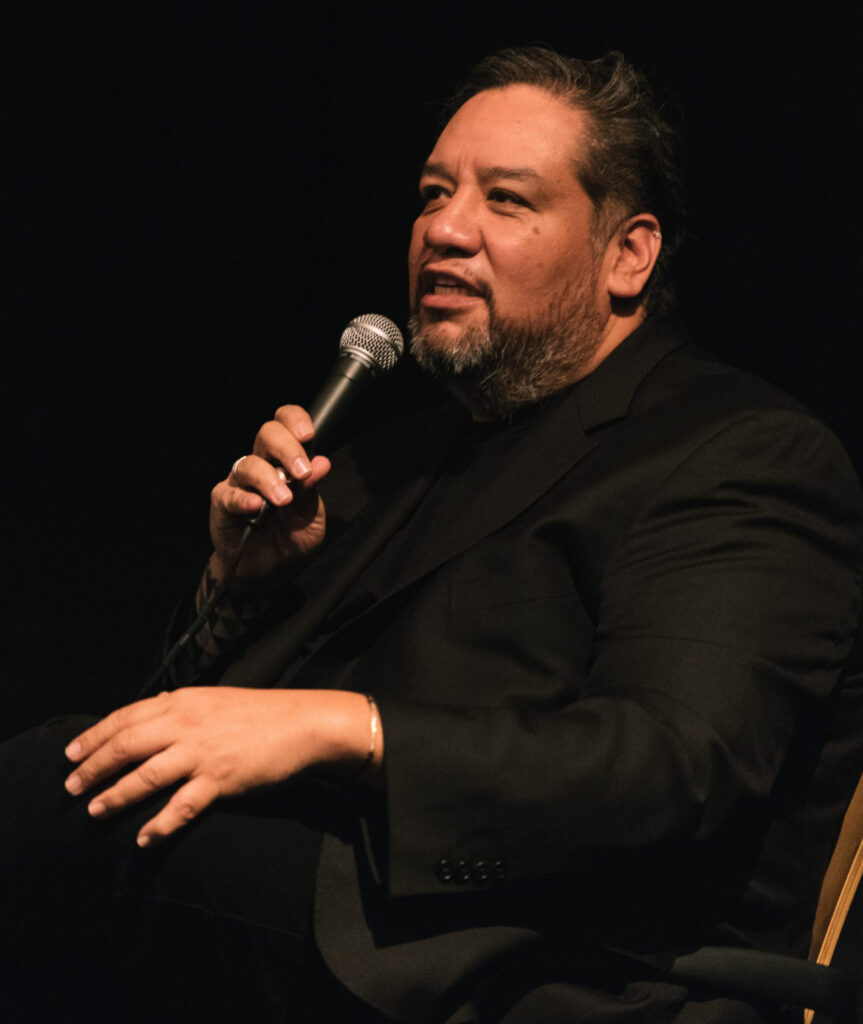
That becomes clear when you see the larger-than-life ancestral figures in Speak to Me. It’s an exhibition he’s particularly excited about, since the Cherokee part of his family—his mother’s side—is from Oklahoma. His sculptures are at once rudimentary and elaborate in their crafting: on one hand, dressed in “coats” based on traditional Native American garments adorned with highly refined handicraft, and on the other, erected with driftwood and topped with garish ceramic heads. The artist’s first-ever video piece, one becomes the other, documents a series of intimate encounters between native craft speople and historic Native American objects that have been locked away in museums around the country.
“Jeffrey’s always been interested in Native American identity, whether it’s people of a specific tribe or [Native Americans] who grew up all over the world,” says Jennifer Scanlan, curatorial and exhibitions director at Oklahoma Contemporary. “This is a proposal for a new native identity not characterized by
one tribe, but by all kinds of native ideas.”
Speak to Me will be on view at Oklahoma Contemporary Arts Center through June 11, 2017. okcontemporary.org