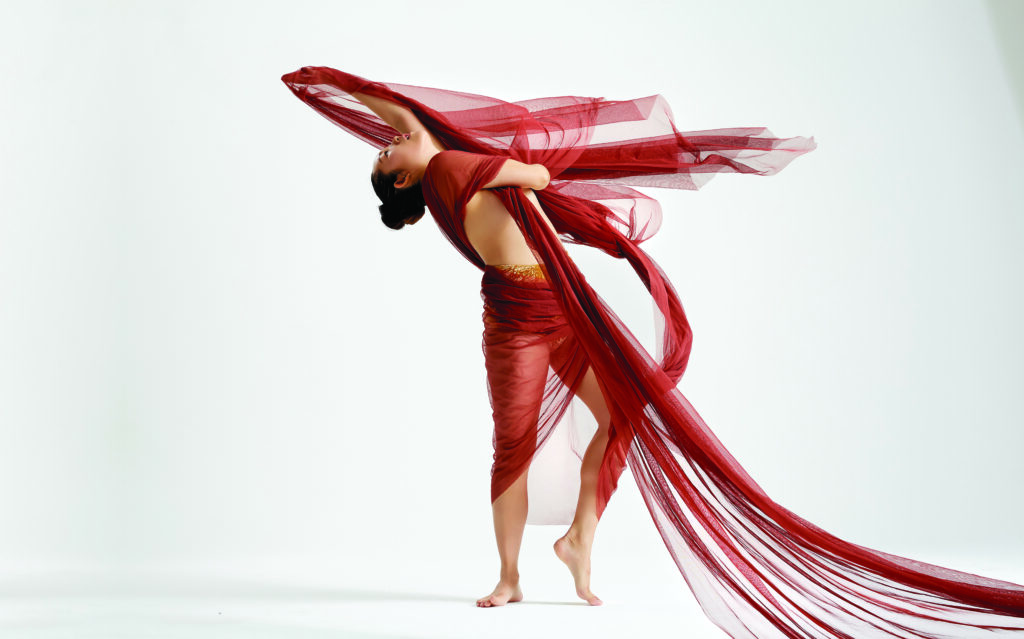
Andrea Miller’s powerhouse dance company, Gallim, is having quite a year. They’ve been tapped as the artist-in-residence at the Metropolitan Museum of Art and have a slew of upcoming performances, in Luxembourg, at the Frieze Art Festival, and at Art Basel. ArtDesk dance editor Larry Keigwin catches up with Andrea at her improvised office space—a New York City diner.
LARRY KEIGWIN: Tell us a little bit about your early life. When did you start dancing?
ANDREA MILLER: I started dancing when I was three in Salt Lake City, Utah—where I was born. I
studied at the Children’s Dance Theatre. It’s part of the Tanner Dance Program [at the University of Utah]. Virginia Tanner studied dance with [modern dance pioneer] Doris Humphrey, and instead of a choreographer or a dancer, she became an educator.
LK: For so many, an introduction to dance is through tap, ballet, or jazz. Here you are in your early formative years, studying modern dance technique.
AM: It’s such an unusual entry to dance, figuring out how to turn a story around into a physical world and characters. I moved to Connecticut when I was nine, and I somehow—randomly through the yellow pages—ended up in the studio of Ernestine Stodelle, who was a dancer with Doris Humphrey. I trained in the Humphrey-Weidman technique—Doris Humphrey and Charles Weidman—with Gail Corbin, until I went to Juilliard.
LK: So then you auditioned for Juilliard.
AM: I would never have gotten in if Benjamin Harkarvy [then director of the dance program at Juilliard] hadn’t attended a performance of the Limón Dance Company at Riverside Church. I was just so lucky enough, in my senior year of high school, to be invited to perform in Missa Brevis with Limón. Harkarvy
came backstage before the show, and I went over to him and said, “Listen, I’m applying for your school. I have no training in ballet. I have no experience in ballet, but if you would just take a look at me in this performance, I would really appreciate it. I’m going to audition in February.”
LK: I love that. You got in because he came to the show and—
AM: I hope that there was a collection of reasons, but I definitely know that helped. After I graduated, I got into Batsheva–The Young Ensemble and moved to Israel for two years.
LK: What was the impetus to start a company or to produce your own work?
AM: Since I was eleven or twelve, I always knew I wanted to choreograph. Everything that I was doing was research for when I was going to have either my own company or the life of a choreographer. I had this moment after I left the ensemble and I came back to New York. I was teaching and dancing here and there. I was like, I’m just going to do it myself. I met this other dancer, Fran Romo, who I fell in love with artistically. I watched her at a Doug Varone workshop, and I remember asking her at the end of the week, “Do you want to dance with me?” And she became my co-founder of Gallim. That was ten years ago.
LK: So this is your tenth year with your own group! Having the perspective of ten years, what are the benefits and the challenges of having your own company?
AM: I would say to my younger self or other people who are thinking about it to be aware—you’re becoming an entrepreneur when you dive into this way of art-making. Making a business relevant and making a business thrive is its own art form and science.
LK: There becomes a rhythm to the creative process. And some of that rhythm might be not knowing. I sometimes try to remind myself that there’s great wisdom in uncertainty.
AM: Completely. You get better at understanding risk and the potential within some uncertain
environments. Some are set up in a way where things can spark. In other uncertain environments, the variables are going to just be chaos. Learning how to cultivate that place of what can be unknown, what can’t stay unknown.
LK: You are the first choreographer as an artist-in-residence at the Metropolitan Museum of Art. I was so fortunate to see a rehearsal for your debut at the Met last October, and I loved it. It was beautiful and very poetic. I thought it was such a great use of a crowd of people. Can you tell me a little bit about the work?
AM: Stone Skipping is a sight-responsive piece to the Temple of Dendur. Our goal was to make the temple feel like it was not just an artifact, but that it was alive again. When I go to see the temple, I’m fascinated by its journey from Egypt to the Met, and how it might be a metaphor for the journey, the displacement, the reinvention or continued life that things need to take on. The environment will become one of the biggest factors in rethinking or relearning how to live.
LK: In May, you’re going to premiere a new work at the Met Breuer. And you have a whole floor. Is that correct?
AM: I do. I have the whole fifth floor. I’m so lucky. I had many, many ideas when I came to Limor [Tomer, general manager of the MetLiveArts performance series] about what I’d like to do at the Met. It’s in response to an exhibition downstairs called Like Life, a look at the history of sculpture and its take on the body in form and color and identity. We’re also looking at the body, not the actual fleshiness of the body or the shape of the body, but more of the soul and the intangible state, the chemistry—the things that have shaped who we are as humans.
LK: Amazing. Do you have any dreams that you’d like to share?
AM: I have a lot of dreams that I’m playing with. I worked on a film, and I would really love to have another opportunity to do more in film. In the future, I have this idea for a Broadway or Off-Broadway show. I’m going to just say it. Put it in the universe.
LK: Sometimes I feel like I say something and then I have to prove myself, but it’s nice to just say something and wait or watch for it to happen.
AM: Yes. Absolutely.