One Public
Writer and professor Kevin Landis on physical theater, clown, and the deep New York history behind The Public Theater, excerpted from his book One Public.
BY Kevin Landis
Kevin Landis is a writer, professor, and director of the Theatre and Dance Program at the University of Colorado, Colorado Springs. We spoke with Landis about his new book (excerpted below), One Public: New York’s Public Theater in the Era of Oskar Eustis, out November 17, 2022.
As a professor and acting instructor, your teachings lean toward the physical schools of acting and performing. Is there something in these classes that a non-actor could use in everyday life?
Absolutely. As I tell my students, contemporary society teaches us that we are brains on tripods. We hunch over computers and stare into our phones and often forget the beautiful reality of our full selves. Physical theater training reacquaints the actor with their body, as a location of creative impulse. So many magical moments in theater come not from intellectualizing through a speech, but by feeling something in the body and allowing that to be the launch pad in understanding a character.
I also teach clown. People outside of theater think that sounds pretty silly for a college education. But it’s not. Clown teaches us to look at our full selves and take stock of all that is beautiful and ugly in the human essence. It’s hard work, emotionally taxing, but I think it is extraordinary in the development of an attuned actor. There is no reason why that couldn’t apply to anyone.
What prompted you to write about the Public Theater?
I believe there is no company in the country as innovative and socially conscious as The Public. When I [went there] on sabbatical, I decided I wanted to create an oral history of the company … and started interviewing people in the Public family.
As I started the archive, with early interviews with Kevin Kline, Jesse Tyler Ferguson, Justin Vivian Bond, and other legends of theater, I realized I was in the middle of what could be an amazing story. About two years ago, I started writing and One Public is what developed.
An abbreviated excerpt from One Public
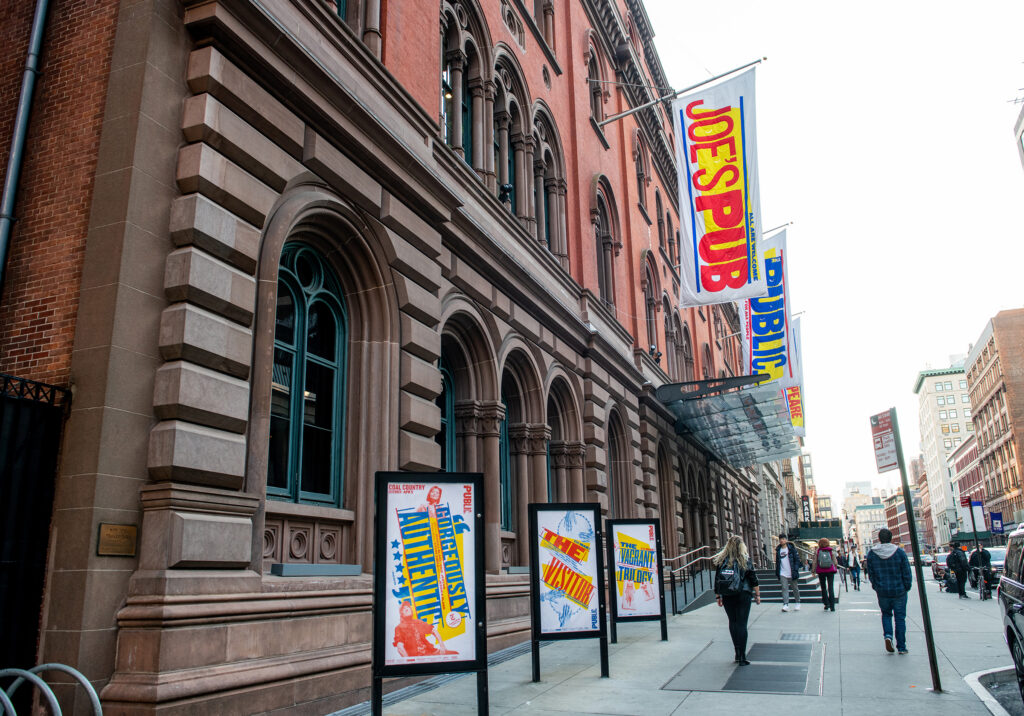
THE HISTORY OF THE library in Astor Place is gloriously and richly “New York,” and once known, it is difficult not to read its history into everything that happens there.
In An Historical Sketch of the Old Astor Library Building 1895, 1980, 2002, Dan Dalrymple tracked the history of The Public. In an elegant foreshadowing of the mission of The Public, the land upon which it stands was first granted to the slaves of the West India Company in 1640. By 1804, it was purchased by John Jacob Astor and subsequently leased to create the Vauxhall Gardens, a verdant pleasure park based on its London namesake, with its first public manifestation being a location of musical performance.
Continuing its deep history as a location of entertainment, what remained of Vauxhall, which was almost precisely on the spot of the present-day Public, was leased to the great circus impresario, P. T. Barnum. Eventually, however, the area was urbanized, and, according to the will of Astor, $400,000 was allocated for a library to be built on the site. The project was overseen by the Harvard librarian, Joseph Cogswell, who would be the original curator of the holdings. Over the years, three architects, Alexander Saelzer, Griffith Thomas, and Thomas Stent, designed and built the sections of the structure that now stand on the spot.
It is well to imagine the Astor Library as you stand at the entry of The Public Theater, a place now known for its dedication to diversity, free Shakespeare, and universal access. While that was the mission of Cogswell library, when it opened it was not a circulating library, and due to hit and miss electricity, it closed when it became too dark to read.
In 1895, as the Astor Library outgrew its space and plans were being hatched for the future of public libraries in New York, The Astor, with its 260,000 volumes, closed its doors to the public. By 1897, the trustees partnered with their counterparts at the Tilden Library and the Lenox Library and formed what would become the New York Public Library. While it operated temporarily out of the building on Lafayette, it relocated to its permanent and current home on 5th Avenue and 42nd Street in 1911. The building at 425 Lafayette Street would stand vacant for eight years.
The second tenant looms just as powerfully to this day in the moral and cultural makeup of The Public. In 1920, the building was purchased by the Hebrew Immigrant Aid Society (HIAS) and was subsequently opened as a space to shelter new Jewish immigrants to the United States and aid in their immigration processing. To accommodate the influx of immigrants and the new necessities asked of 425, the grandeur of the library was lessened; the central staircase was taken out, and spaces were turned over to create offices, a dining hall, and a synagogue. For forty-four years, 425 Lafayette was a safe house of sorts, registering over 250,000 immigrants through the height of the Second World War and the regime of Adolf Hitler. However, after the war, the need for the large building lessened for HIAS, and by 1964, the organization moved uptown, and the Astor Library was again vacant.
When HIAS sold the building to a developer, its razing was all but assured. Enter Joe Papp. To assure its historical status, the building needed an interested owner, and as Ken Turan describes, Papp and his associate, Bernard Gersten, arrived just in time. The two theater-makers, already famed for their New York Shakespeare Festival, toured the building and found it to be a shell of its glory days; skylights boarded up, dust and debris, overseen by a single caretaker, Arthur Abraham, who had stayed on from the HIAS years.
But the old structure—sitting as it was on the site of a former slave sanctuary, a location of an English-styled pleasure garden where P. T. Barnum produced spectacles, and the site of the first major library in New York and the landing place of European Jews—seemed just right for what Papp wanted for the permanent home of the Festival. With an interested champion, and the newly created Landmark Preservation Commission, 425 was close to being spared. Helped by a donation from Florence Sutro Anspacher, Papp secured $250,000 toward the $575,000 asking price. With partial funding, Papp also lobbied the newly created Preservation Commission to allow renovation, and it was granted on the grounds that while he could renovate the interior, the façade had to remain as it was. Papp was to invest $1.8 million into renovations, with subsidies from the City of New York. For the first time, tickets would have to be put on sale to help pay the loans.
By 1970, the City of New York agreed to cover the $2.6 million that Papp needed to cover the purchase of the building and its renovation. The Public secured a fifty-year lease from the City at a cost of $1 per year (the length of the lease was later increased). The “full circle” nature of the evolution of the Astor Place building was complete. The Public Theater would forever be owned by the people of New York.