Carina Evangelista
Model Curator
Originally from the Philippines, Oklahoma Contemporary’s recent director of curatorial affairs drives the intellectual aspects of contemporary art using her experiences at MoMA, the Sol LeWitt estate, and Chuck Close to frame, preserve, and disrupt what we know about art.
What role did the arts play in your upbringing?
I grew up in Manila during the Philippine Martial Law years under the conjugal dictatorship of Ferdinand and Imelda Marcos when art and culture were used to mask the excess and atrocities of the regime. On the one hand, it meant foregrounding art with buildings such as the Cultural Center of the Philippines, the Folk Arts Theater, and the National Arts Center. Cultural programs were made widely accessible to the public such as live performances of classical music at Concert at the Park. Art classes were also made affordable to the masses. (My sister and I personally benefited from really affordable ballet classes and free weekend art workshops.)
The Philippine High School for the Arts has produced many important figures in the visual arts, theater, creative writing, and music over the decades. On the other hand, what has been termed Imelda’s “edifice complex” with all these buildings was on the backs of impoverished citizens. Art and culture were used for propaganda while intellectual and political freedoms were throttled.
As a child, I remember there was a workshop given by an artist who made large black abstract strokes applied with a broom. I saw gestural abstraction made with a tool for sweeping dust, dirt, and dried leaves long before I knew what abstract expressionism was. The transformative use of a utilitarian object felt like a subversive thrill. It’s all in hindsight that I understood why I stubbornly stuck to being an art professional as an adult despite the challenges. I could not ignore the need to participate in the sphere where artistic practices and cultural symbols are barometers of how power is wielded or preserved as well as questioned and challenged.
My very first encounter with the creative impulse came when my mother was registering my sister for a ballet class (I was still too young to enroll at the time) and a male dancer walked into the registrar’s office, borrowed a pair of scissors, ripped open the plastic cover of a brand new white shirt, vertically sliced the bottom front of it, slapped the shirt on his bare torso, and tied a knot with the two sliced halves of the front of the shirt around his navel. I found the gesture radical.
Even before I knew what an artist was, my mind marveled at the power of transforming something with a simple vertical slice. I found the audacity of cutting something whole and brand-new as subversive. Of course the act was merely functional—tightening the shirt around the torso allowed for the line of the dancing figure to cut through the air more precisely—but to my child’s eye, it was the chutzpah of a creative spirit in a milieu demoralized with censure and impunity.
Is there a particular artwork or artist you find yourself returning to?
As a college student at the University of the Philippines, I found myself gravitating to art, theater, music, and literature, and therefore majored in humanities.
I immigrated to New York right out of college and having returned to the Philippines in 2004 and 2005 as an Asian Cultural Council fellow to research Philippine contemporary art, it was exciting to discover a very strong vein of conceptualism, but this was also not a surprise.
Conceptual art allows for the widest range of forms through which to smuggle in ideas, to expose the story of a people literally being martialed by law or might, to contest the bankruptcy of prevailing thought or struggle to defy submission to the oppression. Roberto Chabet, the recognized father of Conceptual Art in the Philippines—prolific as an artist, curator, and teacher—was a singular force that adeptly navigated both the center and the margins of the Philippine art world and made history in an art history that loves to bicker with the appetite and predilection for conceptualism that he fostered in his orbit. He was among the DIY pioneers who created spaces such as Shop Six, which mounted weekly exhibitions at the height of Martial Law.
It was an unprecedented and, to this day, unduplicated frenzy of art production, the only injunction of which was artistic experimentation—essentially the willful exercise of freedom of expression. Chabet led a series of “art-ins” that came and went too fast for censors to clamp down on and were not driven by preconceived themes to allow for the widest and wildest range of possibilities. He was nimble, sensing when the avant-garde was being co-opted and quickly seeking “the alternative to the alternative.”
If you could make sure everyone knew about one artist, who would it be?
Too many artists have equal value to me for different reasons. Howardena Pindell is front center to me right now because we’re running the screening program of her powerful short video on the history of lynching in the US, commissioned by the Shed in New York. Oklahoma Contemporary is the second venue to screen her video. We held preview screenings and community conversations at Rooted Barber + Shop, a fully operational barbershop that’s also a community space and provides visibility for artists. It was critical to be mindful not just of what to “show” in programming but of also how to listen.
Community feedback underscored the sensitivities around a difficult topic that remains relevant since 1901 when the first attempt was made to pass anti-lynching legislation in the US. More than 240 attempts in the 120 years that intervened, the bill’s passage is held hostage by a filibuster in the Senate in 2021.
Along these lines, artists like Adrian Piper, David Hammons, Theaster Gates, Mona Hatoum, Francis Alÿs, Cildo Meireles, Hajra Waheed, Felix Gonzalez-Torres, Cyprien Gaillard, and the duo Jennifer Allora and Guillermo Calzadilla are important in how they interrogate through incredibly arresting and even beautiful forms.
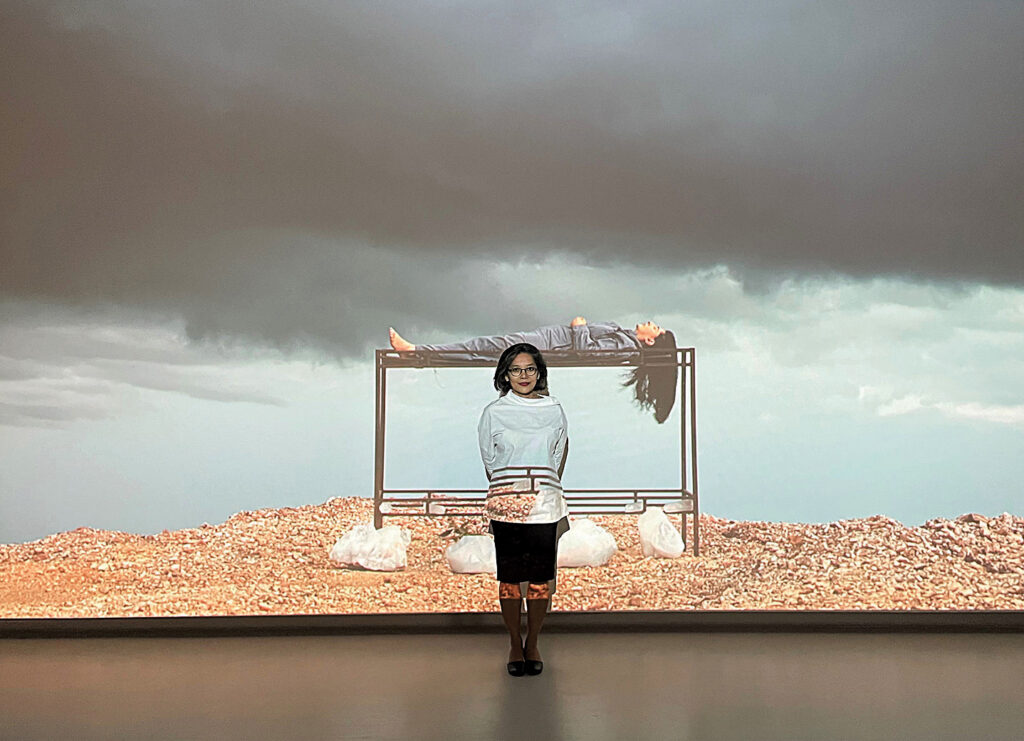
Marina Abramović is also in my prefrontal cortex as I consider the dimensions of her work being at the heart—if not the very heart—of the canon of performance art.
Besides Roberto Chabet, whom I’ve thought about since I was nineteen, there’s the late Chuck Close and his monumental faces made with infinitesimal grid units. For ten years, I worked as the editor of his catalogue raisonné. He expertly made what might be moribund in the art of portraiture so inventive and contemporary. And his legacy can be felt in schools across the country where art teachers love to teach the facture of the whole through small parts.
Cai Guo Qiang, known for “paintings” using the sky as canvas and gunpowder as medium, creating beauty from what creates wars and destruction—or, in his words, “using poison to conquer poison” or “fire against fire.” His father Cai Ruiqin a collector of old books and manuscripts, loved calligraphy and traditional landscape painting.
During the Cultural Revolution that banned traditional art and classical literature, he mourned the books he had to burn in his basement, practiced calligraphy with sticks in puddles, and painted landscapes on the insides of matchboxes. Cai the son referred to the ephemeral writing in water as “invisible skeins of sorrow;” and of the matchbox landscapes said, “A small space can easily be filled with the corners of the earth.” Asked what those miniature paintings were, Cai the father answered, “Home.” Sorrow could be tinder for expression.
The Filipino filmmaker Lav Diaz illustrates this only too well in the slow cinema for which he has won critical acclaim, including at the 2016 Berlin International Film Festival, where jury chair Meryl Streep stated that viewing his film “changed the molecule system of my body.”
Where Cai Ruiqin compressed home in the smallest of spaces, Diaz expands cinematic time to house the ravages of Philippine history, filling the screen with long, slow takes of individual forbearance against the weight of centuries, of colonial battery, of totalitarianism and fundamentalism, of ideological perversions.
His framing of brutality—typically off-screen or obscured from direct view and stark naked of any soundtrack—captures Hannah Arendt’s characterization of “the banality of evil.” In its banality lies the horror of evil.
And then there’s Whang-Od, the 104-year-old tattoo artist of the Kalinga indigenous group from the north of the Philippines. She taps charcoal and water into skin with the thorn of a citrus tree. She broke the patrilineal tradition by teaching the art only to women.
Finally, the bowerbird that creates such marvelous cathedrals built for courtship with twigs, flowers, seeds, shells, and found objects like cobalt-blue bottle caps.
Tell us about your transition from curator to artist.
Chabet nudged me in the direction of making art for years, but I was too busy trying to survive in the nonprofit art world to even consider it. I became an artist only in 2017 upon the instigation of Gerardo Tan, an artist friend in Manila (and the next Philippine representative to the Venice Biennale) who had nagged me for twenty years to make art.
My small body of work threads together historical or art historical references with text, in creating or abstracting codes, and in transmuting symbols to add new layers of meaning. I have had a word etched on the back side of my front teeth legible through lingual reading, carved charcoal bricks, delivering delicious cake that looked like black lung disease to guests to eat at an exhibition opening, pressed poisonous ink out of ripe pokeberry fruit, mounted Braille dots that read “Wet Pain” using broken mirror shards, produced a short animation film of birds dancing following the pattern of a child’s hands conducting the Philippine national anthem, projected video of a candle that flickered to Morse code in a turret doused with the essential oil of the frangipani (the flower traditionally used for funeral wreaths), among other things. Each work, anchored on very specific references, tells a story.
The most recent work I made is a textile print of the bird’s-nest fern in the publishing office in New York I worked at after months of mandated sheltering in place in the city meant dust had collected over our office desks and the office plants had died. Parched to death and brittle, the “corpse” of the plant looked bathed in a golden glow in the shaft of sunlight on its windowsill perch. There was something extremely moving in how it almost looked as if it felt relieved to be finally regarded by human eyes after months of neglect. When a plant dies in a shuttered urban jungle, does it shudder a sound?
I have been very fortunate in the unstinting support from my husband, James Kopp, himself an artist and songwriter whose particular way of seeing and studying the world has been a reservoir of wisdom and wonder for me and whose quiet but distinct sense of self is rock solid.
What is your favorite color and why?
OSHA orange—for high visibility, for hazardous materials, for the dystopian landscape choked in orange haze in Blade Runner 2049, for Andrei Tarkovsky’s burning house, for the heart-shaped nightingale persimmon, for crab and salmon roe, for goldfish and koi, for marigolds and monarch butterflies, for sunsets and autumn leaves.