A WALK IN the park never looked so good.
The artist Erwin Redl—who works in a variety of mediums including light installations, graphic design, computer art, video, and even electronic music—will bring his mesmeric brand of art to Campbell Art Park in Oklahoma City in October, courtesy of the Oklahoma Contemporary Arts Center.
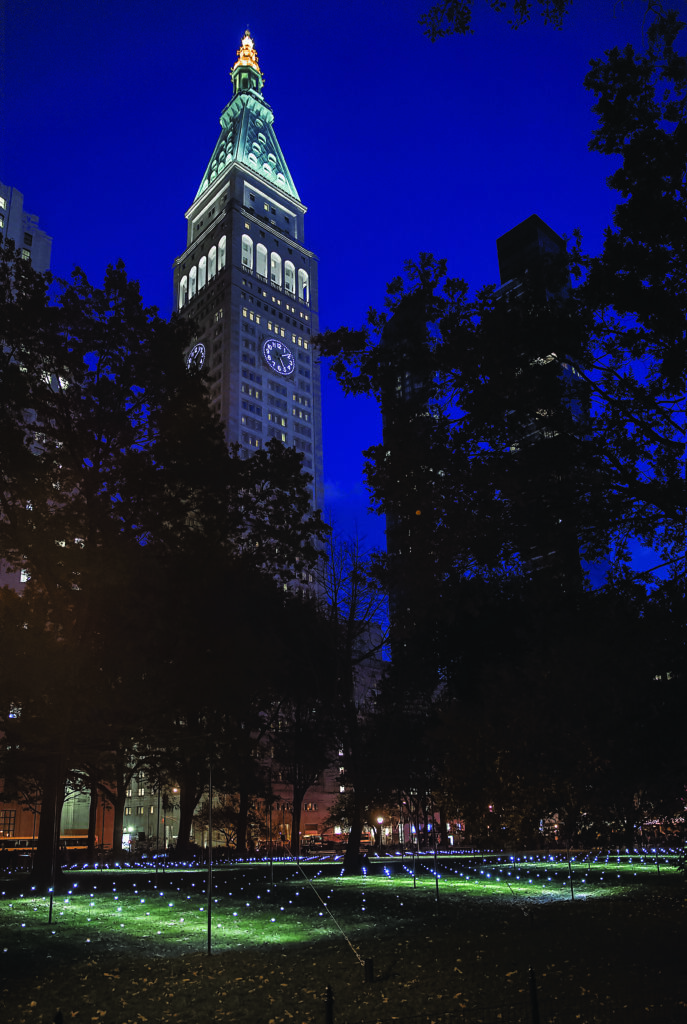
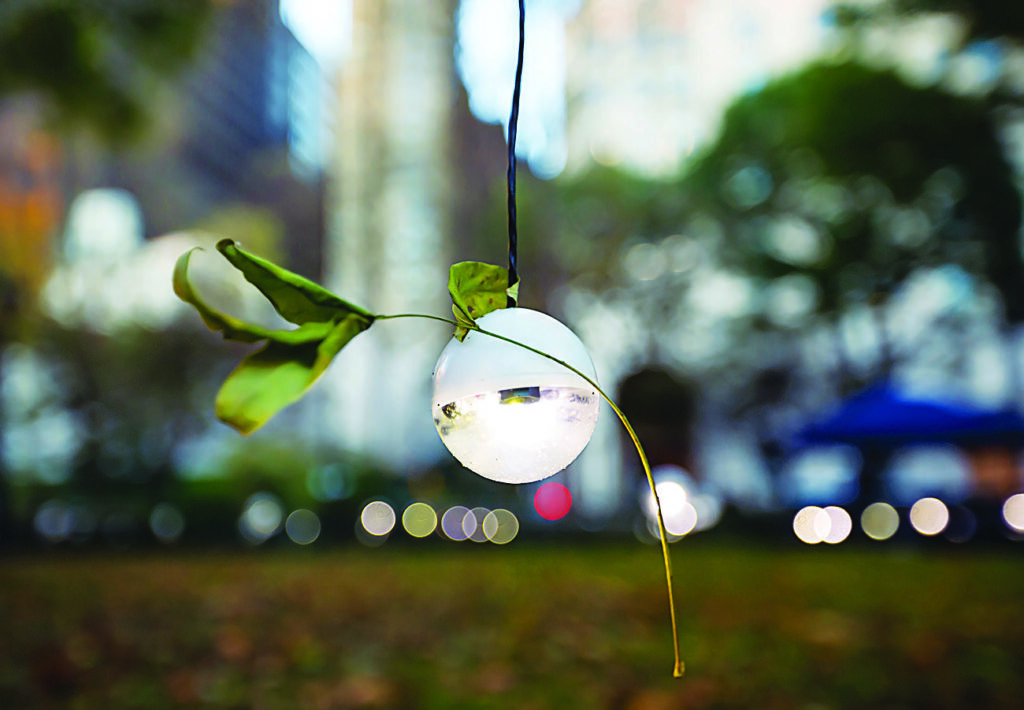
Whiteout was commissioned in 2017 for Madison Square Park in New York City by the park’s curator, Brooke Kamin Rapaport. This immersive lightscape consists of 900 small, blinking LED orbs that hang suspended in a grid a few feet above the ground.
With permanent installations everywhere from Tampa International Airport to the NASCAR Hall of Fame in Charlotte, North Carolina, Redl has seen his career flourish ever since his piece Matrix VI was featured on the facade of the Whitney Museum of American Art during its 2002 biennial. Known for his “dazzling matrices of pixelated lights,” as described by ARTnews.com, the Austrian-born Redl has managed to forge a singular arena for himself in the realm of public art, one that merges technology with the venerated ideas behind the Land Art movement.
“Redl’s artwork always exists in relation to the viewer, the viewer’s body, and the way the viewer moves through space,” says Oklahoma Contemporary curator Jennifer Scanlan about the metaphysical properties of Redl’s work. But unlike great land artists of years past like Walter De Maria and Michael Heizer, who’ve addressed similar topics, Redl works with cutting-edge computer technology to help create his astonishing installations.
“In [Whiteout] the small illuminated spheres only function as indicators of invisible or ephemeral forces,” Redl explains. “Those covert forces are the wind that animates the spheres and the computer program that triggers the light sequences.” Because of this dynamic combination, the artistic outcome feels both natural and programmatic ic—something like a visual form of music. That effect is no coincidence.
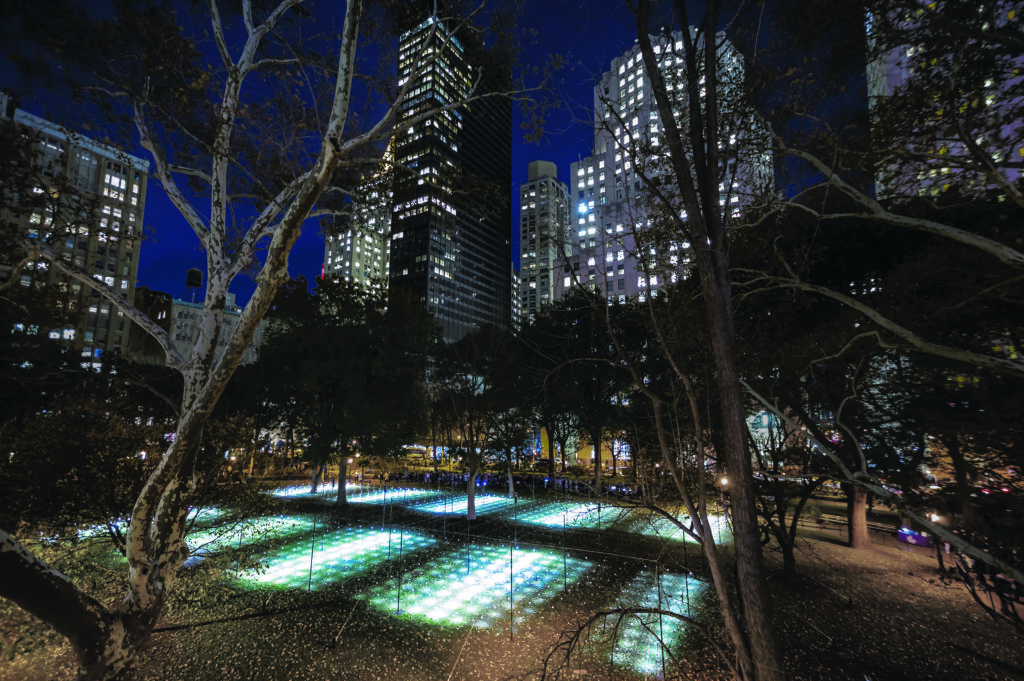
That’s because Redl, interestingly enough, began his career by making art you hear, not art you see. Before turning to visual art, he attended the esteemed University of Music and Performing Arts, Vienna, a school that produced talents like the legendary composer Gustav Mahler. Redl acknowledges the musicology that still informs most of his artwork. “[Whiteout] of course lends itself to a comparison with music where the notes—think about a sphere in Whiteout as a note in a music score—just frame the silence, and the music composition itself is something completely abstract, not rooted in the musical note itself,” he says.
But why move an artwork made specifically for a park in New York City to a park in Oklahoma City? Physically, the dimensions of Campbell Art Park are such that Whiteout could fit well within it, but to Scanlan, this was about more than just dimensions. “I was excited to bring [Whiteout] here because I knew that Oklahoma City would be a perfect place for it,” she says. “The city is growing, there is a lot of innovation and creativity at work, several public art projects have engaged the community, and people are ready for new experiences and seeing art in ways they haven’t before.”
This becomes apparent if you look at Oklahoma Contemporary’s recent exhibitions. The forward-thinking show CODED_COUTURE explored the high-tech future of fashion in 2017. A year before that, Orly Genger’s massive woven piece Terra—a winding wall-like structure made from 1.4 million feet of lobster-fishing rope— completely reinvented the geography of Campbell Art Park.
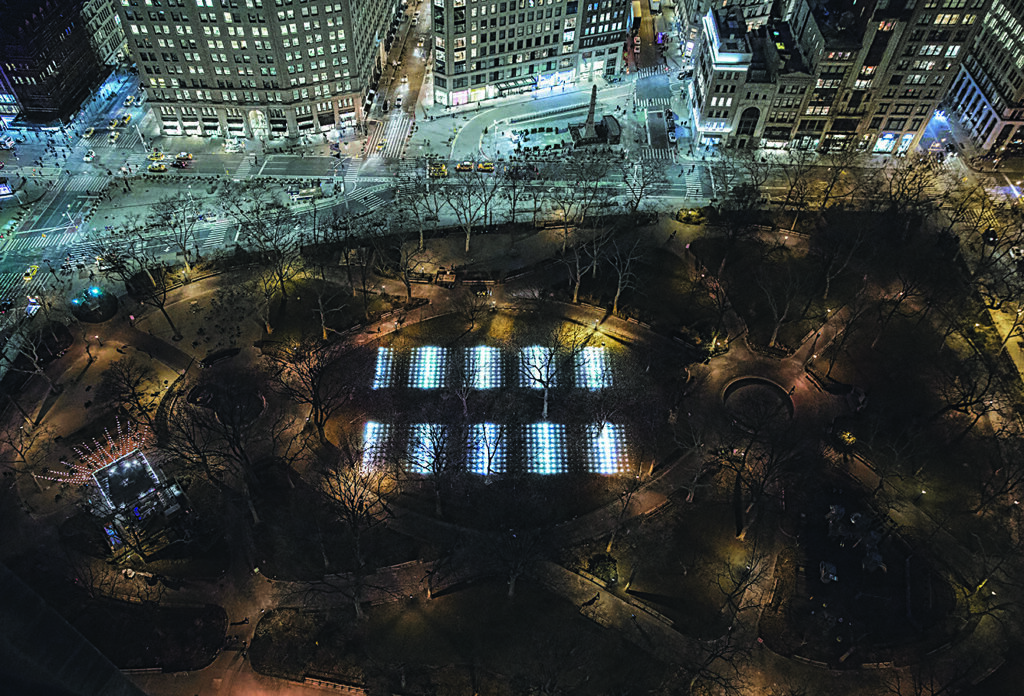
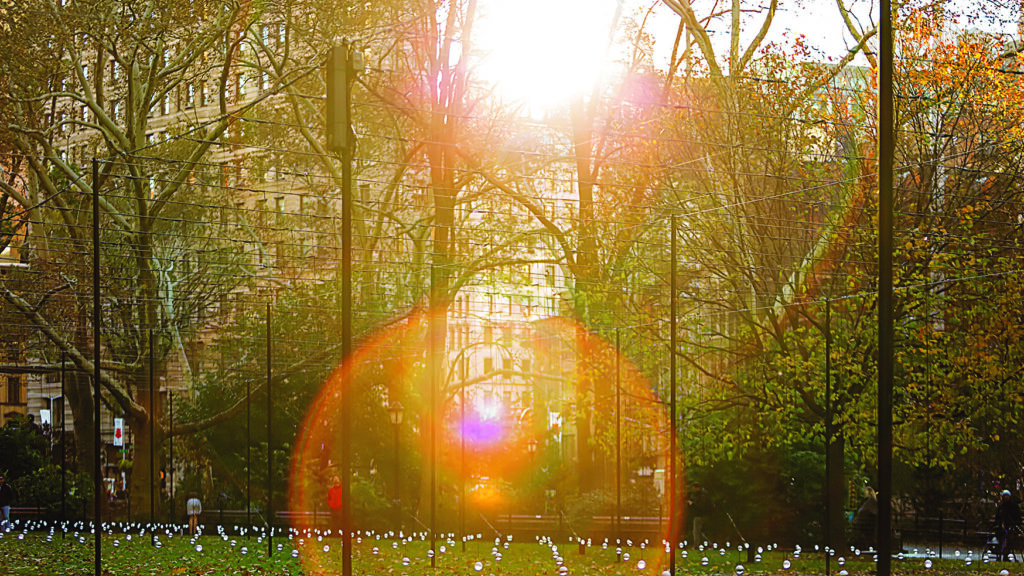
According to Redl, his artwork was designed in such a way that it could easily travel. In fact, the piece benefits from new orientations. “As with most of my installations, Whiteout was conceived as a modular system suitable for a wide range of locations,” he says. “The Campbell Art Park installation will be more compact than what was shown at Madison Square Park. [This] version will feature off set, interleaved, smaller rectangles, which will form an abstract, square, wave pattern. This new pattern will offer radically different viewpoints and a slew of new programming options for the light sequences.”
The reinvention of Redl’s artworks upon different landscapes is yet another fascinating aspect of his process, one that the lucky inhabitants of Oklahoma City will happily consider during twilight strolls around the shimmering magnificence of Whiteout.
Whiteout will be on view from October through March 2019. Free and open to the public, Campbell Art Park is located at Eleventh Street and Broadway in Oklahoma City.