Light & Space
While it’s always safe to say that installation artist Robert Irwin thinks bigger than most, he seems to have outdone even himself with his latest project.
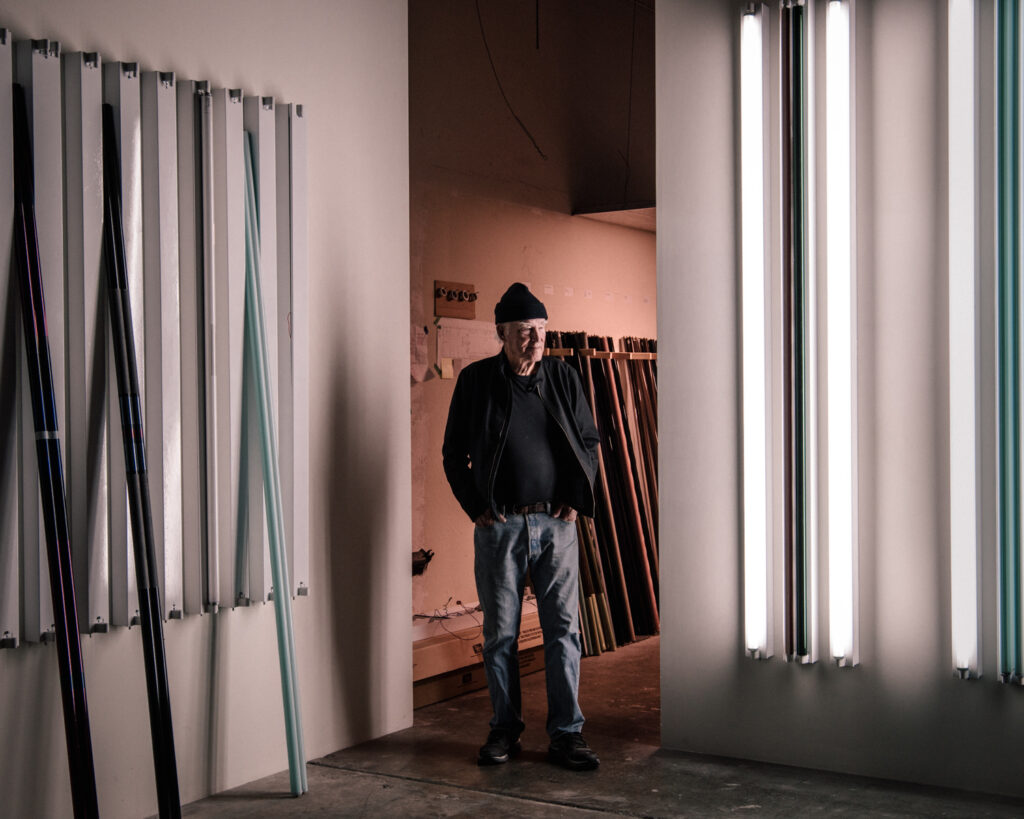
While it’s always been safe to say that installation artist Robert Irwin thinks bigger than most, he seems to have outdone even himself with his latest project.
The painter-turned-purveyor of light has spent the last sixteen years perfecting his most important artwork to date: a former hospital on the grounds of the Chinati Foundation in Marfa, Texas, which he’s turned into an architectural, sculptural and phenomenological wonder.
The southern California native was invited by the foundation to turn the crumbling building, which was built in 1921 as part of the army base that became the late minimalist Donald Judd’s legendary art theme park, into a permanent installation that would harness the artist’s preferred medium—light. “Robert Irwin has pursued perception as an artistic medium for more than sixty years,” says Jenny Moore, director of the Chinati Foundation. “He recognized early on the extraordinary nature of just being aware, through our senses and our consciousness, of the world around us, and what a magnificent thing that experience is.”
Irwin, now eighty-eight, began his career in the late fifties as a painter, first gaining recognition via the famous Los Angeles talent incubator Ferus Gallery with a series of miniature “hand-held” abstract paintings that viewers were allowed to pick up and touch. These little paintings, despite being relatively tiny, had a powerful effect—flying in the face of the preconceived notion that American abstraction had to overwhelm with sheer size as a Jackson Pollock or Barnett Newman would.
Yet by the seventies, Irwin, along with a small group of like-minded West Coast artists known loosely as the Light and Space movement, had turned toward making art from pure light. Like Flavin, Irwin worked with fluorescent lights but soon became more known for his installations employing natural light—often in conjunction with colored scrims or tinted gels—to create magical visual effects.
Since then he’s created more than fifty-five “site-conditional” artworks, including major works at both the Getty Center in Los Angeles and Dia:Beacon in upstate New York, and he has been the subject of countless museum exhibitions around the world, the most recent of which was last year’s lauded exhibition All the Rules Will Change at the Hirshhorn Museum and Sculpture Garden in Washington D.C.
And though Irwin isn’t the household name that other Chinati artists like Judd or John Chamberlain might be, that could change thanks to this ambitious artwork.
“Irwin is one of the most important and influential American artists, although he is not as well known as he should be,” Moore explained. “The installation at Chinati is the culmination of his more than six decades exploring light, and it synthesizes all the elements of his consideration—architecture, light, plants, spacial relationships, conditions of the site—set within the distinct landscape of far West Texas.”
Irwin’s career has been marked by an almost restless desire to experiment—with both ideas and materials—making him a difficult artist to pin down despite the universal praise he’s received from the art world, and most notably from Judd himself. So it made sense to have Irwin added to the impressive list of artists on permanent display at Marfa.
“Donald Judd supported Irwin’s work and wrote about the desire to have Irwin’s art included in the project he was creating in Marfa, the installations that eventually became the Chinati Foundation,” Moore confirmed. To put Irwin’s inclusion into perspective, the last major installation added to the Chinati site was Dan Flavin’s project in 2000, and Judd thought so highly of Flavin, that he named his own son after him (Flavin Judd).
For Irwin’s extraordinary piece, known only as Untitled (Dawn to Dusk), the artist refurbished the C-shaped building and turned it into a luminescent wonder that both brightens and darkens as the Texas sun passes across the sky. The long rows of windows on either side of the building have been outfitted with a subtle tinting material, which creates sequential gradients of light throughout the rooms. Meanwhile, Irwin’s signature scrims are also present, bisecting each wing of the building in order to both capture and deflect natural light. Even the roof (or lack thereof) comes into play in this artwork, areas of which have been completely removed to offer viewers a different kind of sunlit state. As an artist who also frequently works the landscapes of his sites, Irwinalso designed the building’s inner courtyard, planting a grove of Palo Verde trees in a raised planter to provide shade and beauty.
When entering the completed work, one soon realizes that there likely isn’t an artist more perfectly suited for Chinati. For it’s here in this flat, sun-drenched space where a big thinker like Irwin can use an entire building as his canvas and the sun as a paintbrush to maximum effect.
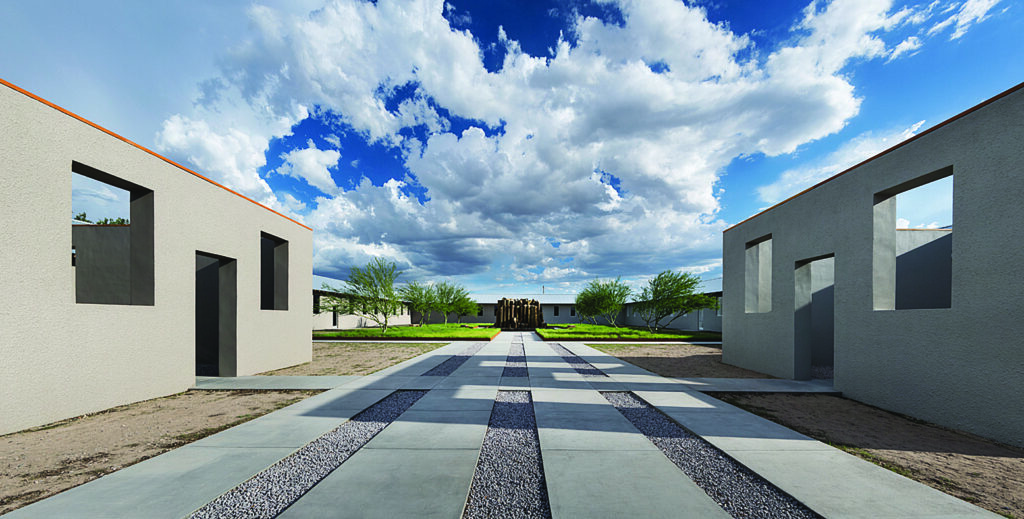
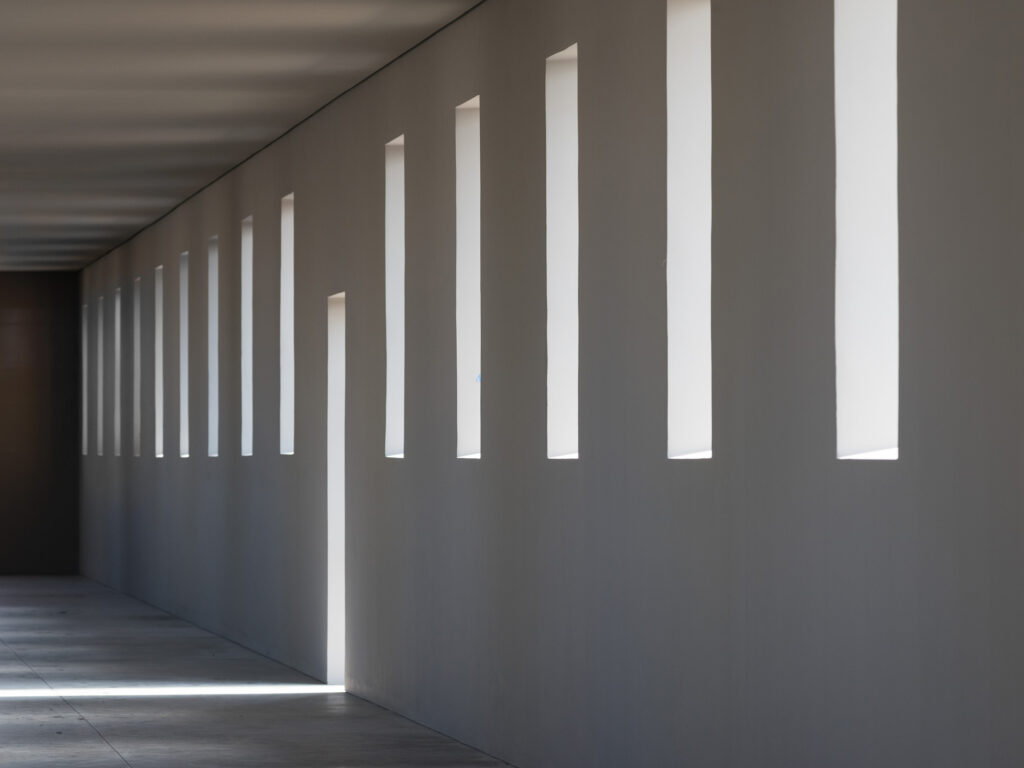
Robert Irwin’s untitled (dawn to dusk) is on view at the Chinati Foundation in Marfa, Texas.