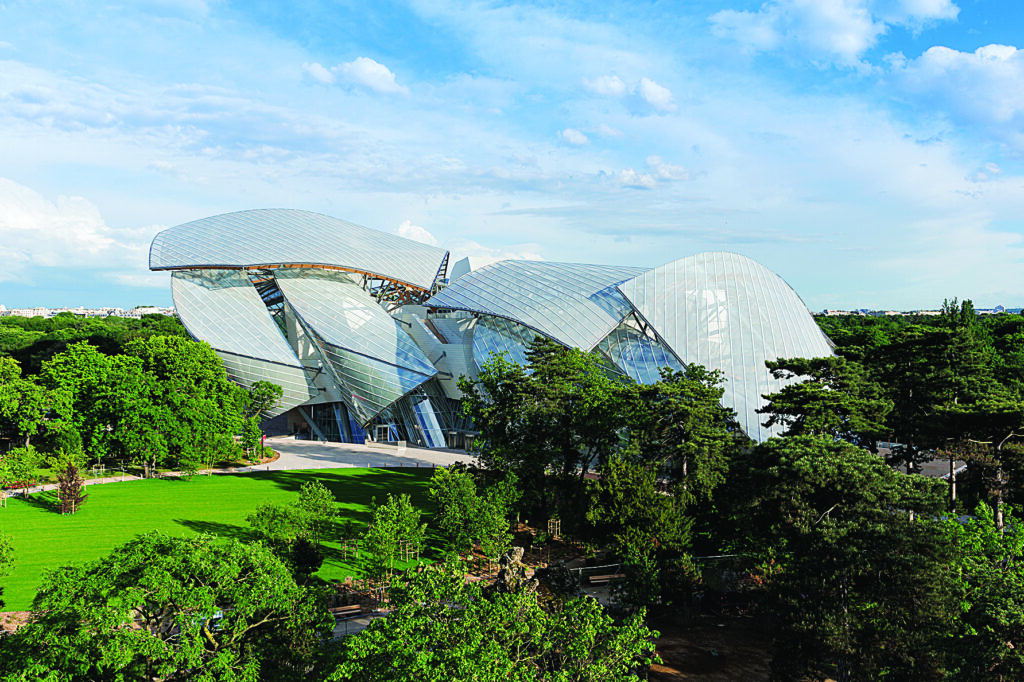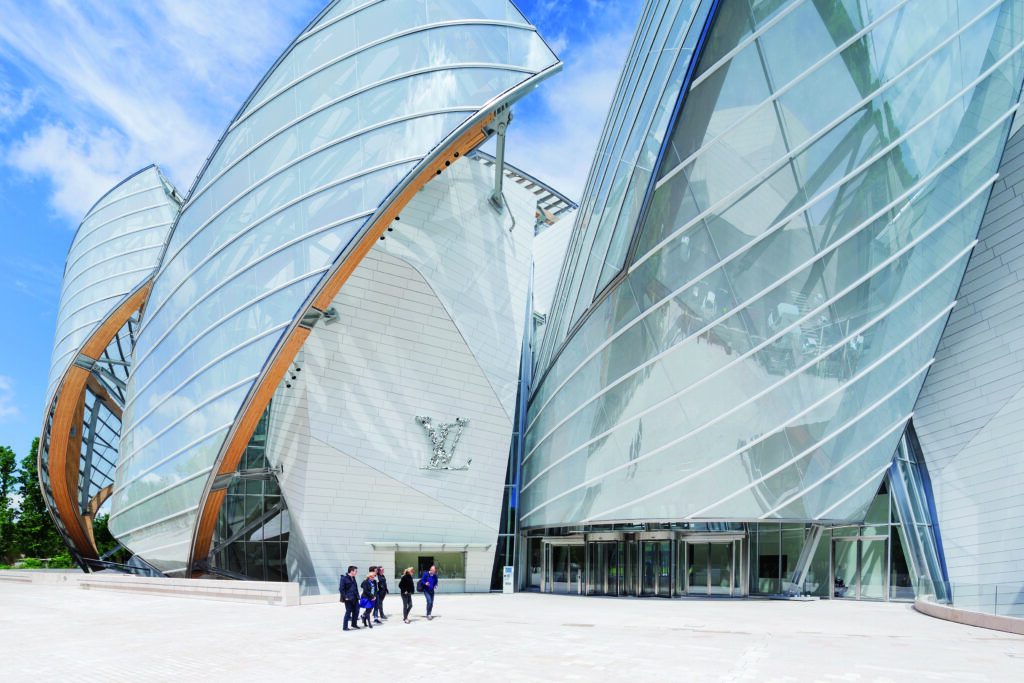
BY FAR THE best way to get to the Fondation Louis Vuitton is to take the métro rather than a taxi. It’s much quicker, and the short, ten-minute walk from the station helps to contextualize the now famous landmark building. Alight at Les Sablons (Line 1), follow the signs past the haute bourgeois residences into the northernmost part of the Bois de Boulogne, and proceed along the verdant route beside the Jardin d’Acclimatation. All of a sudden, among the lush trees and flower beds, comes the surprise. Like an enormous sailing boat or giant cloud, the objective—the 41,000 square-foot compilation of glass and steel and wooden beams designed by Frank Gehry—looms into view. Everything about the Fondation Louis Vuitton shouts quality—not in an understated, modest way but in a supremely ambitious, self-asserting, yet beautiful way. In this it mirrors the upscale conglomerate of luxury goods, LVMH Moët Hennessy Louis Vuitton, known for high-end fashion, champagne, and brandy, to which the foundation owes its existence.
The majority shareholder, chairman, and CEO of LVMH—and France’s richest man—Bernard Arnault, conceived the idea of creating an art museum and cultural hub in 2001. At that stage, Arnault had long been a private collector of works by modern and contemporary artists like Yves Klein, Pablo Picasso, Alberto Giacometti, Je— Koons, and Ellsworth Kelly, and the company itself had been a supporter of the arts, sponsoring exhibitions at the Grand Palais and the Centre Pompidou. It was therefore a natural progression to form a separate, nonprofit entity as part of the group’s promotion of art and culture. Arnault’s choice of architect was not radical, given that Frank Gehry is an established designer of some of the world’s most renowned cultural institutions, including the Guggenheim Museum in Bilbao, the Walt Disney Concert Hall in Los Angeles, and the Museum of Popular Culture in Seattle. But it was bound to be controversial. Being provocative is Gehry’s style, and when one of his buildings is coming to a neighborhood, the initial response is usually shock and horror, which especially applied in the conservative, not-in-my-backyard min-dset of the Sixteenth Arrondissement.
The project took thirteen years from concept to realization, opening its doors to the public in October 2014. A major blip occurred in 2011 when work was interrupted by a pro longed court case brought by disgruntled local residents who feared the arts center would disrupt the peace and beauty of the park. They lost the battle, and in fact, the Fondation Louis Vuitton does not detract from the charm and tranquility of the area—it actually enhances it. With its abundant use of water cascading around the base of the building and the reflections of sky and foliage in its vast curvilinear glass-and-steel form, nature is magnified, illuminated, and celebrated.
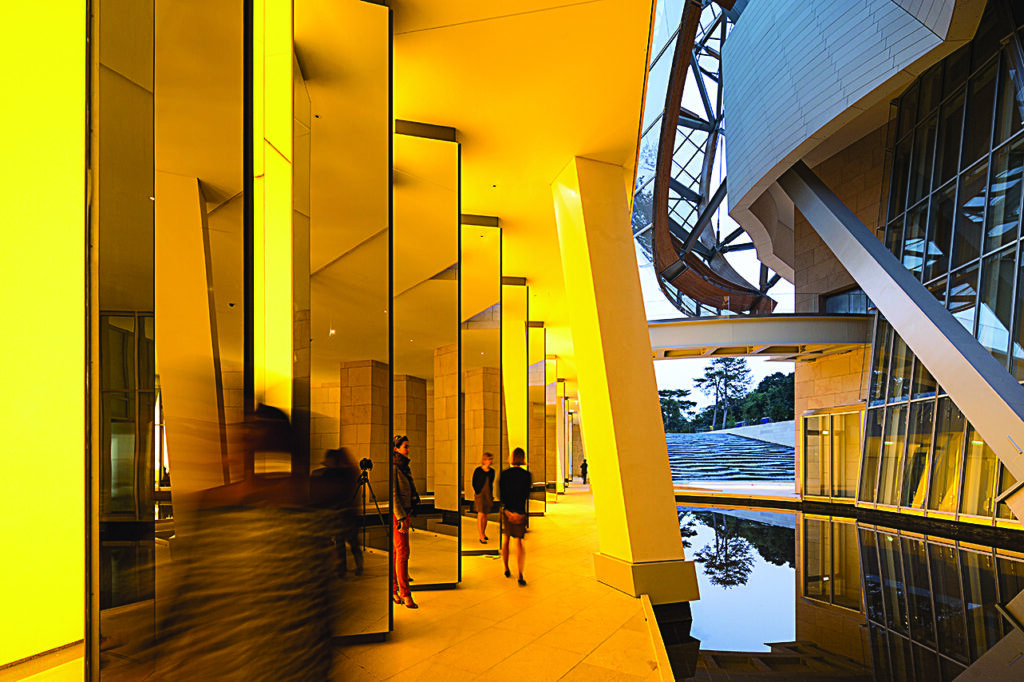
The exterior is so spectacular that the interior comes as a slight anti-climax. The gallery spaces are capacious, well-lit, and simple, but unexciting. Perhaps it was the intention to let the art reign without structural distraction inside, allowing the outside to proclaim with gusto its happy marriage of innovative thinking, technological prowess, and physical presence. If so, the plan succeeded. One of the best spaces is near the lower-ground waterfall, where concerts are held in a “grotto” against the backdrop of Olafur Eliasson’s stunning permanent installation Inside the horizon (2014). Alternating panels of internally illuminated yellow glass and mirrors create multidimensional reflections of the museum’s visitors and diffractions of light as they wander along the lengthy colonnade, multiplying as they move. Equally impressive are the elevated terraces at the top levels, from which views of the city can be seen in every direction and are intersected by the steel joists, which fragment and disrupt the sight lines.
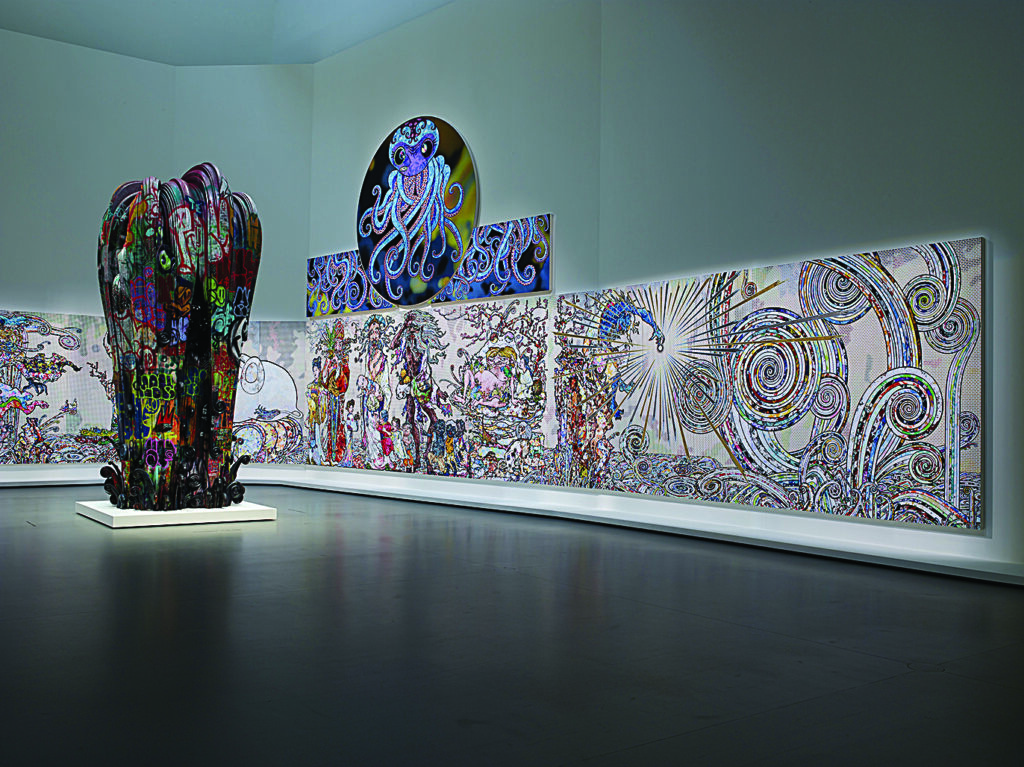
Exhibitions are curated to match visitor expectations of excellence, though not every one is a winner. The recent Humans in the Living Universe failed to make a real impact, but another, In Tune with the World, featured the wildly imaginative work of the cult Japanese artist Takashi Murakami. Its landscape of cartoon-like, alien-world, pop-aesthetic figures provided a selfie-heaven and resonated hugely with a youthful audience. The vast ceiling heights of some of the gallery spaces permit very large-scale sculpture like Murakami’s monumental, five-meter Chakras Open and I Drown Under the Waterfall of Life (2017).
The museum’s restaurant, aptly named Le Frank, a coolly refreshing indoor-outdoor environment serving superb cuisine courtesy of its Michelin-starred chef, Jean Louis Nomicos, is not to be missed. As the foundation rightly points out: “Art is a language, visual, emotional, sensory. Cuisine calls the senses. Art is an experience, cuisine too. Art is sharing, cuisine too.”