Mexican artist Francisco Ugarte gives a conceptual showing in Marfa.
Intervención
THE DESERT IS perfectly in tune with the principles of minimalism, emphasizing repetition, pared-down elements, and heightened visual perception. Donald Judd understood this about the West Texas landscape and became a full-time resident of Marfa, Texas, in 1977. From this, Judd’s Chinati Foundation was born: an immaculately groomed site in the Chihuahuan Desert, housing outsized works by seminal 1960s minimalists such as Dan Flavin, Carl Andre, and Judd himself.
The tradition continues in the mecca of minimalism with Francisco Ugarte’s show, How Things Are, at Marfa Contemporary. Ugarte, who was born and still lives in Guadalajara, Mexico, knows something about the desert, a vast expanse separating his subtropical hometown from the glimmering cities of Texas to the north.
Ugarte began studying architecture at the Western Institute of Technology and Higher Education (ITESO) in Guadalajara, and his artworks are often a reaction to their settings: an approach that’s not dissimilar to the concepts of modernist architecture.
For the exterior of Marfa Contemporary, Ugarte created a site-specific installation—a moving drawing made by the sun. “I actually used an iPhone app called Sun Seeker to help make the piece,” Ugarte says. “It is a series of six objects, each made of two I-beams, and at specific dates and times they’ll form exact triangles with their shadows.”
While Ugarte was in architecture school between 1993 and 1998, he and some fellow architecture students formed a group called Incidental. It had an open atmosphere where art theories were discussed freely, and eventually Incidental mounted a series of group exhibitions. During this time, Ugarte’s influences came from the world of architecture, particularly from fellow Guadalajaran architect Luis Barragán, who is considered to be one of Mexico’s most famous architects and a strong adherent of modernist ideals.
“I related to his work because it felt very familiar,” Ugarte says. “He translated a lot of local ways of life and materials into his work. I was also drawn to the way his buildings became more and more minimalist over time.” Barragán’s reductionist tendencies and his propensity to work in conjunction with the local environment echo the tenets of minimalism. So when Ugarte discovered artists like Robert Irwin and Richard Serra, it seemed only natural to be drawn to their work.
Ugarte’s art isn’t just limited to public sculpture. Alongside his solar pieces, the artist has also created a range of drawings, videos, and installations. Yet, in whichever medium he chooses, his art reflects the natural properties of his chosen materials and in the environment in which it lives.
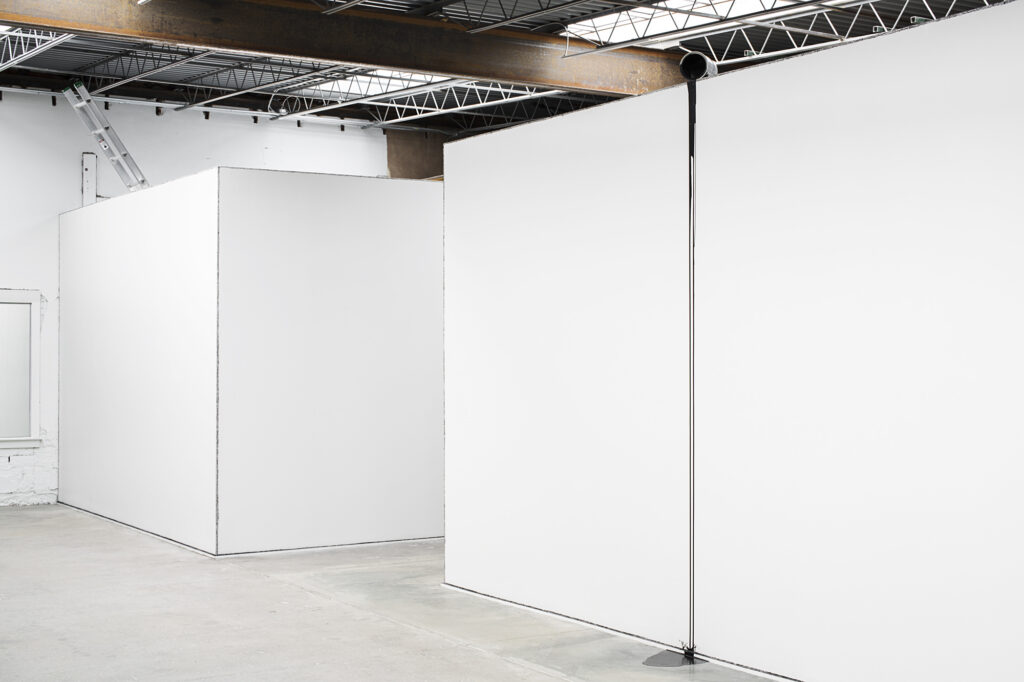
For the exhibition at Marfa Contemporary, Ugarte had gone so far as to create a scale model of the gallery space to determine whether the subtleties of the specific works would have their intended effect. The works include a wall-length paint-can spill, an extraneous column extension bisecting the floor, and a mysterious light emanating from behind a closed door.
“I get excited when the [scale] model starts to feel real, and the real starts to feel like a scale model,” he says. His art is understated, and some of it is easy to pass by unless you’re paying close attention. Ugarte recognizes that people have criticized his seemingly unaffected approach, but to him, that is exactly the point. “The result is not given by me but by the union of the materials and the context,” he says. “I want to create a feeling that what is there is already fascinating.”