Field of Dreams
ARTIST BRUCE MUNRO ILLUMINATES THE NATURE OF HIS LIFE’S WORK.
BY Jessica Dawson | PHOTOGRAPHY BY Mark Pickthal
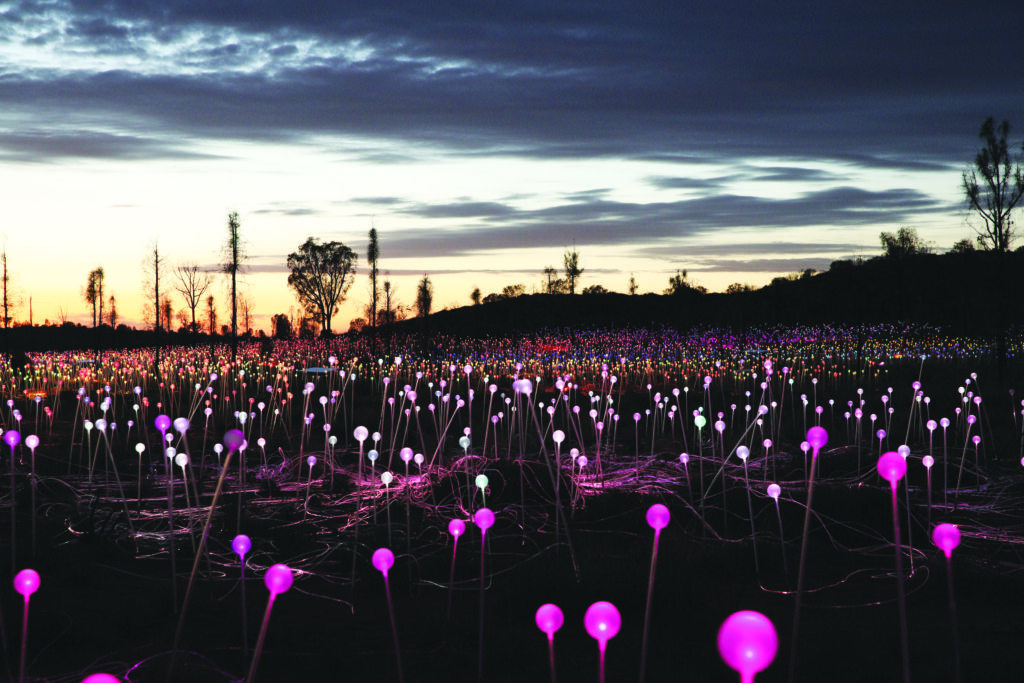
For the past five years, Bruce Munro’s massively scaled light installations have been making their way through American botanical gardens like an invasive species—albeit an entirely welcome one. Kennett Square, Pennsylvania’s influential Longwood Gardens launched the British artist’s invasion in 2012 and since then more than a dozen institutions—conservatories as well as art museums and galleries—have followed suit, making the fifty-eight-year-old Munro one of the most popular illumination artists you’ve never heard of.
Think “light artist” and, if you’re an aficionado of the global gallery and biennial circuit, a roll call slips off the tongue: James Turrell. Leo Villareal. Robert Irwin. The name that likely won’t come to mind is Munro’s. That’s not just because the Wiltshire, England-based artist’s frequent venues—those greenhouses and conservatories—are unlikely spots for the art crowd. It’s also because Munro’s concerns lie not with art world politics but with relating to his audience.
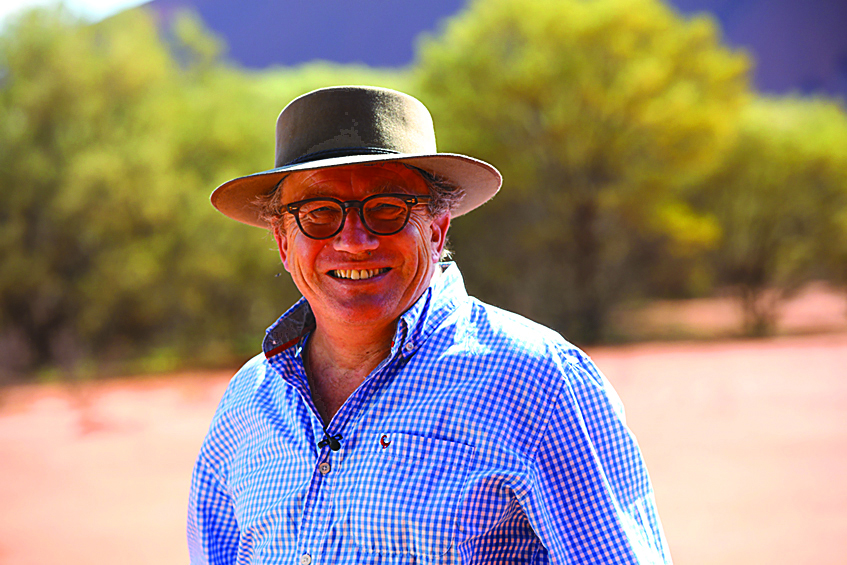
Munro, he’ll happily tell you, is an everyday guy who just wants to connect.
“I break walls down by making things very accessible,” Munro says. “I’m not trying to tease people or test them intellectually. I’m trying to represent thoughts and feelings in materials I love experimenting with.”
That spirit of inclusiveness has proven a strong selling point. For audiences, a Munro show is a magical thing. Incorporating sometimes tens of thousands of LED lights and complex webs of fiber optics that the artist and his team intersperse, embed and plant into natural environments, his nighttime installations enliven gardens, forests, and fields, as well as large-scale indoor atria. Some works also incorporate sound—from feel-good tracks by Ladysmith Black Mambazo to the cacophony of cockatoos.
“I love placing something in a natural landscape and seeing how the landscape changes it and how it changes the landscape,” Munro says. “There’s theater to this—it’s a happening.” In that spirit, his works ask viewers to pay attention, to be present with earth and light. For Munro, it’s about probing the existential human experience, something he seems increasingly to express in his works, likening them to the experience of life itself. “We land on this earth for a set amount of years and then we’re gone,” Munro says. “What I’m doing is what a human being does. You’re here and then you’re gone.”
Installations can be massive. A recent exhibition at the Minnesota Landscape Arboretum included a version of Munro’s popular Field of Light installation that incorporated tens of thousands of individual stems of fiber optics. At Minnesota, the work ran the length of nearly three football fields. That’s almost twenty-four acres covered inlights, fed with a slowly changing spectrum of color that seemed to make the hills undulate and breathe.
“It’s harmony in a way that it’s almost biomimicry,” says Longwood CEO and president Paul B. Redman of Munro’s capacity to blend his work into nature. The artist’s 2012 exhibition in Kennett Square covered twenty-three acres and included two versions of the Field of Light concept that together incorporated 27,000 illuminated stems. Although “they’re not living breathing things,” Redman says, “they have this surrealism to them. Field of Light in our forest almost felt like fireflies.”
“He’s the kind of installation artist that you don’t want to say no to,” says Wendy DePaolis, the Minnesota Landscape Arboretum curator who organized the Munro show that closed this past April. “This idea of synthesizing art and nature with light is something the Upper Midwest craves. The days get shorter, the nights get longer.” Munro’s attraction to the fanciful tales of C.S. Lewis, which inspired some of the works in DePaolis’s show, led him to create something of a winter wonderland for Minneapolis-area audiences
Munro’s life as an artist came together later than most. It wasn’t until his mid-forties that he began creating the immersive installations he’s now known for. Though he graduated from art school, the practical matters of earning a living and supporting a young family led him to work in architectural lighting, first in Australia and then in the United Kingdom.
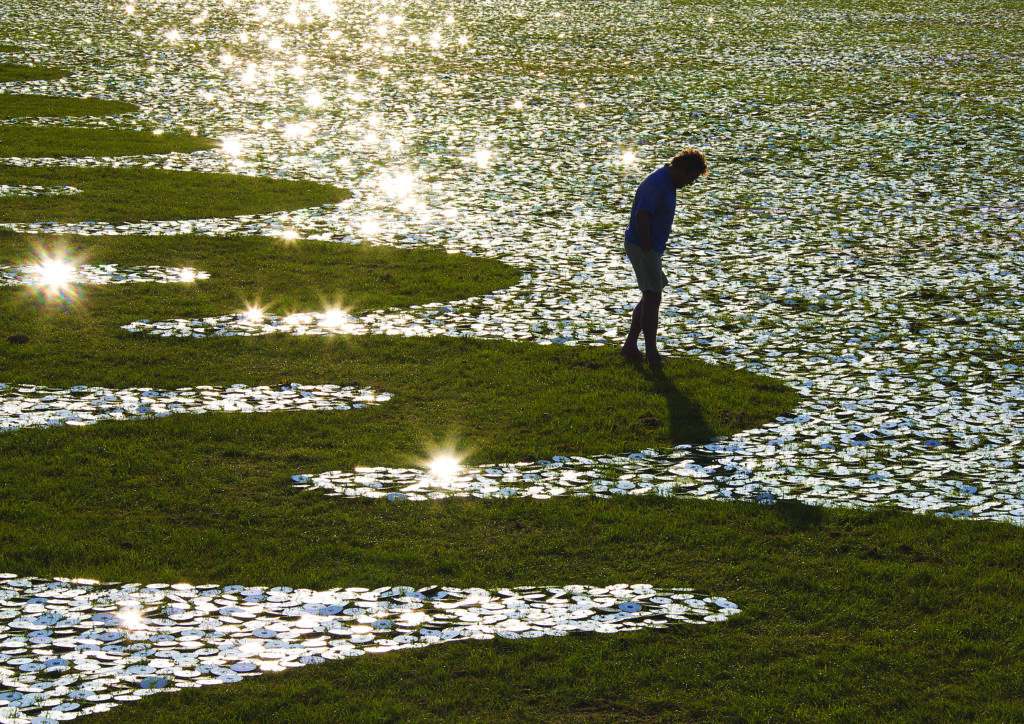
I break walls down by making things very accessible. I’m not trying to tease people.
But landscape–and the British landscape tradition–remained close to his heart. As a child, Munro spent time with his father in the southwestern English fishing village of Salcombe, in Devon. “I was about eight or nine and my father’d take my brother and sister off fishing and I’d get bored,” Munro recalls. “I’d say, Can you drop me off at the beach with my paints and sketch pads? I would sit and paint. When I got a little bit older I took walks around the cliffs.”
In his thirties, while living and backpacking in Australia, Munro struck upon the idea for Field of Light while on an overnight stay at the massive sandstone Ayers Rock, also called Uluru, in central Australia’s Northern Territory. Munro was awed by the innate beauty of the scene and sketched out designs for illuminations that would mirror the powerful natural forces he felt emanating from the spot.
“If I’d been a decent painter I might have painted a picture,” Munro says. “But I was a crap painter.”
It would be another twelve years before those early sketches became the first iteration of Field of Light—and the works’ inaugural run happened in the artist’s own backyard. By then Munro was in his mid-fortiess, his father had died several years before, and he found himself with sketchbooks brimming with ideas he’d never realized. With his mother’s admonishments in the back of his mind— “be a doer, not a talker,” she told him—Munro took out a loan and created Field of Light on the grounds around his farmhouse. Word of the work spread in the community. Friends brought along their friends. A few visitors were moved to tears. A phenomenon was born.
But it was only last year, at long last, that Field of Light was realized at ground zero for its inspiration—Uluru itself. The work is currently on view adjacent the giant rock and will remain there through March 2018. Like so much of Munro’s work, it’s proven immensely popular.
Munro installations are considered by their host venues to be unqualified successes; evidence both anecdotal and numerical confirms that they’re people magnets. Longwood’s attendance numbers nearly doubled during the 2012 Munro exhibition from the same period the year before.
“It was a goal of ours to expand our audience base and reach a younger arts and culture carnivore,” Longwood’s Redman says. “That is exactly what happened. It was a very diverse audience, a younger audience. People were driving for over three hours to see the artwork.”
“We are always trying to find ways to merge art and nature and marry these two worlds,” explains Bonnie Roche, the exhibition manager at Franklin Park Conservatory and Botanical Gardens who mounted a Munro show in fall of 2013 after hearing about Longwood’s show. “His work has such a natural feel to it. They fit right into these spaces and marry together.”
At Franklin Park, Munro managed to surprise those who’d never spent time in the facility at night. Frequent visitors and some staff were surprised to find the facility’s Rainforest Biome rocked by the nighttime croaking of a population of nocturnal frogs. They’d been there all along, having piggybacked on the plant shipments, but until then many hadn’t heard them. “You’d walk into the room and the plants were coming to life in a new way,” Roche says.
The complexity and scale of Munro’s exhibitions aren’t without their challenges. It’s often an institution’s first nighttime exhibition; staff must establish pathway lighting, ensure that electricity reaches far corners of their facility, and work longer hours. Installation runs generally about a month—not unusual in the contemporary art world, but often requiring scores of volunteers as well as Munro’s small team.
That the local community is invited to help install the work was considered an advantage by Julie Maguire, the visual art advisor to Green Box Arts Festival who oversees two Munro installations opening in Green Mountain Falls, Colorado, on July 1.
“When we can involve people in the community with the artwork, it seems to resonate more with the community,” Maguire says. “So that was something that was really a plus.”
But not all locals are keen on cooperating with Munro shows. Unexpected visitors to the Minnesota Landscape Arboretum caused a ruckus of their own, upending the delicate filaments that made their way across the ground to feed the luminous bulbs. Building mechanic Jeff Stuewe’s investigation of the outages unearthed a cadre of non-ticketed guests.
“We’ve been blaming it on the turkeys,” Stuewe says. “But I think the rabbits have been culprits too. Stuewe says anything with bigger feet can catch the fiber optics running across the ground. Those wild guests had Stuewe and his team scurrying to reconnect stems to their wires.
But none of it was insurmountable.
“We’ve had our issues, but we’ve been able to deal with it,” Stuewe says. “Everybody loves the exhibit. That’s the biggest thing.”