Enlightenment
DANISH ARTIST OLAFUR ELIASSON MAKES HIS CONTRIBUTION TO THE NEW AMERICAN WEST.
WHEN LOS ANGELES–BASED Guess clothing moguls and avid art collectors Paul and Maurice Marciano decided to refurbish an old Masonic temple on Wilshire Boulevard for the purpose of displaying
their world-famous art collection, they also chose to redesign the building’s 100,000-square-foot space to showcase projects by artists whose work they were passionate about. Early on, there was little doubt
that Olafur Eliasson would be among them.
“Eliasson’s work seamlessly combines aesthetics, science, and architecture to produce an atmospheric and environmental art experience that is at once completely personal and global,” says Jamie G. Manné, the deputy director of the Marciano Art Foundation, about the art star who is—surprisingly—still fairly unknown on the West Coast, not having shown there in over a decade. “[His] work aims to engage viewers in a holistic experience of art, rather than in just making an object to look at.”
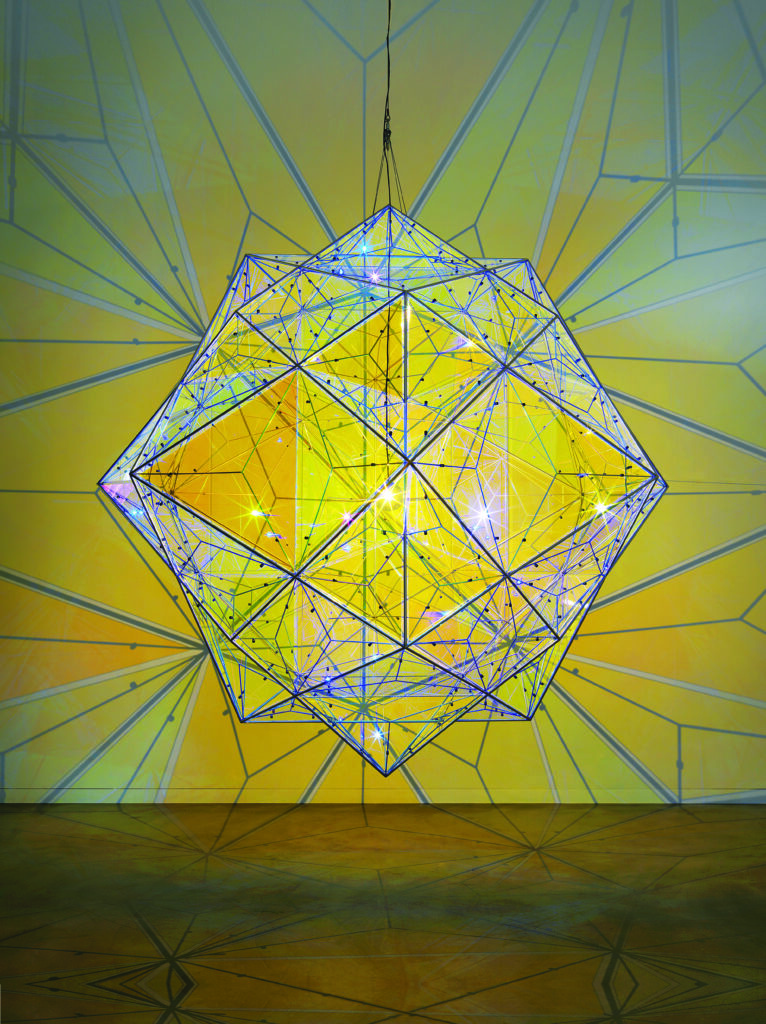
The Danish-born and Berlin-based Eliasson, known primarily for his installations featuring natural materials like light or water, burst onto the international art landscape in 2003 with his show The Weather Project at the Tate Modern in London, a breathtaking exhibition highlighted by a giant orb of light produced by hundreds of reflected mono-frequency lamps. Eliasson’s fake sun was a massive hit with the fog-and gloom bound British public, and he soon became known as one of just a handful of artists who have found immense critical and financial success despite producing ephemeral works
THE SPACE CREATES THE film, THE film CREATES THE SPACE, THE film BECOMES SPATIAL.
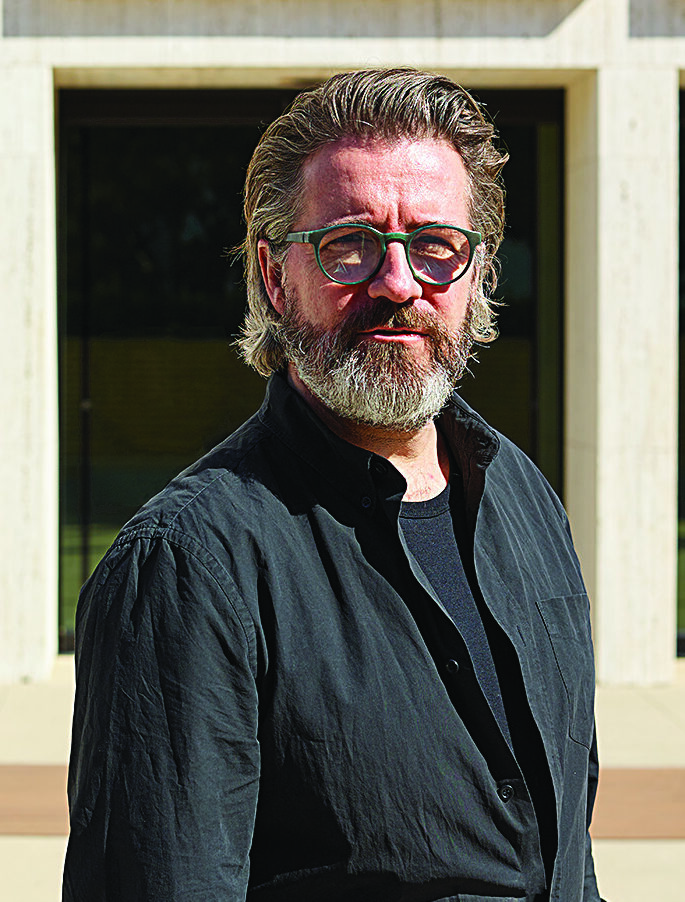
Although the fifty-one-year-old artist might seem like a choice that’s at odds with the glamour and wealth often associated with Tinseltown, Eliasson actually makes perfect sense for a show there—both culturally and artistically.
“Eliasson’s work has a lot of parallels with the history of Light and Space artists in LA, so it’s interesting to think about his work in that context, along with the film industry,” says Ali Subotnick, consulting curator for the Marciano Art Foundation. “He has wanted to present a significant project in LA for some time, and after visiting the space, he came up with a proposal that responded both to the site of the theater and the context of the city and its art and cultural offerings.”
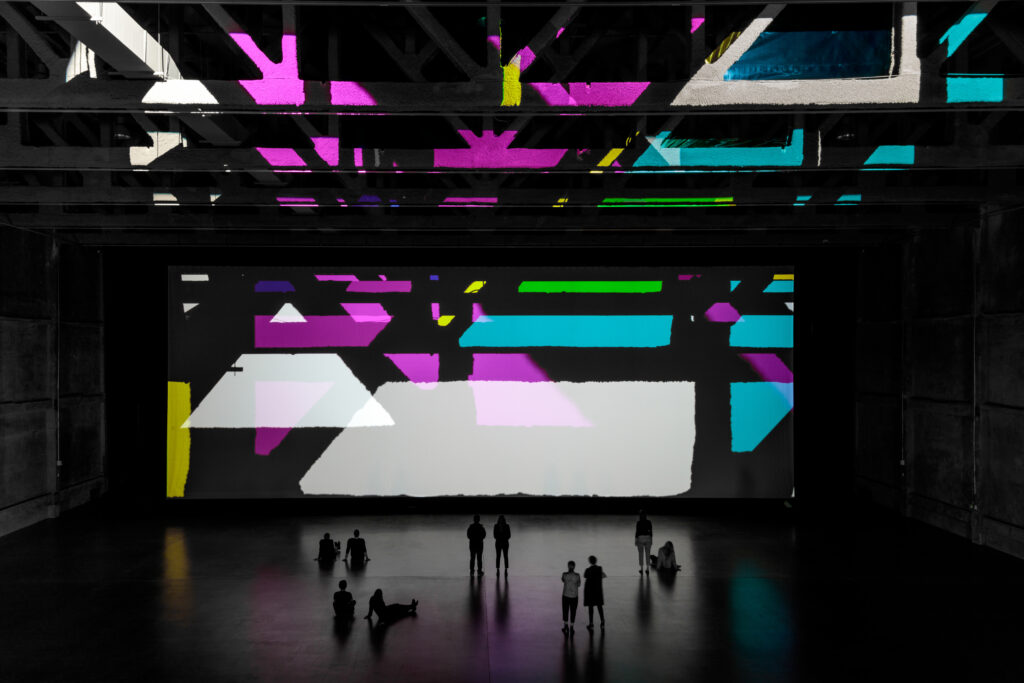
For the artwork, titled Reality projector, the artist uses the gutted theater interior—highlighted only by its concrete supports and steel ceiling girders—as a tool for presenting his primary medium: light.
“When you enter Reality projector, you enter a film machine,” Eliasson says from his Berlin studio.
“Everything needed for a great film is already there in the space: perspective, colour, motion, light,
shadow. All that is needed is the actor and the audience—you. The space creates the film, the film creates the space, the film becomes spatial.”
Inside the cavernous room, projected lights in a myriad of colors move across the building’s architectural elements, illuminating the darkened theater with a range of itinerant and organically produced forms. With Reality projector, Eliasson is not only referencing the building’s original use but also the trade that made its city famous: filmmaking. And yet, there is more to Eliasson’s monumental work than even this, specifically in the way Reality projector connects to the rich history of West Coast art.
“Olafur is certainly aware of the prominent history of the Light and Space movement in the area. However, he is also interested in the history of film and cinema and the role that industry has played in the development of art making in the region,” Manné says. “Viewers who enjoy the Light and Space movement will hopefully respond well to Olafur’s work if they are unfamiliar with it.”
Led by artists like Robert Irwin, Larry Bell, and James Turrell, the Light and Space movement was a loose grouping of artists in and around Southern California who energized the West Coast art scene in the 1960 and ‘70s, employing materials that questioned the nature of visual perception, often through the use of light. Seeing the work of these trailblazing artists was a game changer for Eliasson.
“When I first encountered the work of artists like Robert Irwin and Maria Nordman at the end of the 1980s, I found it really exciting,” Eliasson says. “The Light and Space artists were highly inspirational to me in how they worked with the subject as a projector or producer of the content—as a sophisticated and resourceful agent. The work was about society and identity and subjectivity, about the spatial questions that we have to resolve every day.”
One can see these ideas at work in Reality projector, but with the large-scale ambition that Eliasson always brings to his work. It’s quite likely that his brand of spectacle will wow in Los Angeles just as it has elsewhere. After all, “big” is a concept that every Angeleno understands.
Reality projector will be on view through August 26 at the Marciano Art Foundation’s Theater Gallery, at 4357 Wilshire Boulevard in Los Angeles. The MAF is open Thursday through Sunday. marcianoartfoundation.org