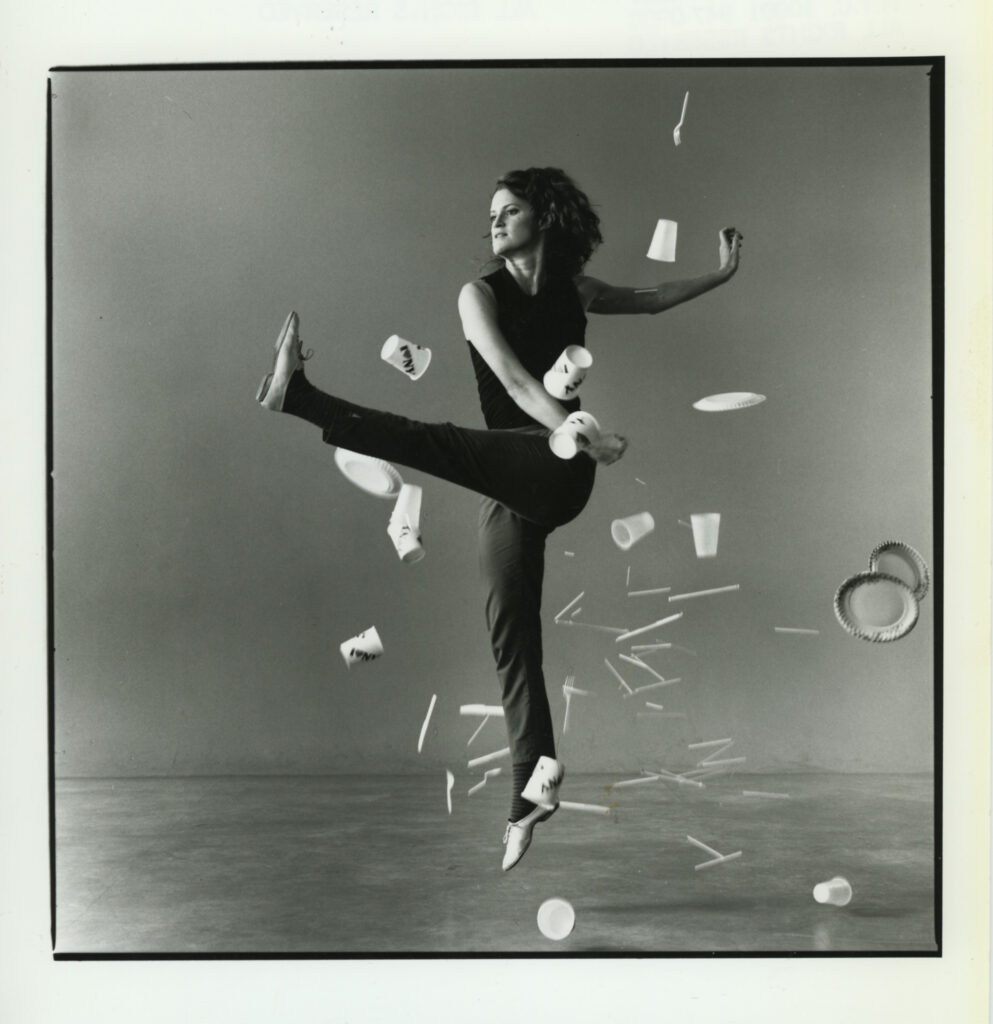
IN MORE THAN FOUR decades of choreography, Jane Comfort has used movement and language to tackle complex social issues with fearless wit. Drawing on her Southern upbringing in Oak Ridge, Tennessee, and her long involvement with the New York City art scene, going back to her early years studying with Merce Cunningham, she has created works of dance and theater that boldly grapple with sexism, racism, abuses of power, and other timely reflections on American life. Whether satirizing the testimony of the Anita Hill-Clarence Thomas hearings for S/He (1995) or reckoning with MAGA anger in Amazing Grace (2018), Comfort has explored how performance can be a platform of activism and dissent. While dance has always been at the core of Comfort’s more than sixty works, she pushes the boundaries of her practice through collaborations with puppeteers, DJs, percussionists, and opera singers.
In a conversation with dance editor Larry Keigwin, Jane Comfort discusses her influential career, from her first minimalist solo in 1978 to large-scale pieces like the choreography for the 1994 Stephen Sondheim-James Lapine Broadway musical, Passion.
Larry Keigwin: When I think of choreography, it’s making things and organizing things. I remember putting together gymnastics routines on the front lawn for passing cars. What is your earliest recollection of choreographing, putting things together?
Jane Comfort: I’m glad you said that about putting on shows for the cars. I think kids just do it. You make little shows. I don’t remember having a show and having people come, but my parents have a home video of me in my squirrel costume from when I was four. I was doing the routine in the backyard.
Larry Keigwin: And then you studied painting at the University of North Carolina at Chapel Hill.
Jane Comfort: I studied dance in high school first. In those days, if you were female, you couldn’t go to Chapel Hill unless you were a pharmacy or nursing student. I went to Greensboro the first two years, which had an incredible dance department. Then I transferred from a girl’s school over to Chapel Hill, which is a great school, but it had no dance and it still has no dance. Then I went to San Francisco for a year and worked in advertising, of all things, and moved to New York and studied at Merce [Cunningham’s] studio for one summer. Then [my husband and I] went into the Peace Corps because of the draft. We went to Venezuela and came back to New York. I had studied at the Art Students League, so I went straight back to Cunningham.
Larry Keigwin: When did you start making dances or dance theater?
Jane Comfort: In the seventies, we had Judson [Dance Theater] and Grand Union to look up to and see all of their work. You could rent space like Eden’s Expressway for fifty dollars and make little postcards to give to your friends. They’d show up, and you’d do a little concert.
Larry Keigwin: It seems like it was very fertile ground to be creative.
Jane Comfort: It was incredible. You’re a freelancer dancing with all these people, but then you would do your thing. [At] my first concert, I looked out, and I’m like, “Oh, God. There’s Trisha [Brown]. There’s David [Thomson]. Oh, okay. Lucinda [Childs]. Oh, oh.” [David] was afraid I was going to turn around and run back into the dressing room.
Larry Keigwin: What were you doing? What was your show?
Jane Comfort: I had three little pieces, but the first was a piece called Steady Shift. I was standing in parallel [position], shifting my weight from right to left, back and forth, and then I started touching my head, one hand and then the other, and making an arch going around. Then I’d touch my shoulder and arch out, and I’d touch my hips and arch out. I started combining them, and it was this very rhythmic touching of the body, and then it stopped. I never asked what it was about. It felt right. It was actually a big success. I found the, quote unquote, “press release” for that recently. It was handwritten, and somebody had edited it for me. I assume it got typed up and then given to the SoHo Weekly News. That’s probably the only place it went, but the room was full.
In the next piece, I started working with text. I had decided to make this piece just for hands, and my torso would be the backdrop, and it would be this gesture piece while Marjorie Gamso read edited sections of a Gertrude Stein story. I’ve always dealt with gesture.
I happened to be in San Francisco at the time of Harvey Milk’s memorial service, and they had American Sign Language (ASL) interpreters, and I had actually never seen that. I thought, Oh, God, that’s my piece. It already exists. Okay. Forget it. I won’t do that.
I’m on the plane going back to New York, and I say, No, I’m going to school, and I’m going to learn sign language. And I did. I went to NYU Continuing Education and learned ASL, and did that piece. American Sign Language is its own grammatical form, its own language. This performance was a direct translation of Stein’s “Many, Many Women,” which would be called Signed English. That’s how language crept into the work.
Larry Keigwin: When did actual text or words come into the performance?
Jane Comfort: In the early eighties, I started going to Afro-Brazilian [dance] classes where polyrhythmic drummers would show up. I met a woman in the class whose boyfriend was a drummer, Auchee Lee, and I told her I was thinking about making a piece with drumming. Auchee worked with us and toured with us those early years. He came back for the fortieth [anniversary] and played, and it was as if no time had passed. At the time, I was working with David Thomson, Donald Mouton, Ann Papoulis, Chris Burnside, and I was transfixed with those rhythms and using the physical steps of Afro-Brazilian. Then I worked text into the piece.
The [spoken parts] may have happened one after the other or on top of each other, but only in one voice: “Is it real? Yes, it’s real.” And in its own rhythm underneath that “It’s going to happen, going to happen to you. Right? Right? That’s right,” and it goes on.
It was complicated [creating choreography with the counter rhythms from the drummers]. At one point I thought, Jane, why are you doing this to yourself? Why? But it was very satisfying, and people loved it. We got great reviews. The polyrhythms gave me such a wealth to play with.
Larry Keigwin: Can you talk about the difference of working in a show that’s being produced by a producer versus a show that you’re building in a living room?
Jane Comfort: You’re building everything yourself, and not only are you the producer but you’re the writer. You’re the choreographer, you’re the rehearsal director. You’re the laundress. You’re the wardrobe assistant. You’re the fundraiser.
Larry Keigwin: Exactly. What was it like when you went into Passion?
Jane Comfort: Unbelievable. All they needed me to do was movement. I didn’t have to direct. It was incredible. It’s such a huge machine and such an expensive machine. It’s terrifying. I have nothing but admiration for Broadway directors.
Larry Keigwin: It seems like you have a knack for successful collaborations. Can you attribute that to something?
Jane Comfort: I couldn’t stand being alone in the studio and making work that I then taught to people. It felt so lonely. I love being in the room with people, the experience with Jamie Cunningham sort of set me up for it, too, because even though Jamie would come in with very strong ideas or we’d learn work that already exists, and he was a really strong director, there was so much room in the room for us. If something popped out of your mouth and he thought it was funny, there was space for it. The minute I started getting people in the room, it felt so comfortable, and I would kind of bring everybody into the room. I’m trying to think, which is an invitation for them to think with me.