Boundary Issues
OSCAR-WINNING FILM DIRECTOR ALEJANDRO IÑÁRRITU EMBRACES VIRTUAL REALITY.
BY Alex Jen
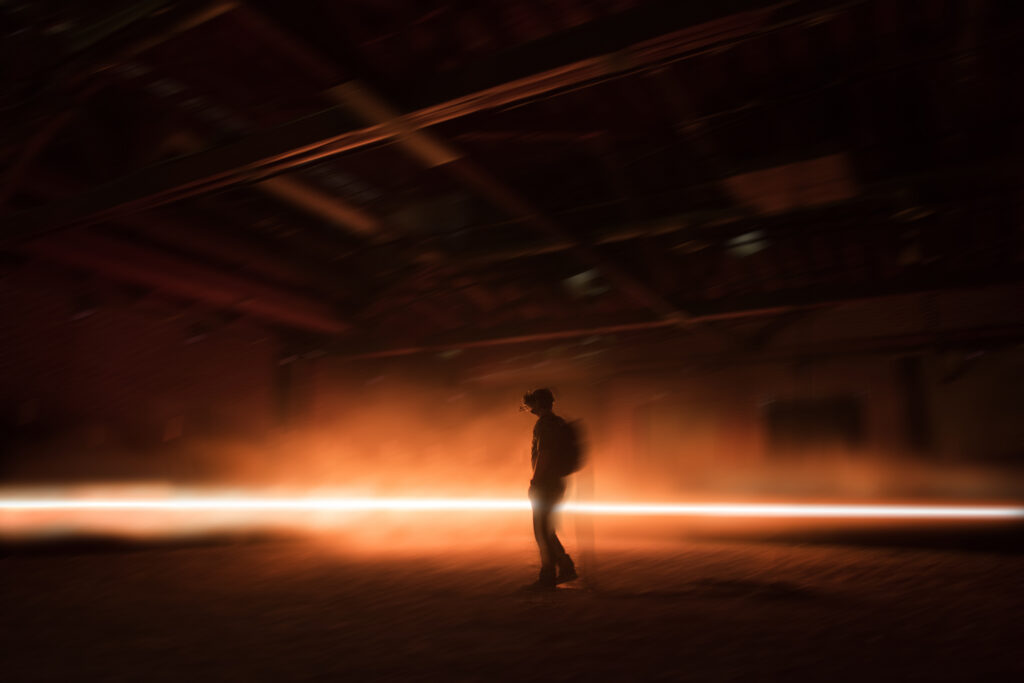
IT’S PART ARTWORK, part virtual reality installation, and part collection of immigrant stories.
CARNE y ARENA (Virtually present, Physically invisible), a new piece by Mexican film director Alejandro Iñárritu, collapses the boundaries between art and lived experience by putting audiences in the desert with
a group of Latin American migrants, suddenly caught in the cross hairs of the United States Border Patrol. The Academy Award–winning director (for The Revenant with Leonardo DiCaprio) collaborated with cinematographer Emmanuel Lubezki to create this state of the art experience.
Upon arrival, viewers are led into a dim, stark holding room and instructed, as apprehended migrants would be, to take off their shoes. This first part of CARNE y ARENA re-creates las hieleras, or the freezers: short-term holding cells where migrants are held anywhere from twelve to seventy-two hours. Discarded shoes litter the room, contorted and encrusted in dirt, deformed from weeks of walking. An alarm blares, and participants walk into the next room, where coarse desert sand digs into bare feet. A backpack, a virtual-reality headset, and headphones send them off to the border.
Without warning, a coyote (or smuggler) yells for the group to get down. But there’s nowhere to hide; a helicopter above floods the group of participants with white light. Border agents surround the immigrants, and one points an AR-15 rifle at a young boy. Iñárritu appears to question the violent intimidation of exhausted, seemingly paralyzed migrants.
“People tend to respond to the piece in a very first-person manner,” says Britt Salvesen, consulting curator for CARNE y ARENA. “There’s something about the immersive aspect in the film that gives it an agency and flow.”
The installation ends with Lubezki’s video portraits of the featured immigrants telling their stories, as their faces fade in and out of focus. The stories in CARNE y ARENA have been re-enacted by the people who lived through them.
“Iñárritu could have scripted and worked with professional actors, but I think he did want the piece to
have a foothold in actual experience while still having a universality,” Salvesen says.
CARNE Y ARENA (Virtually present, Physically invisible) premiered at the 2017 Cannes Film Festival and is now on view at the Fondazione Prada in Milan, LACMA, and the Tlatelolco museum in Mexico City. lacma.org