The Path of Julian Opie
Walk This Way
Upon arriving at Oklahoma Contemporary Arts Center, visitors won’t help but notice one curious sculpture of a more than six-foot figure that appears to be walking in place.
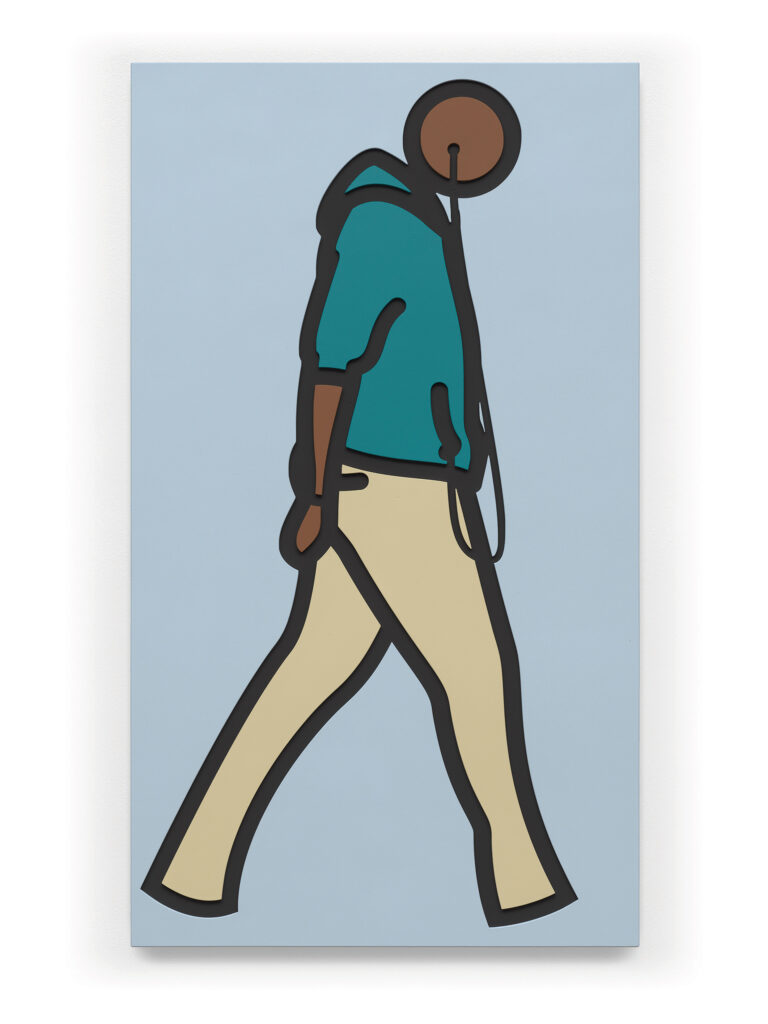
UPON ARRIVING AT Oklahoma Contemporary Arts Center, visitors won’t help but notice one curious sculpture of a more than six-foot figure that appears to be walking in place. Yet, unlike a traditional figure sculpture, this object takes the form of a black, rectangular monolith, lit on both sides with LED (light-emitting diode) displays that aggregate an image of a walking male figure in perpetual motion.
The box of blinkering lights, which is titled Faime Walking, was created by the London-born painter, printmaker, and sculptor Julian Opie. The artwork will be on view in the sculpture garden, directly adjacent to the main entrance, until the spring of 2021.
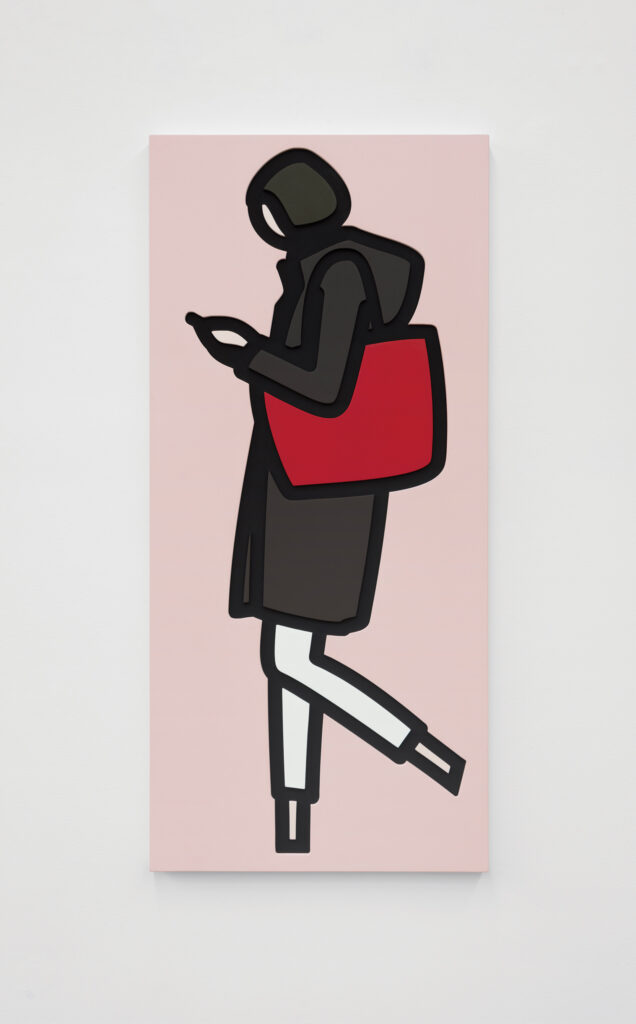
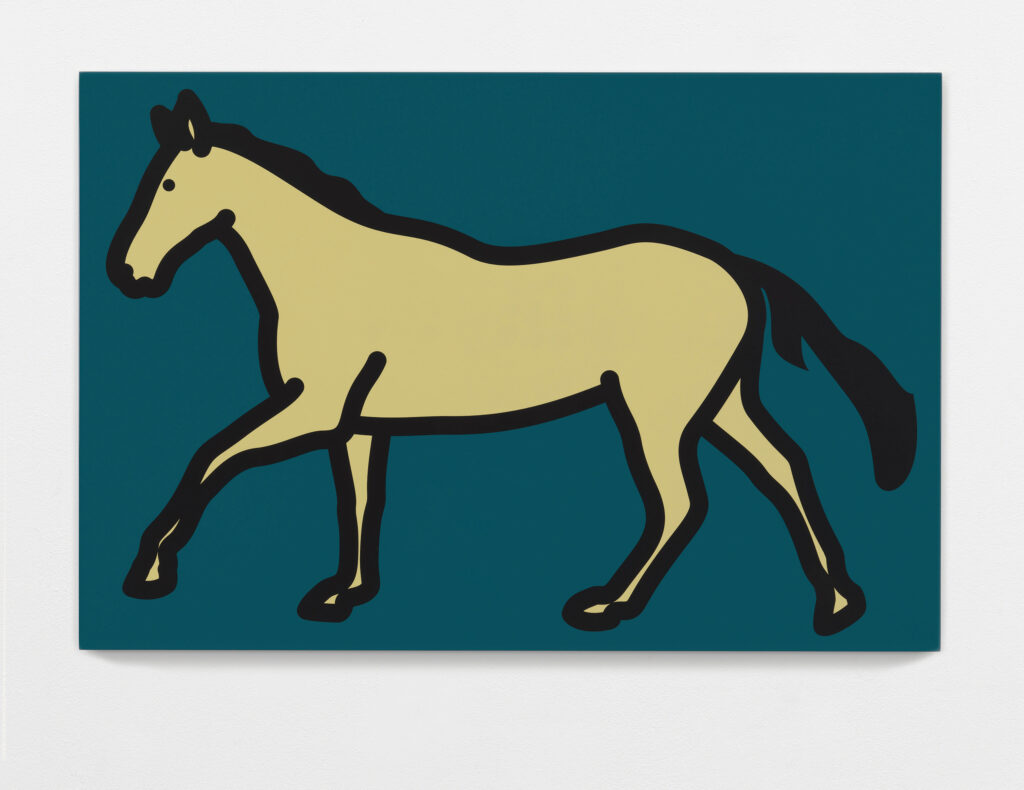
As part of the New British Sculpture movement to emerge in the early-1980s alongside art luminaries like Anish Kapoor and Tony Cragg, Opie started his career off with a bang and never looked back. From his early digital-looking landscape paintings and three-dimensional office building sculptures to his black-lined stick figures and pared-down portraits (which were famously featured on an album by the iconic Brit-pop band Blur), Opie has always had a knack for capturing an essence in his subjects.
Later on, Opie’s interest in contemporary forms of portraiture would lead him to work with LED lights as a way to bring motion into the equation. In his own words, the artist describes the process of this medium as making “a loop of some sixty drawings that sets Faime into constant motion.”
The work’s dynamism is its main appeal for Jeremiah Davis, the artistic director of Oklahoma Contemporary. “Faime Walking is an excellent example of the artist’s corpus of work focusing on bodies in motion,” Davis says. He also acknowledged that Opie’s artwork feels crucial to the mission of the arts center—and maybe even the community as a whole. “We hope this installation inspires the sense of forward momentum Oklahoma Contemporary, the city, and our arts communities continue to embody,” he adds.
Surprisingly, Faime—the sculpture’s namesake—was a stranger to Opie before he made the iconic piece. Opie found Faime on the street and paid him to model on a walking machine. “I like to watch the people passing by,” Opie says in regards to his LED series. “Not following the figures with my eyes but more seeing the scene as a picture with a flow of humans walking back and forth like a frieze or a ticker-tape message.” In Faime Walking, that process led to a hypnotic loop of a highly realistic, yet banal, activity which Opie then caricatured in his signature style of simplified and heavily outlined figures.
Even before Faime Walking was created, Opie’s LED work drew the eye of New York City collector, choreographer, and ArtDesk dance editor Larry Keigwin. “I first came across Julian Opie’s work in 2005, when I saw two large electronic walking sculptures, one male and one female, anchored on both sides of the courthouse near city hall,” Keigwin says. “As a dancer and native New Yorker, I was captivated by the work’s constant movement but also by the way it reminded me of the city’s ‘walk’ and ‘do not walk’ pedestrian crossing signs.”
Keigwin was elated when he purchased Faime Walking in 2017, and after having it installed outside his Green Mountain Falls, Colorado, house for a few years, he was happy to loan the work to Oklahoma Contemporary’s new space. Opie himself says that the work becomes “a motif and a sign, almost a repeatable hieroglyph,” making it an appropriate tool for an entrance where visitors are obliged to have signage lead them around. Faime Walking also pinpoints a deeper urge we have during a visit to any public space: gawking at other people.
“The people on the pavement are, in a sense, interchangeable,” Opie says in a statement on his work. “Each one a perfect example, each startlingly different and individual, and yet doing the same thing with the same body parts, moving in a similar way.”
As such, Faime Walking shows viewers a bit about how they live among other humans, which includes the signs we subconsciously give each other and the idiosyncratic ways people try to stand out in a sea of people.
Faime Walking by Julian Opie is on view at Oklahoma Contemporary Arts Center through the spring of 2021.