A Place in the Sun
Billy Joe Miller's open invitation in Green Mountain Falls.
I’ve known in my mind for ages that when the scale and function of my public art meet my more organic pieces, that’s when my most powerful work will happen.
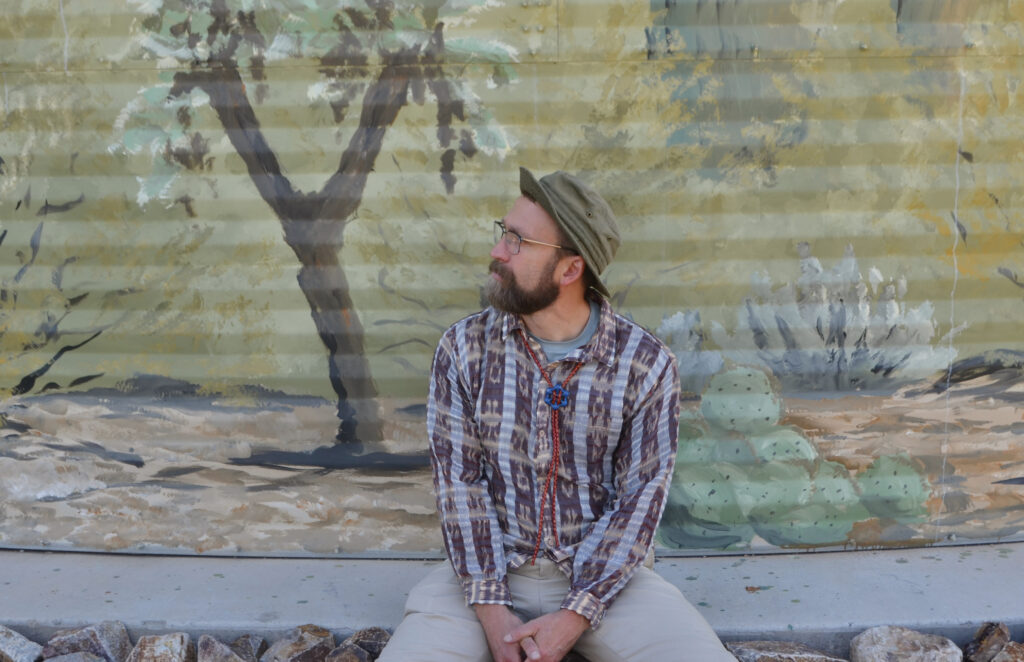
EVERYONE DESERVES A sanctuary, according to the artist Billy Joe Miller.
For years, Miller has created work with the hope it will bring viewers closer to a state of reverence that he felt as a kid at church, just without the church. “I grew up in conservative Christian churches, and while I experienced some extreme magic, I also experienced abuse,” Miller says.
For at least the past two decades, church attendance in America has been in decline. In his own community, Miller watched with curiosity as people “sort of canceled church in a way,” he says. “I think we as humans are missing out on this opportunity for more,” he says. “It’s not just coming together, but coming together in a really powerful, visceral space. I want to be a part of that. I think there’s so much opportunity there.”
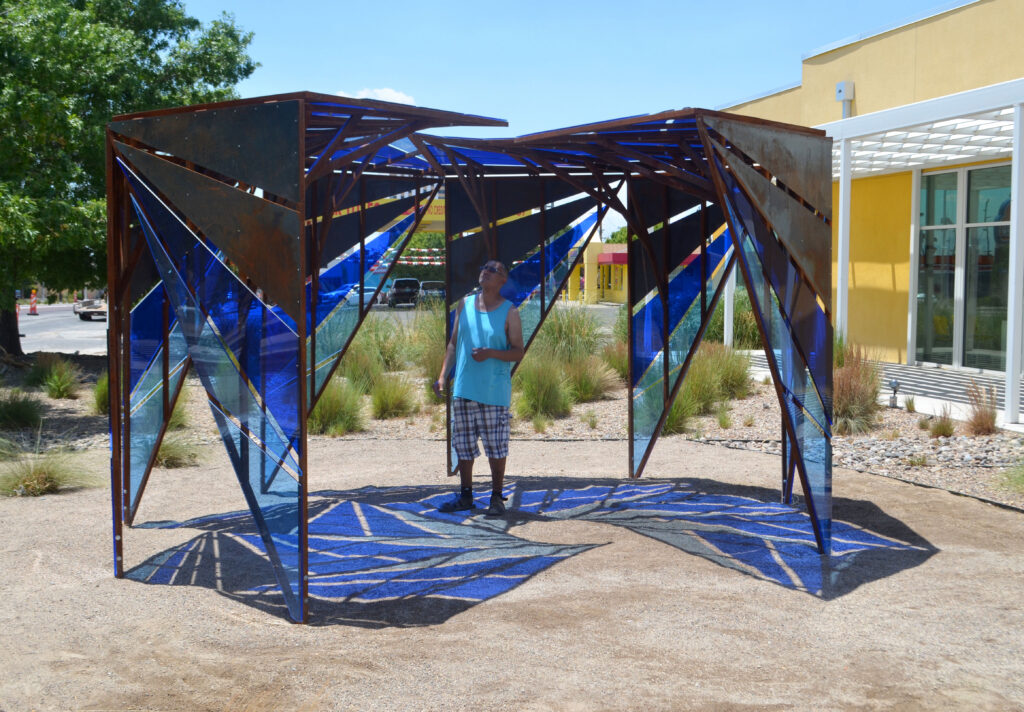
In 2014, Miller began work on a public structure for Albuquerque’s International District, a diverse corner of the city once shaped by Historic Route 66. The piece, Morning Glory, is a steel-framed enclosure with shards of blue acrylic—reminiscent of stained glass—that filter sunlight onto the gravel-covered ground.
“The person off the street who just had the hardest knocks could access that sanctuary space with no icons and just take in the color and light,” Miller says of Morning Glory. “I’ve seen it happen. I want to continue to be a part of that.” The path to Morning Glory led Miller deep into Albuquerque’s community, where more than 130 residents drew, schemed, and dreamed up the local monument.
That process filtered directly into his large-scale installation Ritha, a fourteen-by-twenty-foot wreath made of natural materials collected from the high desert of New Mexico for 516 ARTS. The form came to him through extensive talks and meals with families from the International District. He was inspired by the simplicity of the wreath, which has been made and hung since ancient times and used by cultures all around the world.
In 2025, Miller visited Green Mountain Falls, Colorado, to scope out a site for a new installation, commissioned by Green Box Arts. During his visit, he lay on the floor of James Turrell’s Green Mountain Falls Skyspace and stared at the sky through a perfectly cut square in the ceiling. “It was quite emotional. Like, I’m going to make something next to this?” Miller says, referring to Skyspace. “I really asked myself, ‘What can I do?’”
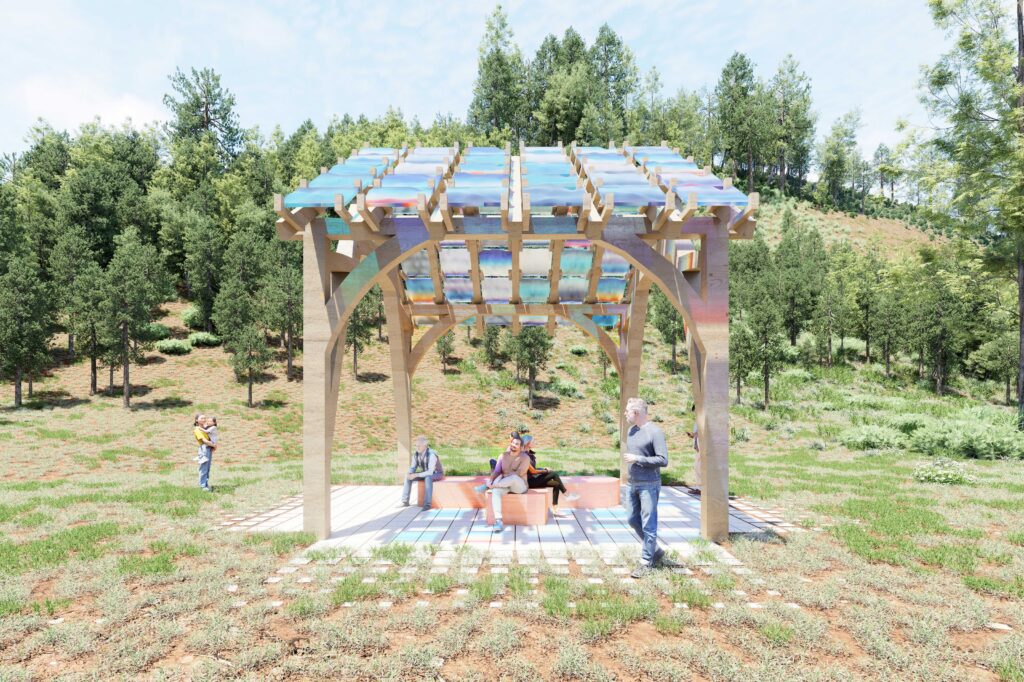
The word that came to mind regarding the Turrell work was “sterile,” he says, “but in the most positive sense. No one does sterility better than Turrell.” What he could offer was something with the same sense of upward- and outward-facing reverence, but with a more natural feel. He’d use wood to form a cruck frame—a curved timber system once used to build barns and gathering spaces—and fit it, once again, with blue acrylic panels.
He’d keep the sides open to the surrounding environment. The frame shape “very slightly points to the sacred,” he says, indicating an arch with his hands, “but it doesn’t hit you in the face.” He titled the installation Open House, an explicit invitation.
Miller toured three potential sites around town for Open House. He was shown two where water could be a component, and one a bit more tucked away, nestled against the Red Butte hillside. He wept when he visited the third site. “I’ve known in my mind for ages that when the scale and function of my public art meet my more organic pieces, that’s when my most powerful work will happen,” he says. “Now that’s what’s happening.”
Open House by Billy Joe Miller is a permanent installation that will be unveiled on July 5, 2026, during the Green Box Arts festival in Green Mountain Falls, Colorado.