AN UNASSUMING ODE TO LOVE AND LOSS
Sweet Emotion
An unassuming ode to love and loss through the work of Felix Gonzalez-Torres, whose candy installations blur the boundaries of pop, minimalism, and conceptual art.
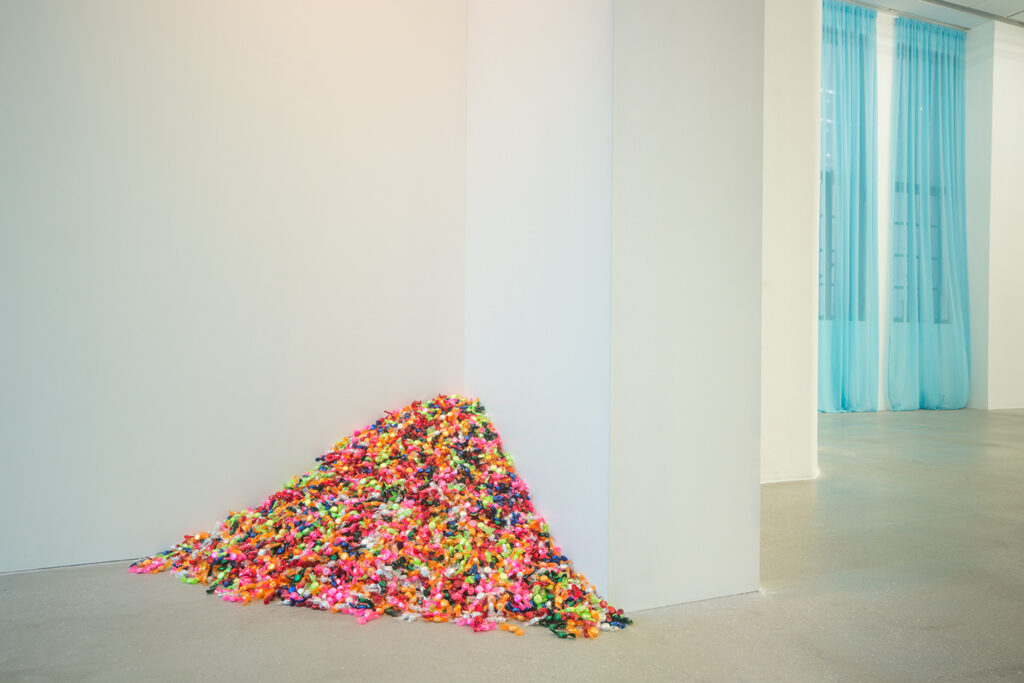
VERY FEW, IF any, artworks have ever blurred the boundaries between pop, minimalism, and conceptual art so thoroughly as “Untitled” (Portrait of Ross in L.A.). Yet the artist Felix Gonzalez-Torres was able to make this piece one of the most intimate and heart-wrenching of our time, proving this artist’s inimitable and lasting genius.
The Cuban-born American artist utilized minimalist and conceptual vocabularies to produce poignant personal artworks in the 1980s and 1990s, and he is rightly considered one of America’s most revolutionary modern artists.
With seemingly simple artworks composed of everyday materials like light bulbs, stacks of paper, and candy, Gonzalez-Torres flipped the script on minimalism’s macho, muted, and supposedly pure agenda pioneered by artists like Richard Serra and Donald Judd.
One of twenty “candy works” made during the artist’s short lifetime—he died at age thirty-eight from an AIDS-related illness—Portrait of Ross in L.A. is made entirely of multicolored, wrapped candies. The piece was named after Gonzalez-Torres’ former partner Ross Laycock, who also died of AIDS-related complications in 1991—the year “Untitled” was created. Despite its seemingly simple appearance, Portrait of Ross stands as a complex and moving tribute to Gonzalez-Torres’ closest relationship.
As with many of Gonzalez-Torres’ artworks, much about Portrait of Ross gets decided by its exhibitor, completely taking the artist’s hand out of the work. In this sense, the work follows a lineage of esteemed conceptual artists (such as Sol LeWitt) whose compositions were meant to be made by others from a set of instructions.
While conceptual, Gonzalez-Torres put some parameters in place (for instance, the work must weigh close to 175 pounds, Laycock’s weight before he fell ill), Portrait of Ross can take any form the exhibitor would like: a flat rectangle, a heap, an organic arrangement, or something else. Additionally, viewers are invited to take the candy, so this ephemeral artwork slowly disappears as time passes. The work’s indeterminate shape perhaps mimics his former lover’s changing positions, moods, or states. Meanwhile, the slowly dwindling weight of the candies references his partner’s lost battle with AIDS.
This work is part of Felix Gonzalez-Torres: Always to Return, an exhibition at the Smithsonian’s National Portrait Gallery. Charlotte Ickes, co-curator of time-based media art and special projects at the National Portrait Gallery, the leeway inherent in Portrait of Ross creates an intense yet exciting pressure for art curators. “What configuration do we want to install the candy work,” she asks, “a pile in a corner, a carpet, or some other shape? Do we install the candy work at its ideal weight? And do we replenish the candy and how much? What if we can’t find candy with multicolor wrappers due to issues with the Mylar supply?”
Ickes is joined by co-curator Josh T. Franco, national collector at the Archives of American Art. The show focuses on the artist’s fascination with portraiture and identity; this iconic artwork is one which most exemplifies Gonzalez-Torres’ one-of-a-kind audacity. It’s also one of his most touching. – RYAN STEADMAN
On View
Felix Gonzalez-Torres: Always to Return is on view at the Smithsonian’s National Portrait Gallery in Washington, D.C., through July 6, 2025. si.edu