Jeffrey Gibson at the Venice Bienniale
The first Indigenous artist to have a solo exhibition in the United States Pavilion at the Venice Biennale, Jeffrey Gibson brings his bold, colorful, geometric installations to the global stage.

LA BIENNALE DI Venezia began in 1895 and is one of the most prestigious contemporary art events in the world, introducing thousands of global visitors to exciting new work. This year, a long overdue and powerful critique on what the art world has held to be culturally important will mark the United States Pavilion: an Indigenous artist.
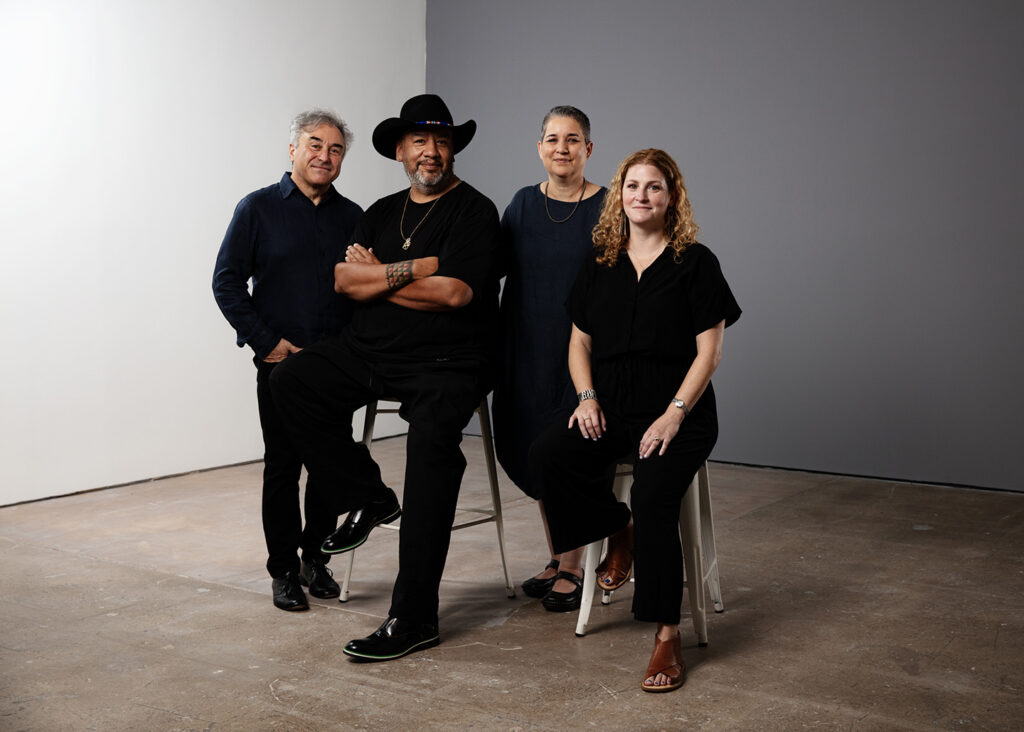
Artist Jeffrey Gibson (Mississippi Band of Choctaw Indians/Cherokee descent)—with his bold, colorful, geometric, and inclusive installations—is triumphantly representing the United States at this year’s Venice Biennale. The US Department of State’s Bureau of Educational and Cultural Affairs, the government body responsible for organizing the US Pavilion alongside Oregon’s Portland Art Museum and New Mexico’s SITE Santa Fe, confirms Gibson as the first Indigenous artist to have a solo exhibition in the United States Pavilion since its construction in 1930.
Adding to the momentous firsts, Kathleen Ash-Milby (Navajo Nation), curator of Native American Art, Portland Art Museum and co-commissioner of Gibson’s work, is the first Native American co-curator at the prestigious international arts event. The occasion underscores to the global art world what supporters of Indigenous art already knew: Native American artwork has been a vital part of the greater context of modern, postwar, Pop, and contemporary art.
Indigenous artists have shown more broadly in Venice over the years, including the 2007 public art installations of Edgar Heap of Birds (Cheyenne and Arapaho Nation) and the 2015 and 2017 special exhibitions of Keli Mashburn (Osage Nation) and Marcella Ernest (Ojibwe), respectively.
However, the last time Indigenous artists had a presence at the biennale’s US Pavilion was as part of a 1932 group exhibition featuring ten Native American artists and organized by painter John Sloan.

The 2024 Venice Biennale provides audiences with their first opportunity to experience Gibson’s work outside the United States. Celebrated for his multi-media practice combining American, Indigenous, and LGBTQ histories, Gibson’s work uses vibrant color, complex patterns, and text to create dynamic commentaries on individual and collective identities. On view through November 24, 2024, Jeffrey Gibson: the space in which to place me will activate the US Pavilion with a series of new, recent, and site-specific works. The title references Oglala Lakota poet Layli Long Soldier’s poem He Sápa, adding nuance to how we give and share space.

The Central Pavilion also debuts Native American artists like Kay WalkingStick (Cherokee Nation), further acknowledging Indigenous art as a living culture that continuously impacts our constantly evolving present with its intergenerational visual language.
The sixtieth Venice Biennale, curated by Brazilian Adriano Pedrosa of the São Paulo Museum of Art, is titled Stranieri Ovunque – Foreigners Everywhere, a celebratory theme with 331 artists that embraces “outsiders,” including the “Indigenous artist, frequently treated as a foreigner in his or her own land.”