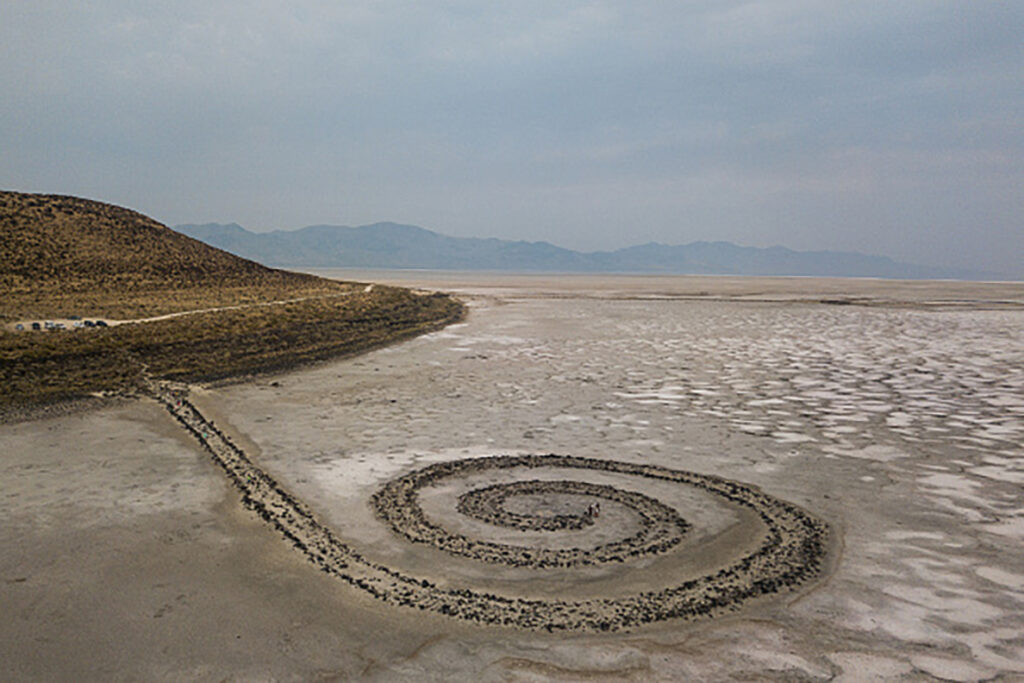
IN APRIL 1970, American artist Robert Smithson completed what has become perhaps one of the most iconic artworks of our time. Comprising 6,650 tons of black basalt rock and earth in the form of a spiral coil jutting out from the northeastern shore of the Great Salt Lake in Utah, Spiral Jetty continues to fascinate us fifty years after its completion. With the help of a team of heavy machinery operators, two dump trucks, a tractor, and a large front loader, Smithson completed the 1,500-foot-long, roughly fifteen-foot-wide earthwork in approximately three weeks. The artist was drawn to the location after hearing legends of the Great Salt Lake’s connection to a primordial sea; he was likewise captivated by the water in that particular location of the lake, which was described as the color of tomato soup—an effect of seasonal algae bloom.
Meanwhile, Smithson’s contempories Michael Heizer and James Turrell also posted up in the American West to create their own landscape projects. In 1973, Smithson died in a plane crash in Texas while surveying Amarillo Ramp, his final earthwork. Although Spiral Jetty is best known through indirect media—photographs, moving images, and social media posts—the work has become an art-lover’s pilgrimage since its reemergence from the lake in the early 2000s. Visitors can access the earthwork at any time and those who do gain an understanding of the scale of the sculpture and can participate in the immersive experience of following the spiral to its center. Owing to its renown and significance, Spiral Jetty became Utah’s official state work of land art in 2017—the first artwork dedicated as a state symbol in the United States.