Artistic director Janet Eilber of the Martha Graham Dance Company continues the legacy of one of dance’s greatest innovators.
Body Language
BY Larry Keigwin | PHOTOGRAPHY BY Erin Baiano
YOU CAN’T BE A REVOLUTIONARY WITHOUT REJECTING THE CONFINES OF SOCIETY’S VALUES—the expectations of the traditional.
LARRY KEIGWIN: Let’s jump in! I want to talk about you and your experience dancing for Martha Graham and as artistic director for the Martha Graham Company.
JANET EILBER: I danced for Martha throughout the 1970s and then came back as a guest artist in the ’80s and ’90s. It was a time of reinvigoration for Martha. She had accepted her role as a living legend, and that was sustaining her even though she had to be off the stage. It was a very productive and exciting time. She became a celebrity, and Jackie O. visited rehearsal, and Betty Ford, and Halston, and Truman Capote, and Alexander Calder, and, of course, [Isamu] Noguchi and all the composers. For us young dancers who weren’t part of her revolutionary time in the ’30s and ’40s, this was still a very exciting era, and she was still creating work, directing us in the classics, and we were touring the world. At the time, I didn’t think it was momentous and historic, but now as I look back at it, I feel pretty lucky to have been there.
LK: You have so much happening this year. You’re preparing for your season at the Joyce [Theatre in New York] and touring season, and you have the EVE Project—could you describe that a little bit?
JE: One of the things we discovered about bringing fresh eyes to the grand classics is to bring context. We do this through spoken introductions, through media, and narration onstage, through online offerings. We also choose an overarching scene that directs all of our work, our work at the school, our work onstage, our work in the public schools. For the next two seasons we’ve chosen the EVE Project. By offering ways of looking at
different aspects of womanhood centered mostly around the idea of female power, this allows us to underscore one of Martha’s great innovations for the stage—the female characters that she created—both heroines and anti-heroines, and they were complex, they were powerful. This is all leading up to the 100th anniversary of women’s right to vote.
LK: Another program that the Martha Graham Company is staging—and I know I’m going to mispronounce it—but Hérodiade, how do you pronounce it?
JE: [HE ro dee ad]
LK: Hérodiade! …which premiered at the same time Appalachian Spring did. I think it’s so interesting
how one work can really blossom and last over time, and then this other work flies under the radar. Why is it resurfacing now?
JE: There’s a great story there, that Hérodiade and Appalachian Spring premiered on the same night, October 30, 1944. Appalachian Spring—you’re right—got the attention in the year that followed and won a Pulitzer Prize. It rode on the wave of the end of World War II, and this great feeling of patriotism and hope for the future, which is what [Aaron] Copland and Martha and Noguchi worked fully into Appalachian Spring. They thought it was their contribution to the war effort to remind people about America’s hope for the future, our athleticism, our frontier mentality. Hérodiade is the essence of a theme that is woven through Graham’s career—the empowerment of the individual. It turns up again and again in—I’d say—all of her work.
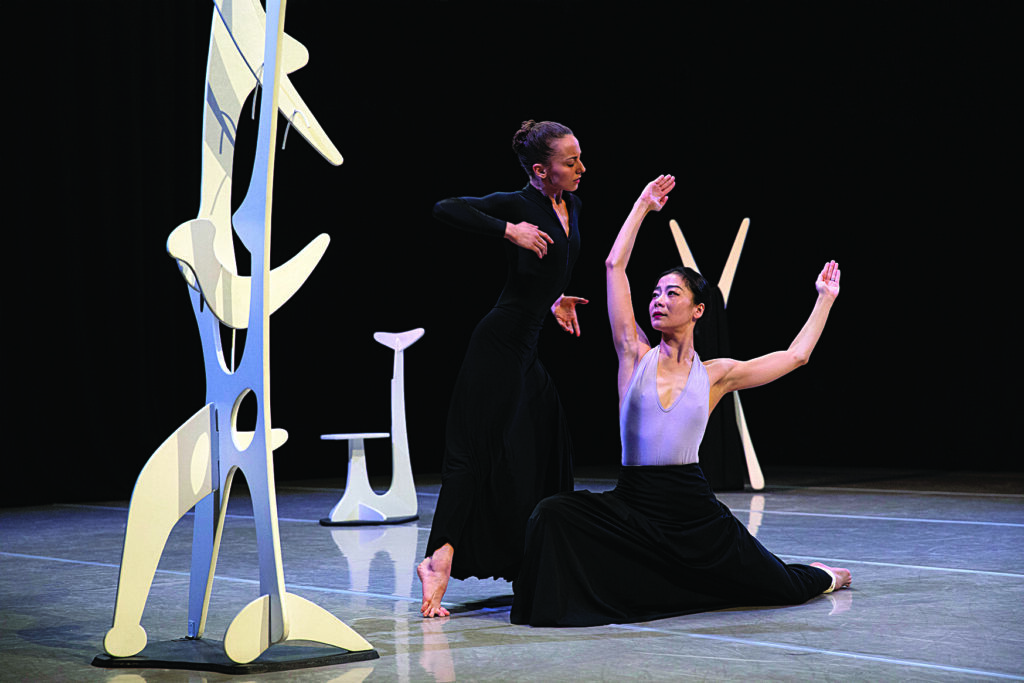
Hérodiade is a duet for two women. Martha says in her program notes that it’s a dance about choice. The Martha Graham role is making the momentous decision. The other woman is called the attendant, and she was trying to soothe and mollify and confine the Martha Graham role, and Martha’s role is making a choice that perhaps goes against her family’s wishes, society’s wishes, religious dictates, and she makes that choice in the end.
LK: So as soon as we have a duet—two people on stage—we have a relationship. Is it mirroring a
relationship in her life?
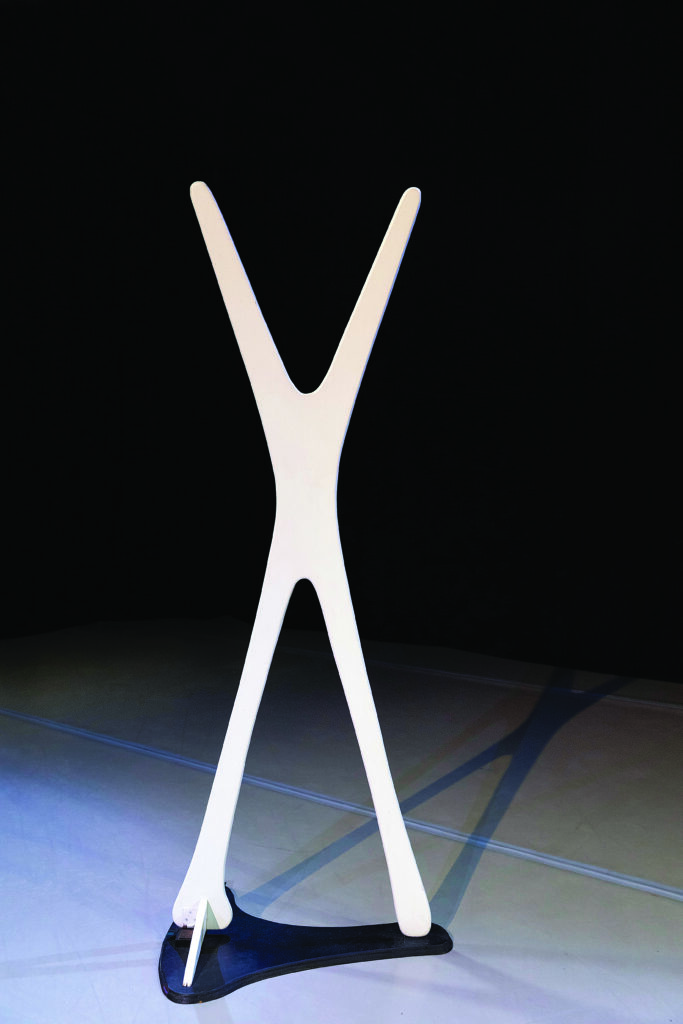
JE: I think it’s a metaphor for how she broke the mold. You can’t be a revolutionary without rejecting the confines of society’s values—the expectations of the traditional. It’s a deep dive into the psyche of this woman, and we know that because of what we know about the incredible set that Noguchi created for it. People don’t remember that this premiered on the same night as the Shaker-inspired simplicity of the Appalachian Spring set. Which evoked the frontier and the immense landscape of America, whereas Hérodiade is the interior of the woman. There’s an object on the stage, which is identified as the mirror. Martha asked for a mirror, but it’s constructed as an organic bone-like shape. So as the woman faces the mirror, she looks into the future and sees her skeleton. She sees herself aging. She is, as Noguchi said, she sees the desecration of beauty.
LK: So you’re looking at the evolution of an artist’s work, what makes Graham’s work revolutionary?
JE: Well, let’s go back to one of her very first works, Lamentation, 1930. Martha started presenting her own work in 1926, and had a style of physicality that represented real human emotions and human concerns.
Breaking away from American dance of her time, which was a lot of exotica, imaginary gods and goddesses, floating fabric and smoke and theatrical tricks, and Martha felt that was inconsequential in this time between the wars where we had become a world power, where we were dealing with civil rights and union rights and the socialist movement. By looking for gesture that revealed human emotions, she turned body language—the most organic way of communication—into a theatrical language. It was really shocking to audiences. She brought the modernist movement to dance—stripping things down to essentials. It revolutionized the way people thought of dance. It was like a modernist sculpture come to life, but it was revelatory for audiences. Martha tells this story about a woman who came backstage and said you’ll never know what you’ve done for me, and this is a woman who saw her son killed by a truck, and couldn’t cry, couldn’t grieve and, when she saw Lamentation, was able to cry, saying that Lamentation showed her that grief was honorable and had dignity, and she could understand her loss.
LK: Janet, I have to say this is probably one of my favorite interviews. You’re so articulate and knowledgeable and passionate about the work, and I learned something. Thank you so much.
JE: Oh, thank you.

Into the Groove
JANET EILBER BROKE into the Martha Graham Dance Company on a high note, dancing many of Graham’s greatest roles and working closely with Graham herself as principal dancer. Since becoming the company’s artistic director in 2005, Eilber works to create new connections between audience and performance through educational programming, new media, and collaborations with rising contemporary choreographers. The four-time Lester Horton Award winner directs Graham ballets internationally, performed under the direction of modern dance greats Agnes deMille and Bob Fosse, and then acted in movies and television before returning as artistic director. With ties to the Interlochen Center for the Arts and the Dana Foundation, Eilber continues the modern-dance legacy alongside her screenwriter and director husband, John Warren, and her two daughters, Madeline and Eva. —KELLY ROGERS