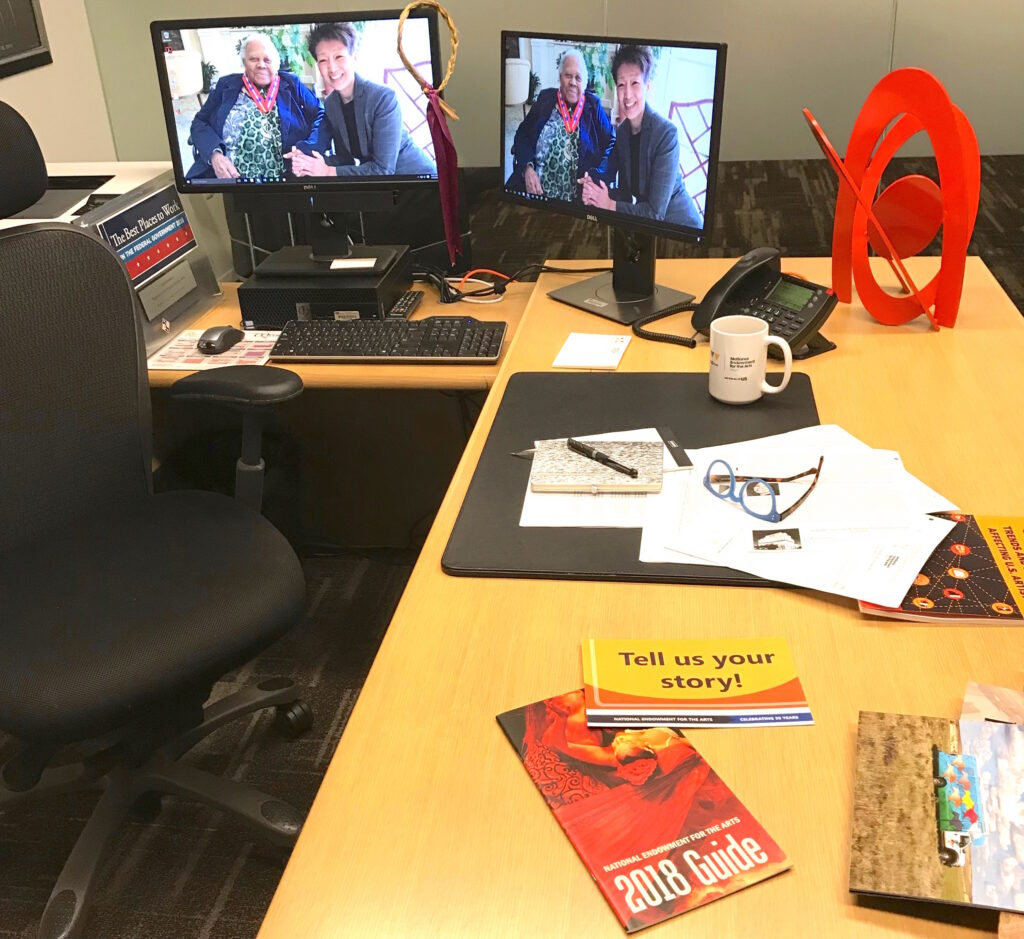
At the National Endowment for the Arts (NEA), I work with a dedicated group of people and organizations to support and fund the arts in every state, region, and district throughout the United States. More and more people in America understand that the arts are an essential part of our everyday lives and, I, too, have experienced firsthand the transformational power of the arts.
My mother and father were born in China, and I was born in Shawnee, Oklahoma, and grew up in Arkansas, about 7,000 miles from the traditional Chinese way of life. I juggled living in two opposite cultures simultaneously. But when my father died of illness when I was nine, the only avenue I found to express my own grief over the loss of a parent was through the arts. I played the piano, sang, acted in theater productions, and drew. Over time, I became intellectually interested in music and art activities and ultimately majored in music in college.
Creative leaders have the ability to stand in the middle of multiple perspectives. They understand how the arts can bring people together and communicate a vision, especially when that vision involves bringing together new perspectives around a common theme. At the National Endowment for the Arts, we want to make sure that all Americans have the opportunity to be engaged in and benefit from the arts. Nearly half of all NEA grants go to smaller organizations, as well as to communities with small and mid-sized populations. About 13 percent of NEA grants are in rural and remote communities. More than half of our arts-education grants are awarded to organizations in high-poverty communities, because we have seen underachieving students achieve academically through the arts. We are seeing the arts enliven the economic level of communities. We are seeing military service members and veterans with post-traumatic stress manage their physical pain better, because of NEA arts projects.
Art is found in museum galleries. It is seen and heard on stage. It instills beauty around us, in which we all deserve to live. But art is not removed from the rest of society or isolated in some ivory tower. The arts are all around us, and they touch every aspect of our world. They contribute to our economy. They revitalize neighborhoods. They increase our sense of well-being. They are an equalizer in communicating with families within our communities who do not use English as their first language. They spark new ideas in science and technology, and they draw out our feelings to help us understand ourselves. They provide us with an avenue of expression, just like they did for me as a child.
The National Endowment for the Arts is proud of its work in helping to bring the multiple benefits of the arts to Americans across the nation. —JANE CHU